

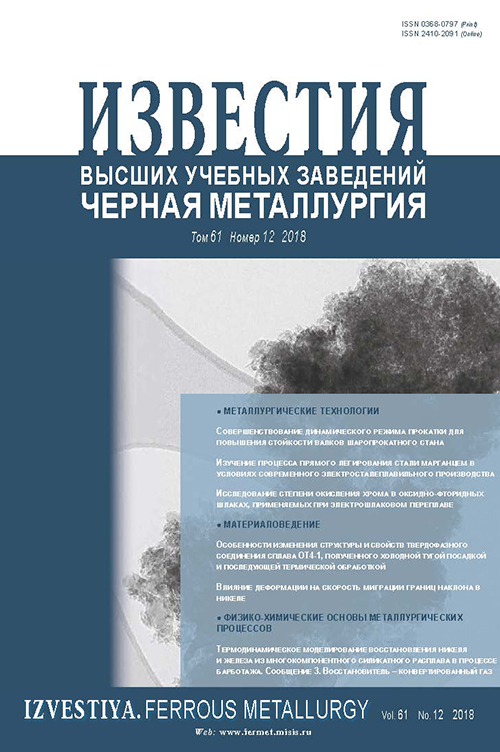
Scienitifc and technical journal "Izvestiya. Ferrous Metallurgy" ("Izvestiya vuzov. Chernaya metallurgiya")
Published since January 1958. Issued: 6 issues per year.
The journal publishes the results of original mainly basic, applied and exploratory researches and postgraduate works. Considerable attention is paid to the publications of reviews, problem and discussion papers on topical questions of modern metallurgy.
The main sections of the journal are: METALLURGICAL TECHNOLOGIES; RESOURCE SAVING IN FERROUS METALLURGY; ECOLOGY AND RATIONAL USE OF NATURAL RESOURCES; INNOVATIONS IN METALLURGICAL INDUSTRIAL AND LABORATORY EQUIPMENT, TECHNOLOGIES AND MATERIALS; SCIENCE APPLICATION; INFORMATION TECHNOLOGIES AND AUTOMATIC CONTROL IN FERROUS METALLURGY; PHYSICO-CHEMICAL BASICS OF METALLURGICAL PROCESSES; MATERIAL SCIENCE; SUPERDUTY STEEL; ECONOMIC EFFICIENCY OF METALLURGICAL PRODUCTION; PERSONNEL TRAINING FOR METALLURGICAL INDUSTRY
The journal is included in Scopus (from 2017), Russian Science Citation Index (Web of Science platform), Research Bible, OCLC and Google Scholar.
The journal "Izvestiya. Ferrous Metallurgy " accepts articles in Russian and English for consideration and publication. An English-language article can be submitted to the international SCOPUS database with full text. The editors can provide translation services for Russian texts into English and for English texts into Russian.
The journal is included in the "List of scholarly journals and publications, which should publish basic scientific results of dissertations for the degree of doctor and candidate of sciences".
The journal is intended for faculty members and researchers of higher education institutions and research institutes, engineering and technical personnel of industrial enterprises and design organizations.
Our journal is distributed by subscription in Russia, CIS and other countries. Detailed information about the subscription can be obtained from general catalog "Russian Press. Newspapers and journals”. Post code: 70383.
Founders: National University of Science and Technology "MISIS" and Siberian State Industrial University.
Publisher: National University of Science and Technology "MISIS".
Current issue
METALLURGICAL TECHNOLOGIES
The article provides information on the applications of chromium in modern industry. The main raw materials for its production are chromite ores. Data on the composition, volume of extraction of chromite ores and production of concentrates from them in 20 countries of the world for 2023 are presented. In 2023, 40,759 thousand tons of commercial chromite raw materials were produced, of which 48 % contains Cr2O3/FeO = 1.5 – 1.9 and 67.5 % contains 40 – 44 % Cr2O3 . Deterioration of quality of the raw materials used was noted. In terms of Cr2O3 content, only 28 % of all ores produced meet the requirements of the ferroalloy industry used 10 – 15 years ago, while only 19 % meet the requirements for Cr2O3/FeO, and 18 % do not even meet the requirements for charge chromium. The authors present the data on production volumes, Cr2O3 and Cr2O3/FeO content in commercial chromite ores and concentrates, as well as development plans for various deposits in Russia. The needs of the Russian Federation for chromite raw materials were met by 65 % through imports. Most of the consumed chromite raw materials are used in ferrous metallurgy in the form of chromium ferroalloys. The paper describes the applied man-made raw materials for production of FeCr, scope of slags application, possibility of processing sludge and dust. Globally, more than 18 % of chromite raw materials are obtained from sludge and tailings. The results of industrial tests of chromite raw materials from the Aganozerskoe and Sopcheozerskoe deposits are presented, as well as information on the technical and economic calculations carried out by different companies for the ores of these deposits. Therefore, to eliminate the shortage of imported raw materials and to develop the domestic industry, it is proposed to process ores from these deposits. Non-commercial (substandard) ores in developed mining and processing areas may become another source of chromium.
The article discusses the issues related to the process of continuous accelerated modernization of the Kuznetsk Metallurgical Plant (KMK) during the Great Patriotic War. The stages and methods of production transformation from obtaining metal for the civilian industry to the mass production of armored metal are described. The evacuation of industrial enterprises’ equipment from the south-east of the country to the south of Western Siberia was a purposeful process for the preservation and development of defense production in the most difficult conditions of the first military year. The commissioning of new evacuated facilities is shown as a complex process of adaptation to improve the quality and volume of production. Based on the analysis of scientific literature and periodicals, the paper describes the measures to continuously improve the quality of steel and military products, and reduce production time. The authors clarified the specifics of new production technologies and the contribution of individual KMK shops to the development of the country’s defense complex: rail-beam, blast furnace, by-product coke, tool, medium-section and others. The paper describes the problems of productivity growth before the turning point in the Great Patriotic War in 1942, when the resource base of the enterprise needed significant correction. Attention is paid to solving the personnel issue in conditions of a shortage of highly qualified personnel due to an increase in the proportion of women and youth at the enterprise. The authors noted the contribution of production scientists and engineers in solving complex technical problems. The development of the Stalin Kuznetsk Metallurgical Plant is viewed through the prism of the contribution of the whole country and the people of the USSR to the common cause of victory over Nazi Germany and militaristic Japan, and the special role of patriotic education of workers.
MATERIAL SCIENCE
At the moment, there are very few studies on fatigue failure of the products obtained by additive manufacturing, especially when fatigue failure occurs due to various types of defects. The importance of this topic is due to the potential for premature components damage under cyclic loading, especially in critical applications such as aviation and energy, where WAAM (wire arc additive manufacturing) can save significant manufacturing time by up to 40 – 60 %. The study evaluates the impact of technological defects on the fatigue strength of 08CrMoV and 30CrMnSi steels produced by WAAM. The authors used different surfacing modes to generate various types of defects, including macrodefects such as pores, lack of fusion, and surface concentrators, as well as microstructural defects like Widmannstetten structures and grain diversity. Defect-free samples were also produced. The authors performed metallographic analysis to investigate the metals microstructure, distribution and nature of any possible defects. Samples were etched using a 4 % aqueous HNO3 solution. Fatigue tests were conducted on a specialized machine with sample loading following the cantilever bending method. Defect-free samples of both steels exhibited the highest fatigue strength. The presence of any type of defect, whether microstructural or macrostructural, resulted in a decrease in fatigue strength. Macrostructural defects, such as large pores and lack of fusion, had a stronger impact on the material fatigue strength compared to microstructural defects. Additionally, it was found that the presence of a surface concentrator had a greater influence on initiation of a primary fatigue crack than the presence of large non-melted regions in the sample central part.
The paper describes the features of structure formation of heat-resistant alloy Inconel 625 obtained by wire electron-beam additive manufacturing (WEBAM) technology and then subjected to quenching at 1200 °С and two-stage quenching at 1200 – 1000 °С. Heat treatment was carried out in a vacuum furnace, in a low vacuum environment of –1 Bar, inert gas (Ar) blowing was used for accelerated cooling. Using high-precision analytical equipment, the authors studied the microstructure, phase composition and mechanical properties of the samples in the sections along and across the deposition direction. When examining the sample in the cross-section along the deposition direction, three characteristic zones were identified: base metal zone, reheating zone, and zone of change of the crystallization front. They have different structure and, as a consequence, the difference in structure-sensitive mechanical characteristics. It was found that in the deposition process in the base layer zone, due to the material low thermal conductivity, there is an accumulation of heat, leading to the release of orthorhombic phase δ-Ni3(Nb, Mo) in the interdendritic space. The chosen quenching temperature allowed to correct the dendritic morphology, with the formation of coarse grains of 0.3 – 0.5 mm and complete dissolution of δ-phase in γ-Ni matrix. The two-stage quenching is accompanied by isothermal release of δ-phase at grain boundaries and within grains, leading to dispersion hardening of the alloy. Uniaxial tensile tests at room temperature were carried out and numerical values of tensile strength (σv ), yield strength (σt ) and relative elongation (δ5 ) were determined. The best combination of mechanical characteristics was obtained by two-stage quenching of the alloy.
In conditions of the Scientific and Production Center “Welding Processes and Technologies” of the Siberian State Industrial University, the developed flux-cored wires of the Co – Cr – Fe – Mn – Ni system were surfaced by automatic arc welding under a layer of flux. Chemical composition of the deposited coating samples was determined using the atomic emission method on the DFS-1 spectrometer and the X-ray fluorescence method on the XRF-1800 spectrometer. The research results indicate the possibility of obtaining coatings consisting of 60 – 70 % iron and 30 – 40 % alloying elements. Microstructural studies of the samples were carried out using the metallographic microscope METAM RV-34 and the NEXSYS ImageExpert software package. The deposited samples contain point oxides of grade 2a, non-deformable silicates of grade 4a, b. Compared with the substrate (09G2S steel), the resulting deposited layers of the samples are noticeably cleaner, however, K4 sample has less contamination. Microstructure of the first deposited layers is represented by needle-like martensite, which is confirmed by the results of microhardness measuring. Subsequent layers of the deposited samples are represented by an austenitic crystal structure. Moreover, the structure has an elongated (dendritic) structure, which is inherent in structures obtained by arc welding. The authors studied the microhardness distribution using the HVS-1000 microhardness tester according to Micro-Vickers GOST 9450 – 76. The results indicate the production of an alloy with a hardness slightly higher than that of the substrate used, while it is worth noting that the deposited layer contains zones with twice hardness. Most often, an increase in hardness is observed on the first deposited layers.
The authors studied the samples of as-cast ferritic-pearlitic GG15 gray cast iron with lamellar graphite (σu = 121 ± 7 MPa). Tension of 20 mm diameter cylindrical samples was performed on N50KT testing machine. Static crack resistance tests of cast iron were carried out at temperatures of 20, –70 and –196 °C on 10 and 20 mm thick prismatic samples using a three-point bending scheme on Instron 8802 testing machine. The authors estimated the implementation of plane strain (PS) conditions by the t/(KQ /σ0.2)2 ≥ 0.6 criterion specified in GOST 25.506 – 85, as well as by the hmax/t < 10–2 criterion, where hmax is the maximum depth of the plastic zone under the fracture surface, t is the sample thickness. Depth of the plastic zones beneath the fractures surface was determined using X-ray diffraction. Tensile tests on cylindrical samples with a 10 mm diameter and 50 mm length were conducted at 20 °C using MK-50 tester. The authors examined the fractures surface microrelief using SIGMA scanning electron microscope (ZEISS). Static crack resistance tests of cast iron showed that at 20 °C, the PS condition according to GOST 25.506 – 85 is met only for 20 mm thick samples at –70 °C. However, according to the hmax/t criterion, the PS condition is met for all the samples, regardless of thickness and testing temperature. Therefore, the obtained static crack resistance values (20.6 ± 1.5 MPa·m1/2) correspond to K1C . To evaluate the PS conditions of GG15 cast iron, it is proposed to use the criterion t/(KQ /σ0.2)2 ≥ 0.38. In the static failure area, regardless of the sample thickness and test temperature, cast iron destruction occurred via intergranular brittle failure and cleavage mechanisms. Results from tensile tests of the samples showed that crack initiation occurred at graphite inclusions near the sample surface. Subsequent sample failure occurred at an angle to the sample cross-section by a cleavage mechanism.
INFORMATION TECHNOLOGIES AND AUTOMATIC CONTROL IN FERROUS METALLURGY
The paper presents an improvement of the basic methodology for energy-force calculation of hot rolling process, based on the elastic-plastic model of the deformation zone, by increasing the accuracy of determining the forces of this process with refining the dependence of the strip elastic properties on its heating temperature. To assess the decrease in the elastic properties of the strip material with respect to the rolling temperature, graphical dependencies of the change in the modulus of elasticity for 0.3–Cr–Mn–Si and 0.5–Cr–V high quality alloyed steels were obtained. These graphical dependencies were received by analyzing the classical reference literature on the change in the steels mechanical properties during pressure treatment. The author tested the effect of applying new dependencies on the accuracy of determining forces by conducting a computational experiment for the technological modes of hot rolling in finishing group of an operating continuous wide-strip mill using two methods. The first method of calculating the forces uses the previously obtained general dependence of the modulus of elasticity on temperature for low-carbon steels, while the second method uses new adequate regression dependencies determined from the graphs of changes for each of the studied 0.3–Cr–Mn–Si and 0.5–Cr–V high quality alloyed steels. During the experimental calculations, the error between the calculated and measured values of the rolling forces was determined, and these errors were then compared. As a result, the author concluded that the use of new dependencies of the modulus of elasticity of the strip on the hot rolling temperature, in comparison with the use of a general dependence for low-carbon steels, gives an increase in the accuracy of the rolling force calculation only for 0.5–Cr–V high quality alloyed steel. The reduction of the error in calculating the forces using such a dependence was verified by a statistical assessment of the comparison of the calculated and measured values of the forces for 10 technological rolling modes for 0.5–Cr–V high quality construction alloyed steel.
Improving the process of billets piercing on helical rolling mills is closely related to the study of the nature of metal forming in deformation zone. The parameters of true deformation zone are determined by a combination of factors: calibration of the deformation tools and their positioning in the deformation zone, shape of the contact surface, the process conditions (especially in its unsteady stage), etc. As a result, it is quite difficult to accurately determine these parameters relying only on geometric representation of the deformation zone. These difficulties in the analytical description of the nature of metal forming in the deformation zone do not allow one to accurately determine the contact surface width from the actual geometry of the deformation zone, and with it the area of the contact surface, and therefore to estimate the process energy–power parameters. The work involved studying the billet helical piercing using FEM (finite-element method) modeling of the process in order to adjust the calculated parameters of the geometric deformation zone and to assess the energy-power parameters. The paper presents the results of the method application for assessing the billet forming during helical piercing using the FEM modeling software. This method makes it possible to take into account the complex nature of the metal flow in the deformation zone and to adjust the calculated parameters for estimation of the process energy-power parameters. The calculation results showed the convergence of the values of the rolling moments with the graph of the rolling moment obtained from the control panel of the piercing mill in the pipe rolling shop No. 1 of JSC Seversky Pipe Plant when piercing 360 mm diameter billets into a sleeve measuring D×S = 433×26 mm made of steel grade D.
The article discusses the issue of assessing the effectiveness of corporate quality management system of a metallurgical company. Of particular difficulty is the assessment of the effectiveness of corporate quality management systems (QMS) in large vertically integrated holdings, where classical approaches based on the achievement of established criteria often do not take into account industry specifics, multi-level structure and the impact of uncertainties. The object of the research is the vertically integrated corporate QMS of a large metallurgical holding company, which unites more than 10 production sites. The authors note that the traditional assessment methods used in the company do not fully take into account the residual risks of failure to achieve the target values of the performance criteria. As a solution, a modified methodology based on the Takagi–Sugeno algorithm is proposed, which integrates into the calculation not only the actual performance indicators of the processes and their weights, but also assessment of the residual risk for each criterion. The existing methodology for assessing the effectiveness of corporate QMS of a metallurgical company is compared with the proposed methodology, which implements the Takagi–Sugeno binary fuzzy set algorithm. Calculations for each method are implemented in a model based on the AnyLogic information system. Calculations using the developed model made it possible to assess the effectiveness of processes using both methods and to compare their applicability for performance assessments. Evaluating the effectiveness of corporate QMS for each method confirmed that the system is effective. Value of the effectiveness of the company’s QMS according to the existing methodology was 0.81, and according to the proposed one – 0.92. The use of the residual risk of process failure allows for a more accurate assessment of the effectiveness of corporate QMS. The developed model identified processes whose efficiency was overestimated or underestimated under the standard approach, which indicates the influence of risk factors.
The article examines the stress-strain state of flexible cylindrical parts during the combined process of straightening and strengthening with flat wedge plates. The relevance of the work is determined by the need to improve the geometric accuracy and operational reliability of long, low-rigid shafts subjected to significant deformations during manufacturing and heat treatment. The authors developed a new method for straightening and strengthening flexible cylindrical parts such as shafts and axles in a single technological operation. It is intended primarily for machining parts made of ductile metals and alloys. The objective of the study was to determine the permissible geometric values of curved cylindrical parts and rational technological parameters for the straightening and strengthening process with flat wedge plates. A theoretical model was developed during the study, which made it possible to determine the critical conditions for gripping and stable rotation of a cylindrical billet between the working surfaces of flat wedge plates. Based on the theoretical calculation, the permissible value of the billet initial deflection was determined, which should not exceed 4 mm over a length of 200 mm. To verify the theoretical data, computer simulations were conducted using the ANSYS software package. Using the finite element method, the process’s stable boundaries were clarified. The simulation results revealed that, to ensure the straightness of the billet axis without damaging the surface, the initial deflection should not exceed 3.5 mm over a length of 200 mm. An assessment of the distribution of residual stresses and plastic deformations revealed that the optimal relative reduction ratio is within the range of 1.3 – 1.5 %. The obtained results can be used in development of effective technologies for machining flexible cylindrical parts, contributing to improved performance and manufacturing accuracy.
The quality of sheet metal products produced in the metallurgical industry depends on the correct selection and adherence to process conditions. Metal heating before rolling is typically performed in continuous furnaces. During the heating process, complex phenomena occur in the furnace working space, requiring the use of CFD systems to simulate these processes. The specialties of fuel combustion and the movement of combustion products, which stipulate the heat transfer to the surface of the heated metal, are determined by the design of the burners used. Flat-roof furnaces use flat-flame burners. The Ansys Fluent simulates the processes occurring in a portion of the working space of a heating furnace equipped with flat-flame burners.
The article presents a mathematical model for estimating the filling and emptying of a blast furnace hearth with liquid smelting products, namely iron and slag. The developed algorithm is based on integration of material balance data, chemical composition of charge materials, and history of discharges. This ensures high accuracy of calculations both in real time and when analyzing historical data. The model is applied to a blast furnace with a volume of 2000 m3, with the hearth geometric parameters being taken into account. In this study, physical properties of the materials in question are considered, incorporating such metrics as hot iron density, apparent density of foamed slag, and porosity of coke charge. The algorithm comprises multiple stages, including the request of data on the last six discharges, the processing of missing values by means of imputation with averages, validation of time intervals, and calculation of the dynamics of furnace filling and emptying. The calculation was performed with a 5-minute sampling interval using a one-dimensional model that takes into account the supply of iron with ore and coke ash, as well as the volumes of products tapped. It is imperative to emphasize the meticulous attention devoted to the results rectification with consideration for the stipulated filling limits and the temporal allowance prior to the initiation of slag discharge. The model enables the calculation of the levels of hot iron and slag at any given moment in time, thus constituting a useful tool for technologists. The results are presented as three-dimensional profiles illustrating the furnace filling process. The developed system contributes to improving the safety, stability, and efficiency of the blast furnace process by preventing furnace overflow and optimizing the tapping mode. The model can be integrated into digital twins of blast furnaces.
ANNIVERSARIES
Announcements
2026-03-27
Publication Fees Update
Starting March 30, 2026, the journal "Izvestiya. Ferrous Metallurgy" introduces a flexible funding model for editorial and publishing services. A publication fee applies only to articles by authors with external targeted funding. Publication remains free of charge for all other authors.
| More Announcements... |

ISSN 2410-2091 (Online)





