Contents
Scroll to:
https://doi.org/10.17073/0368-0797-2026-2-176-182
Scroll to:
The most critical stages in the metallurgical production of steel products are casting and hardening of steel, since it is during the hardening process that most of the imperfections of future products are formed. These stages become even more important in the production of products for heavy and energy engineering, which involve casting steel into ingots, due to the high requirements for reliability, durability and safety of the manufactured products (critical products), as well as with a significant mass of billets requiring casting of ingots weighting hundreds of tons. Despite the importance of casting and hardening of a steel ingot, by now, relatively little information about the billet being transferred was received for subsequent alterations (forging, heat treatment): average chemical composition of the steel, geometric dimensions of the ingot, its mass, temperature, and surface quality. At the same time, a number of imperfections that can lead to the rejection of a future product (for example, pores exceeding a critical size) are detected using ultrasound control only at the final stages of production, after completion of long and labor-intensive operations of thermal deformation and thermal treatments. The authors described the principle of modeling the main types of inhomogeneities of a steel ingot: physical (porosity), chemical (dissolution) and structural (distance between the vertical axes, grain size). When using specialized software, for example, the Large Ingot software (JSC “RPA “CNIITMASH”), numerical information about these types of inhomogeneities can be obtained over the entire section of the ingot. This topology of the distribution of inhomogeneities, calculated for a specific ingot based on the actual conditions of the technological process, makes it possible to form the so-called technological summary of the ingot, which is transferred along with the billet itself to the following alterations. The paper presents an approach to applying the ingot technological summary in subsequent alterations, which implements the idea of an end-to-end description of the entire technological process of metallurgical production of critical products. This approach makes it possible to increase production efficiency and reduce the cost of manufactured products.
Dub V.S., Tokhtamyshev A.N., Mal’ginov A.N., Ivanov I.A., Ronkov L.V., Strizhov M.A. Ingot technological summary as a tool for improving the quality of critical steel products. Izvestiya. Ferrous Metallurgy. 2026;69(2):176-182. https://doi.org/10.17073/0368-0797-2026-2-176-182
Introduction
The increasing quality requirements for metallurgical products [1 – 4] are particularly important for critical industries, including heavy and power engineering.
In metallurgical engineering, after molten steel of the required chemical composition has been produced and cast into an ingot, relatively little information about the billet is transferred to subsequent processing stages, such as forging and heat treatment: the average chemical composition of the steel, the geometric dimensions of the ingot, its mass, temperature, and surface quality. However, the main imperfections of the future product that determine its quality, including structural and chemical inhomogeneities, discontinuities, and others, are formed precisely at the casting and solidification stage of the ingot [5 – 9].
A considerable amount of information and a number of methods have been accumulated for describing solidification processes and the various types of inhomogeneities associated with them. These include the methods presented in studies by Russian researchers [9 – 15], European researchers [4; 16 – 18], and researchers from North and South America [3; 5 – 8; 19; 20]. However, the systematic application of such information may require qualified operator intervention, additional theoretical information, and considerable time for preparing and performing calculations.
In this regard, the development of tools that enable industrial control and end-to-end prediction of the quality parameters of critical products at each stage of their production, including casting and forging of steel billets, including for the purpose of adjusting subsequent stages, is an important task for metallurgy and mechanical engineering.
This paper considers an approach to the prediction of quality parameters of a steel ingot over its entire cross-section depending on the actual implementation of its production technology through the development of so-called “ingot technological summary”, and the use of the prediction results at subsequent processing stages. This approach, based on the assessment of billet quality parameters from one processing stage to another during product manufacture, is consistent with the concept of end-to-end modeling described in [21].
In this paper, the quality parameters of a steel ingot and the forgings produced from it are understood as a set of the following indicators: the degree of chemical inhomogeneity, namely macrosegregation; physical inhomogeneity, namely porosity and shrinkage cavity; and structural inhomogeneity, namely dendrite arm spacing and as-cast grain size. Quality of the final product obtained after heat treatment is understood as the set of its mechanical properties that depend on the above indicators.
Modeling of ingot solidification
The principle of modeling the processes of solidification and inhomogeneity formation in a steel ingot is presented below. The proposed relationships illustrate the main ideas implemented in the calculation and, where necessary, may be expressed by other equations, as is considered below for structural inhomogeneity.
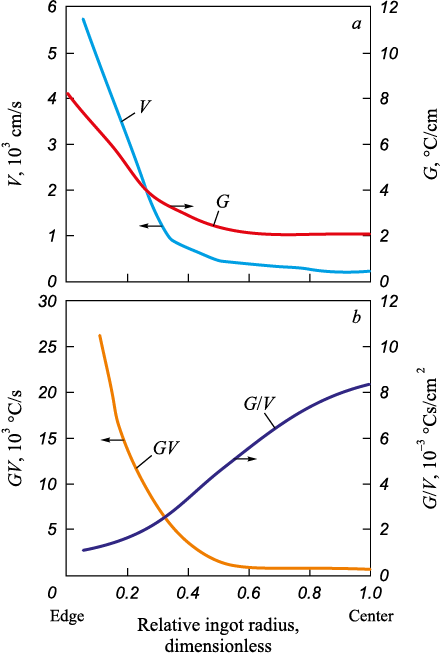
The solidification process of an ingot depends on thermophysical conditions, the main parameters of which are three thermophysical quantities (Fig. 1) [14]:
– V – linear crystallization rate, m/s;
– G – temperature gradient, °C/m;
– ɛ – cooling rate, °C/s.
Fig. 1. Changes in linear crystallization rate (а), temperature gradient (b), |
In the calculations, it is assumed that the crystallizing steel is an ideal isotropic material; therefore, two of the above quantities are independent. This allows the cooling rate to be considered, in simplified form, as the product of the temperature gradient and the linear crystallization rate: ε = GV (Fig. 1, b).
For an accelerated assessment, the ratio of the temperature gradient to the linear crystallization rate, G/V (Fig. 1, b), may also be used. This ratio is a qualitative indicator of the level of impurity accumulation ahead of the solidification front [15].
The principle of modeling for the stage of casting steel into an ingot is schematically described below.
1. By solving the problem of transient heat transfer, changes in the position of the TS isotherm, i.e., the solidus temperature; the TL isotherm, i.e., the liquidus temperature; and the TFZ isotherm, i.e., the temperature of the feeding difficulty zone, are determined at different time points from the beginning of ingot casting to the end of solidification. For each subsequent calculation step, it is advisable to take into account changes in the values of TS , TL and TFZ caused by enrichment of the liquid part of the solidifying ingot with impurities, as described in item 3.
2. Based on the dynamics of changes in the position of the TS , TL and TFZ isotherms, the values of V, G and ɛ are determined for selected points of the ingot. In an accelerated assessment, these values may be determined for specified, preselected points, for example, at the ingot edge, at one-half of the mean radius of the ingot cross-section, and on the ingot axis.
3. Knowing the dependence of the nonequilibrium partition coefficient on the linear crystallization rate, kv = f (V), the content of chemical elements across the cross-section of the solidified ingot is determined. This dependence may be described, for example, by the Aziz equation (1) (Fig. 2) [5]:
| \[{k_v} = \frac{{k + \frac{{{\delta _i}V}}{{{D_i}}}}}{{1 + \frac{{{\delta _i}V}}{{{D_i}}}}},\] | (1) |
where (δi V/Di ) = Pi is the Peclet number applied to the interface; δi is the characteristic interface thickness, m; V is the linear solidification rate, m/s; Di is the interface diffusion coefficient, m2/s; k is the equilibrium partition coefficient.
Fig. 2. Dependance of distribution coefficient kv of impurity i on linear crystallization rate (LCR) |
Thus, information on the chemical inhomogeneity of the ingot is generated.
If necessary, other equations may also be used, for example, the Burton–Prim–Slichter equation [20].
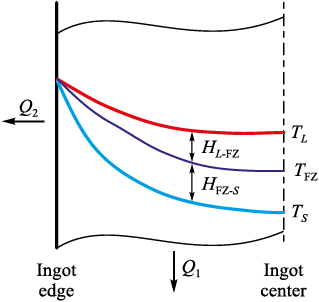
4. Depending on the ratio of the length of the liquid–solid and solid–liquid zones, HL-FZ / HFZ-S across the ingot cross-section (Fig. 3), zones with a probability of porosity formation can be determined: the lower this ratio, the higher the probability of pore formation [12]. At this stage, information on physical inhomogeneity in the ingot is generated.
Fig. 3. Schematic representation of the liquid-solid (HL-FZ ) |
5. Knowing the value of ε = GV during solidification and constructing a function relating the mean dendrite arm spacing \(\bar \lambda \)m.s. to the cooling rate ε, it is possible to determine the distribution of mean dendrite arm spacing \(\bar \lambda \)m.s. across the ingot cross-section. For structural steels, mean dendrite arm spacing \(\bar \lambda \)m.s. can be calculated using the equation [15]:
| \[\lg {\bar \lambda _{{\rm{m}}{\rm{.}}{\rm{s.}}}} = - 0.4023\lg (\varepsilon ) + 2.167.\] | (2) |
Similar equations for various steel grades may be obtained from experimental studies [6; 7; 18]. Given that the mean grain size is \(\bar r\)gr = n\(\bar \lambda \)m.s. (where n is the proportionality coefficient), the distribution of the grain structure in the ingot can be described. This is of particular interest for subsequent stages of thermomechanical processing and heat treatment.
Implementation of the proposed modeling principle makes it possible to obtain information on ingot inhomogeneities under the actual conditions of its casting. When specialized software is used, information on ingot imperfections can be calculated not only for selected points, but across the entire cross-section. Thus, together with the ingot itself, detailed information on the distribution of physical, chemical, and structural inhomogeneities – that is, the topology of inhomogeneity distribution across the cross-section of the future forging – is transferred to the forging shop.
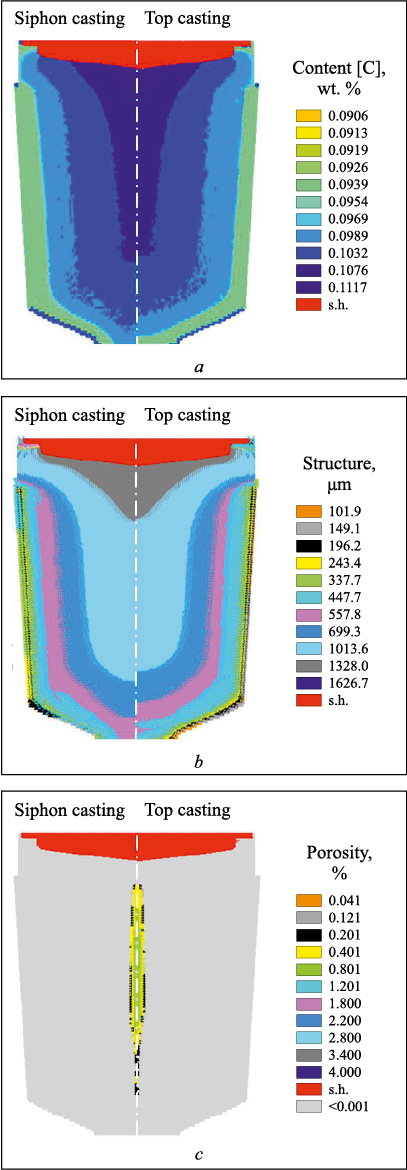
This modeling principle is primarily implemented in the Large Ingot software developed by JSC “RPA “CNIITMASH”. Examples of calculations performed using this software are presented in Fig. 4, which compares the physical, chemical, and structural inhomogeneities of a steel ingot produced by siphon casting (right) and top casting (left).
Fig. 4. Calculated values of inhomogeneities for an 8 ton stainless steel ingot |
As the ingot is axisymmetric, a two-dimensional formulation is sufficient, with modeling performed in the vertical section of the ingot. This reduces calculation time and allows the software to be used to support the production of each individual ingot. Since these calculations are intended for direct use under industrial conditions, they require relatively high computational speed and rely mainly on process parameters recorded at the enterprise.
Application of ingot modeling results in subsequent processing stages
As noted above, the result of modeling is the topology of inhomogeneity distribution across the ingot cross-section, which is transferred together with the actually cast ingot to the subsequent thermomechanical processing stage. At the production planning stage, it is advisable to perform an additional preliminary calculation in full accordance with the regulatory and technical documentation, assuming exact fulfillment of all requirements of the planned technology, that is, an ideal process route. Then, during the main calculation, which takes into account the actual implementation of the technology, the main and preliminary calculations are compared, with deviations from the initially predicted ingot quality values recorded. This set of information, which constitutes the ingot technological summary itself, is transferred to subsequent processing stages.
The transferred information may be used for rapid quality assessment and, if necessary, for adjusting the thermomechanical processing stage. For example, it may describe the changes in the cutting location for the head and/or bottom parts to select the part of the ingot that is most homogeneous in terms of chemistry, density, and/or structure for subsequent processing. It may also describe the changes in the deformation degree for a specific region of the ingot to obtain a grain size not exceeding the specified value.
Information on ingot inhomogeneities may also be used for early defect diagnosis, for example, a high percentage of porosity in the axial part of the ingot, before forging, heat treatment, and subsequent ultrasonic testing.
Where changes in forging quality parameters can be modeled directly during thermomechanical processing, information on the inhomogeneities formed by the end of this stage is also transferred together with the billet to the subsequent heat treatment stage. Such software, developed by JSC “RPA “CNIITMASH” using machine learning algorithms [22], enables rapid modeling of the thermomechanical processing stage for a number of structural steel grades and billet masses. As a result, even before heat treatment begins, the heat-treatment operator has information on the quality parameters of the initial forging, including grain size, which is related to the mechanical properties of the future product [14]. This information can therefore be used for rapid process adjustment, for example, to change the holding time at specified temperatures.
Implementation of the described approaches will enable end-to-end quality modeling of products actually manufactured under industrial conditions and, consequently, reduce production cost through early defect diagnosis and justified adjustment of the technology based on the actual implementation of previous stages in the manufacture of the future product.
Conclusions
The principle of rapid modeling of steel ingot quality parameters, namely physical, chemical, and structural inhomogeneities, under industrial production conditions has been considered. The described principle is mainly implemented in the Large Ingot software developed by JSC “RPA “CNIITMASH”. The set of calculated information on the ideal process route, corresponding to the regulatory and technical documentation, and the actual process route, allowing for deviations from the ideal variant, over the entire ingot cross-section constitutes its ingot technological summary, which is intended to be transferred together with the ingot itself to subsequent processing stages.
An approach to using the ingot technological summary as a tool for end-to-end quality assessment and control at the stages of casting, forging, and heat treatment has been described. Implementation of this approach is consistent with the concept of end-to-end modeling of the technological process and is aimed at improving the quality of critical steel products and reducing their manufacturing cost by taking into account the specific features of each particular billet caused by the actual implementation of the technology, while minimizing possible negative consequences caused by deviations from the ideal process route.
1. Durynin V.A., Solntsev Yu.P. Research and Improvement of Production Technology in Order to Increase the Resource of Steel Products from High-Duty Large Forgings. St. Petersburg: KHIMIZ-DAT; 2006:272. (In Russ.).
2. Popova L.F. The elaboration of the quality management system based on the process approach in industrial enterprises administration. Bulletin of Perm University. Series: “Economics”. 2017;12(3):453–466. (In Russ.). https://doi.org/10.17072/1994-9960-2017-3-453-466
3. Vasconcellos da Costa e Silva A.L. Non-metallic inclusions in steels – origin and control. Journal of Materials Research and Technology. 2018;7(3):283–299. https://doi.org/10.1016/j.jmrt.2018.04.003
4. Greger M. Forging. Ostrava: VŠB – TU Ostrava; 2014:176.
5. Kurz W., Fisher D. Fundamentals of Solidification. Trans Tech Publications Limited; 1998:316.
6. Tiller A.W. The Science of Crystallization: Macroscopic Phenomena and Defect Generation. New York: Cambridge University Press; 1991:484.
7. Flemings M.C. Solidification Processing. McGraw-Hill, 1974: 364.
8. Chalmers B. Physical Metallurgy. New York: John Wiley and Sons; 1962:468.
9. Elanskii G.N. Casting and Crystallization of Steel. Moscow: MGVMI; 2010:192. (In Russ.).
10. Efimov V.A. Casting and Crystallization of Steel. Moscow: Metallurgiya; 1976:552. (In Russ.).
11. Tikhomirov M.D. Basics of casting process simulation. Thermal problem. Foundry production. 1998;(4):30–34. (In Russ.).
12. Makarov I.I. Studies of the influence of head parameters on kinetics of steel hardening and formation of shrinkage defects in large ingots: Cand. Tech. Sci. Diss. Moscow: 1976:175. (In Russ.).
13. Dobosh L.Yu., Feoktistov N.A., Golod V.M. System modeling of cast microstructure of 11013L steel. In: Transactions of the X All-Russ. Conf. “Crystallization, Computer Models, Experiment, Technologies” (CRIS-2025). Izhevsk: UdSU; 2025:35–37. (In Russ.).
14. Dub V.S., Kosyrev K.L., Dub A.V., etc. State, prospects and importance of large-scale ingots production in Russia. In: Proceedings of the XIV Int. Congress of Steelmakers and Metal Manufacturers. Moscow – Elektrostal; 2016:65–73. (In Russ.).
15. Dub V.S. Investigation of extracentric liquor and development of the methods for suppressing its formation in large ingots: Dr. Tech. Sci. Diss. Moscow: 1980:394. (In Russ.).
16. Smirnov A.N., Makurov S.L., Safonov V.M., Tsuprun A.Yu. Large Ingot. Donetsk: Weber (Donetsk branch); 2009:278. (In Russ.).
17. Samoilovich Yu.A., Timoshpolskii V.I., Trusova I.A., etc. Steel Ingot. In 3 vols. Vol. 1: Crystal Structure Management. Minsk: Belorusskaya navuka; 2000:583. (In Russ.).
18. Pickering E.J. Macrosegregation in steel ingots: The applicability of modelling and characterisation techniques. ISIJ International. 2013;53(6):935–949. https://doi.org/10.2355/isijinternational.53.935
19. Chalmers B. Principles of Solidification. Wiley; 1964:319.
20. Pfann W.G. Zone Melting. New York: Wiley; London: Chapman and Hall; 1958:236.
21. Ivanov I.A., Mal’ginov A.N., Safronov A.A., etc. Digital system for monitoring and controlling metallurgical production of large steel billets for machine-building industry. In: Proceedings of the First Int. Conf. “Pure Steel: From Ore to Rolled Products”. Moscow: Association of Steelmakers; 2020:269–275. (In Russ.).
22. Ronkov L.V., Malginov A.N, Barbolin A.N., Ivanov I.A., Dub V.S., Tokhtamyshev A.N., Strizhov M.A. Development of a method for simplified modeling of the thermal deformation processing of large ingots. Metallurg. 2023;(11): 149–158. (In Russ.).
Vladimir S. Dub, Dr. Sci. (Eng.), Prof., Scientific Supervisor in Metallurgy and Materials Science
4-1A Sharikopodshipnikovskaya Str., Moscow 115088, Russian Federation
Allen N. Tokhtamyshev, Senior Researcher of the Laboratory of Large Ingots and Deformation Processing
4-1A Sharikopodshipnikovskaya Str., Moscow 115088, Russian Federation
Anton N. Mal’ginov, Head of the Laboratory of Large Ingots and Deformation Processing
4-1A Sharikopodshipnikovskaya Str., Moscow 115088, Russian Federation
Ivan A. Ivanov, Cand. Sci. (Phys.-Math.), Deputy General Director – Director of the Institute of Metallurgy and Mechanical Engineering
4-1A Sharikopodshipnikovskaya Str., Moscow 115088, Russian Federation
Leonid V. Ronkov, Cand. Sci. (Eng.), Chief Researcher of the Laboratory of Large Ingots and Deformation Processing
4-1A Sharikopodshipnikovskaya Str., Moscow 115088, Russian Federation
Maksim A. Strizhov, Research Associate of the Laboratory of Large Ingots and Deformation Processing
4-1A Sharikopodshipnikovskaya Str., Moscow 115088, Russian Federation
Dub V.S., Tokhtamyshev A.N., Mal’ginov A.N., Ivanov I.A., Ronkov L.V., Strizhov M.A. Ingot technological summary as a tool for improving the quality of critical steel products. Izvestiya. Ferrous Metallurgy. 2026;69(2):176-182. https://doi.org/10.17073/0368-0797-2026-2-176-182
 Email this article (Login required)
Email the author (Login required)
Email this article (Login required)
Email the author (Login required) Publishing House of National University of Science and Technology "MISIS"
4, Leninskii prospekt, Moscow, 119991, Russia
Phone: +7 (495) 638-44-11, +7 (495) 784-58-66
E-mail: fermet.misis@mail.ru