Contents
Scroll to:
 K. N. Pleshivtsev,
A. A. Metelkin,
O. Yu. Sheshukov,
A. N. Rogotovskii,
D. K. Egiazaryan,
A. V. Koryukov
K. N. Pleshivtsev,
A. A. Metelkin,
O. Yu. Sheshukov,
A. N. Rogotovskii,
D. K. Egiazaryan,
A. V. Koryukov https://doi.org/10.17073/0368-0797-2026-2-143-148
Scroll to:
Obtaining an ultra-low carbon content in steel at a level of less than 0.002 % is a critically important task of modern metallurgy, which determines the quality of such high-tech products as electrical, superferritic and austenitic stainless steels. In the presented study, an in-depth comprehensive analysis of the kinetics and mechanisms of decarburization of a metallic melt under conditions of a circulating vacuum unit (CVA/RH process) was carried out. Five competing processes were studied in detail: desorption of gases from the melt surface, homogeneous formation of carbon monoxide bubbles in metal volume, heterogeneous formation of bubbles on lining surface, diffusion of an inert carrier gas into bubbles, and intense interaction of metal sprays with a vacuum medium. The dominant mechanism of carbon removal is the homogeneous formation of {CO} bubbles in the melt depth, the efficiency of which is 25 times higher than the efficiency of bubble formation on the lining. Microstructural and X-ray spectral analyses confirmed that nonmetallic inclusions (5 – 140 μm in size) are present in the non– deoxidized metal, which can serve as active centers of {CO} bubble nucleation. Based on the industrial tests, optimization of technological parameters was proposed: reduction of the inert gas flow rate to 80 m3/h to increase the contact surface of the phases and the residence time of bubbles in the melt, strict observance of the holding time before casting in the range of 20 – 30 min, as well as the mandatory use of carbon-free lining in the steel ladle to minimize secondary carburization. The integrated application of these measures makes it possible to consistently achieve a target carbon content of less than 0.002 %, which is confirmed by industrial practice.
Pleshivtsev K.N., Metelkin A.A., Sheshukov O.Yu., Rogotovskii A.N., Egiazaryan D.K., Koryukov A.V. Obtaining ultra-low carbon content in metal processing using a circulation vacuum degasser. Izvestiya. Ferrous Metallurgy. 2026;69(2):143-148. https://doi.org/10.17073/0368-0797-2026-2-143-148
Introduction
Modern requirements for steel quality, especially for electrical and special grades, necessitate reducing the carbon content to ultra-low values (<0.002 %). In circulation vacuum degassers, this process is complicated by many interrelated factors, including reaction kinetics, melt hydrodynamics, and lining properties [1 – 5].
Materials and methods
The studies were carried out on industrial RH-process units using:
– microstructural analysis of metal samples;
– X-ray microanalysis of inclusions;
– theoretical calculations of phase interaction areas;
– industrial trials with variation of process parameters [6].
Results and discussion
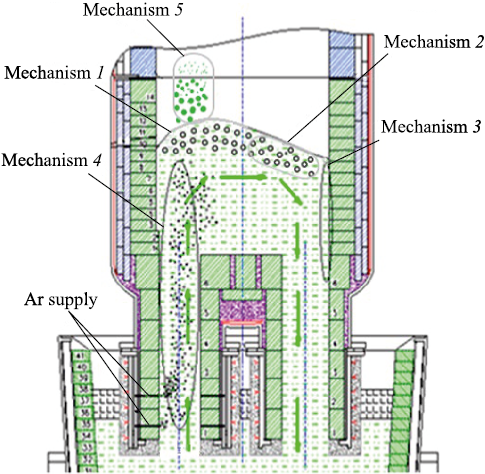
The present work analyzes the following mechanisms of carbon removal under reduced pressure in a circulation vacuum degasser (shown in Fig. 1) [1 – 3; 7; 8]:
1 – desorption of gases from the melt surface;
2 – formation of {CO}bubbles in the melt depth;
3 – formation of {CO}bubbles on the lining surface;
4 – diffusion of the inert gas supplied through the inlet snorkel into the bubbles;
5 – interaction of metal sprays with the vacuum medium in the vacuum chamber.
Fig. 1. Механизмы удаления газов в циркуляционном вакууматоре |
Mechanisms 1, 4, and 5 operate in the diffusion mode and depend on the area of interaction between the melt and the gas medium, whereas mechanisms 3 and 4 depend on the number of formed {CO} bubbles [9; 10].
Theoretical calculations showed that the interaction area for mechanisms 4, 1, and 5 is 60, 6, and 1 m2, respectively. Thus, the main mechanism of carbon removal in the diffusion mode through {CO}formation is mechanism 4.
The rate of carbon removal from the melt by mechanisms 2 and 3 depends on the concentrations of oxygen and carbon in the metal, on the contact area between the lining and the melt (mechanism 3), and on the volume of treated metal (mechanism 2). Theoretical calculations show that, under identical technological parameters of melt treatment, mechanism 2 is 25 times more efficient than mechanism 3.
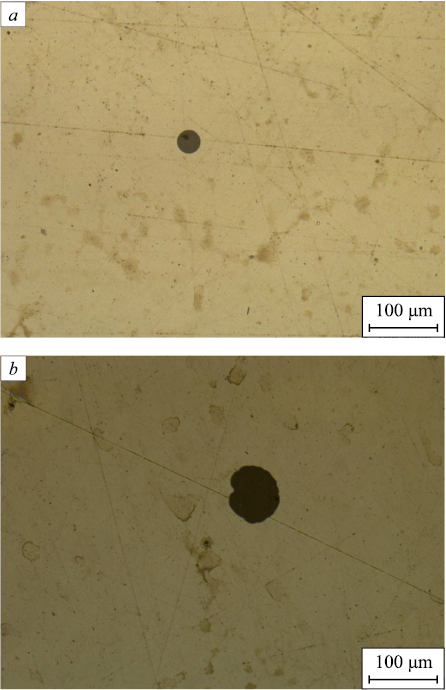
However, for an objective assessment of carbon removal through formation of {CO} bubbles (mechanism 2), it is necessary to consider the conditions and possibility of their formation [8; 11]. Formation of gas bubbles in the melt depth is possible in the presence of various microinhomogeneities or on the surface of microparticles in the melt. To determine the presence of microparticles in the melt, a metal sample was taken from the converter heat during temperature measurement, before the deoxidation/alloying operation. For this purpose, an immersion sampler was used, from which the deoxidizing element had been removed in advance. After polishing of the test sample, a microstructural analysis was performed to identify nonmetallic inclusions in it, shown in Fig. 2 [5].
Fig. 2. Sample for investigation of non-metallic inclusions |
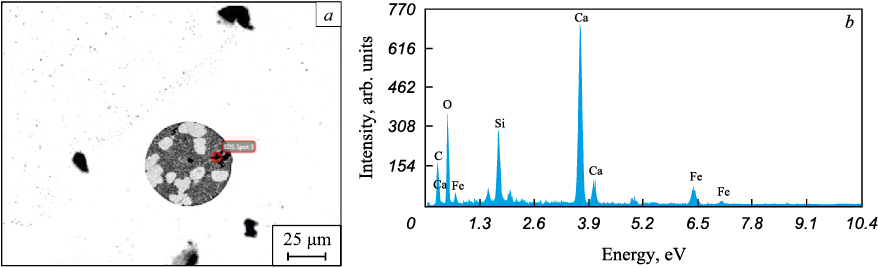
The study results revealed the presence of nonmetallic inclusions of various sizes, from 5 to 140 μm (Fig. 3) [5]. In addition, the elemental composition of the nonmetallic inclusions identified in the sample was determined by X-ray microanalysis using a Quanta Inspect S200 scanning electron microscope equipped with a Trident-XM4 system. The results are shown in Fig. 4 [5].
Fig. 3. View of nonmetallic inclusions
Fig. 4. Composition of a non-metallic inclusion |
The data shown in Figs. 3 and 4 indicate that the composition of the nonmetallic inclusions corresponds to the composition of the slag formed in the converter, that is, even in non-deoxidized metal (before treatment in the vacuum chamber), nonmetallic inclusions are present that can serve as the basis for the formation of {CO} bubbles.
Thus, it was established that the main mechanisms of carbon removal in a circulation vacuum degasser are the formation of {CO} bubbles in the melt (mechanism 2) [12 – 14] and the diffusion mode (mechanism 4) [15; 16].
When considering the process of carbon removal from the metal, it is necessary to take into account the input of this element from the lining. To achieve an ultra-low carbon content in steel (less than 0.002 %), it is advisable to intensify the degassing mechanisms and reduce carbon input from refractory materials.
Mechanism 2 of carbon removal (formation of {CO} bubbles in the depth of the melt) can be intensified by increasing the number of inhomogeneities in the melt, which is achieved by preliminary deoxidation of overoxidized metal with aluminum before vacuum treatment. For example, at one plant the deoxidation operation using aluminum is permitted to achieve an oxygen concentration of 400 ppm before decarburization in a circulation vacuum degasser. According to theoretical calculations, the optimal values of carbon and oxygen concentration in the melt before vacuum treatment are: [С] = 0.043 %, i.e., [О] = 576.87 ppm.
The rational gas flow rate in the inlet snorkel of the circulation vacuum degasser depends on the state of the lining. In vacuum chambers (140 – 170 t), a large amount of gas is supplied to intensify decarburization processes, which may lead to an increase in bubble size and a decrease in decarburization efficiency [17 – 19].
For example, at one metallurgical plant, a mode of deep decarburization of the melt in an RH vacuum degasser was developed. To increase the contact surface between the metal and the gas phase, the transport gas flow rate was reduced from 140 to 80 m3/h, which made it possible to achieve a carbon content of 0.003 % and lower in the finished steel [7].
Another factor affecting the carbon content is the holding time of the metal before casting. The optimal holding time before casting is 20 – 30 min, taking into account all related operations such as crane handling, sampling, measurements, and others. An increase in this time may lead to a rise in carbon content, whereas a shorter holding time may result in unstable parameters during continuous casting, as illustrated in Fig. 5.
Fig. 5. Final carbon content vs metal holding time before casting |
Carbon content is also influenced by other factors, including the operability of the ejectors and the degree of their wear. Regular inspection of the ejectors and assessment of their condition are necessary, since this directly affects the system’s ability to reach low pressure. In practice, it has been observed that the faster the pressure drops below 100 Pa, the higher the probability of effective carbon removal and of achieving a carbon content below 0.002 % in steel.
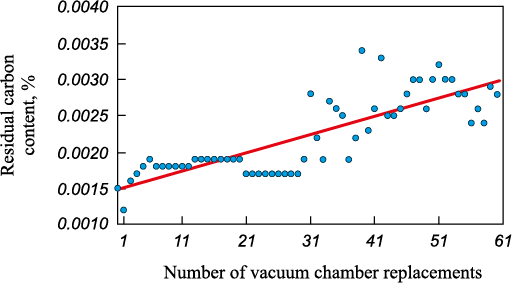
An important factor is the cleanliness of the off-gas system. The presence of contamination in the form of slag-metal deposits in the gas duct system, particularly in the gas duct elbow, prevents the system from reaching low pressure and, as a consequence, hinders carbon removal (Fig. 6).
Fig. 6. Change in carbon content over the time after repair/cleaning of gas duct |
The final carbon content can also be affected by the lining [18; 20]. In this case, the residual carbon content depends on the amount of carbon dissolved from the lining of the steel ladle. Studies have shown that replacing carbon-containing refractory materials with carbon-free or low-carbon materials in the bottom area and lower part of the ladle walls significantly reduces the overall rate of carbon dissolution from the lining (by 60 %) [7].
Conclusions
The main mechanisms of metal decarburization in a circulation vacuum degasser are the formation of {CO} bubbles in the melt volume and purging with inert gas. The key technological parameters are a gas flow rate of 80 m3/h and a holding time of 20 – 30 min.
The use of carbon-free lining significantly reduces carbon input into the melt.
1. Knuppel G. Deoxidation and Vacuum Processing of Steel. Fundamentals and Technology of Ladle Metallurgy. Moscow: Metallurgiya; 1984:414. (In Russ.).
2. Knuppel G. Deoxidation and Vacuum Processing of Steel. Thermodynamic and Kinetic Laws. Moscow: Metallurgiya; 1973:312. (In Russ.).
3. Sheshukov O.Yu., Nekrasov I.V., Metelkin A.A., Lozovaya E.Yu., Shevchenko O.I., Savel’ev M.V. Modern Steel: Theory and Technology: Tutorial. Nizhny Tagil: Nizhny Tagil Institute of Technology (branch) UrFU; 2020:400. (In Russ.).
4. Bigeev A.M., Bigeev V.A. Metallurgy of Steel. Theory and Technology of Steel Melting. Magnitogorsk: MSTU; 2000:544. (In Russ.).
5. Metelkin A.A., Sheshukov O.Yu., Pleshivtsev K.N., Koryukov A.V., Aleksandrovskaya D.E. Determination of the main mechanisms of melt decarbonization in a circulating vacuum unit in order to find rational technological solutions to achieve a carbon content of less than 0.002 % in steel. Metallurg. 2025;(4):21–24. (In Russ.). https://doi.org/10.52351/00260827_2025_4_21
6. Dagman A.I., Zaitsev A.I., Kalmykov K.B., Arutyunyan N.A., Dunaev S.F., Lavrov V.A. Development of principles for achieving specified characteristics of nonmetallic inclusions and steel quality. In: Proceedings of the XVII Int. Congress of Steelmakers and Metal Manufacturers ISCON-2023 “From Ore to Steel”. Magnitogorsk: Magnitogorsk Iron and Steel Works; 2023:54–59. (In Russ.).
7. Saitgaraev A.A. Improvement of technological modes of production of electrotechnical isotropic steel with a particularly low carbon and sulfur content: Extended Abstract of Cand. Sci. Diss. Magnitogorsk; 2024:22. (In Russ.).
8. Liu B.S., Zhu G.S., Li B.H., Zhu L.X., Cui A.M., Li H.X. Optimization of parameters for high efficiency RH decarburization process. Teshugang (Special steel). 2009;30:25–28.
9. Bi E. Research on optimization of RH decarburization process for ultra-low carbon steel. Agricultural Mechanization Research. 2019;(5):40. (In Chin.).
10. Zhou J., Luo G. Optimization of 210 t RH decarburization process for ultra-low carbon steel refining. Special Steel. 2015;36(6):33–35. (In Chin.).
11. Yuan B.H., Liu J.-H., Zhou H.-L., Huang J.-H., Zhang S., Shen Z.-P. Refining effect of IF steel produced by RH forced and natural decarburization process. Chinese Journal of Engineering. 2021;43(8):1107–1115. https://doi.org/10.13374/j.issn2095-9389.2020.10.10.002
12. Chang C., Chen L., Liu C., Chen L., Cui H. Research on Optimization and Practice of IF Steel RH Decarburization Process Control. Metallurgy and Technology. 2020;(7): 53–57. (In Chin.).
13. An C., Li H., Zhang P., Li L., Du G., Liu X. Effect of oxygen content on liquid steel cleanliness after RH decarburization of IF steel. Steelmaking. 2023;39(2):24–27.
14. Luo Kaimin, Lan Tian, Lin Liping, He Zhibin. Analysis of influencing factors of RH decarbonization efficiency in IF steel. Southern Metals. 2025;(4):7–11. (In Chin.).
15. Wang X. Research on decarbonisation speed by RH vacuum treatment. Henan Metallurgy. 2006;14(S):117–121. (In Chin.).
16. Li T., Chen Y., Cheng D., Tang X., Fan J., Wu Z. Study on control technology of ultra-low dissolved oxygen content after RH decarburization. Steelmaking. 2025;41(5):24–29.
17. Yamana H., Takahashi M., Koyama S., Saito T., Katsuta J. Decarburization behavior in RH-degasser. ISIJ International. 1995;35(9):1016–1023.
18. Viertauer A., Mutsam N., Pernkopf F., Gantner A., Grimm G., Winkler W., Lammer G., Ratz A. Refractory condition monitoring and lifetime prognosis for RH degasser. In: AISTech 2019 – Proceedings of the Iron & Steel Technology Conference, 6–9 May 2019; Pittsburgh, Pa, USA. Association for Iron & Steel Technology (AIST): Warrendale, PA; 2019:1083–1091.
19. Ding R., Blanpain B., Jones P.T., Wollants P. Modeling of the vacuum oxygen decarburization refining process. Metallurgical and Materials Transcastions B. 2000;31:197–206. https://doi.org/10.1007/s11663-000-0145-5
20. Li Y.-H., Bao Y.-P., Wang M., Wang R., Tang D.-C. Influence of process conditions during Ruhrstahl-Hereaeus refining process and effect of vacuum degassing on carbon removal to ultra-low levels. Ironmaking and Steelmaking. 2015;42(5):366–372. https://doi.org/10.1179/1743281214Y.0000000236
Konstantin N. Pleshivtsev, Lecturer of the Chair of Metallurgical Technologies
5a Internatsional’naya Str., Lipetsk 398050, Russian Federation
Anatolii A. Metelkin, Dr. Sci. (Eng.), Deputy Head of the Scientific Research Center, JSC EVRAZ NTMK; Prof. of the Chair of Metallurgy of Iron and Alloys of the Institute of New Materials and Technologies, Ural Federal University named after the first President of Russia B.N. Yeltsin
1 Metallurgov Str., Nizhny Tagil, Sverdlovsk Region 622025, Russian Federation
19 Mira Str., Yekaterinburg 620002, Russian Federation
Oleg Yu. Sheshukov, Dr. Sci. (Eng.), Prof., Director of the Institute of New Materials and Technologies, Ural Federal University named after first President of Russia B.N. Yeltsin; Chief Researcher of the Laboratory of Technogenic Formations Problems, Vatolin Institute of Metallurgy of the Ural Branch of the Russian Academy of Sciences
19 Mira Str., Yekaterinburg 620002, Russian Federation
101 Amundsena Str., Yekaterinburg 620016, Russian Federation
Aleksandr N. Rogotovskii, Cand. Sci. (Eng.), Assist. Prof., Head of the Chair of Metallurgical Technologies
5a Internatsional’naya Str., Lipetsk 398050, Russian Federation
Denis K. Egiazaryan, Cand. Sci. (Eng.), Assist. Prof. of Chair of Iron and Alloys Metallurgy, Ural Federal University named after first President of Russia B.N. Yeltsin; Head of the Laboratory of Technogenic Formations Problems, Vatolin Institute of Metallurgy of the Ural Branch of the Russian Academy of Sciences
19 Mira Str., Yekaterinburg 620002, Russian Federation
101 Amundsena Str., Yekaterinburg 620016, Russian Federation
Anton V. Koryukov, Chief Specialist in Technical Development of Steelmaking
1 Metallurgov Str., Nizhny Tagil, Sverdlovsk Region 622025, Russian Federation
Pleshivtsev K.N., Metelkin A.A., Sheshukov O.Yu., Rogotovskii A.N., Egiazaryan D.K., Koryukov A.V. Obtaining ultra-low carbon content in metal processing using a circulation vacuum degasser. Izvestiya. Ferrous Metallurgy. 2026;69(2):143-148. https://doi.org/10.17073/0368-0797-2026-2-143-148
 Email this article (Login required)
Email the author (Login required)
Email this article (Login required)
Email the author (Login required) Publishing House of National University of Science and Technology "MISIS"
4, Leninskii prospekt, Moscow, 119991, Russia
Phone: +7 (495) 638-44-11, +7 (495) 784-58-66
E-mail: fermet.misis@mail.ru