Contents
Scroll to:
 A. I. Dagman,
V. S. Il’ichev,
E. N. Tyulenev,
O. V. Zayakin,
V. I. Zhuchkov,
I. N. Kel’,
D. S. Renev
A. I. Dagman,
V. S. Il’ichev,
E. N. Tyulenev,
O. V. Zayakin,
V. I. Zhuchkov,
I. N. Kel’,
D. S. Renev https://doi.org/10.17073/0368-0797-2026-2-128-135
Scroll to:
The article presents the results of a study on the melting processes of ferroalloy grades FeMn78, FeMn88, MnS17, FeSi65, FeSi75, SiCa15, and AB87 in an iron-carbon melt during the production of steel grades 08U, 3Sp, E3A, and S355MC. The research was conducted using a mathematical model developed by scientists from the Institute of Metallurgy, UB RAS and the Ural Federal University, which accounts for heat and mass transfer coefficients, as well as the physicochemical and thermophysical characteristics of the ferroalloys and steel. It is shown that the lump size of the ferroalloys at different temperatures of the iron-carbon melt significantly affects the change in their melting (dissolution) time. An increase in the lump size leads to an increase in the mass of the ferroalloy, which results in a thicker frozen steel shell and higher heat content. With an increase in the lump diameter, the total melting time of the ferroalloy increases. All studied ferroalloys belong to the group of low-melting alloys. Among the considered ferroalloys, high-carbon ferromanganese grade FeMn78 has the longest melting time; the total melting time of its 100 mm diameter lump in 08U steel can exceed 160 s at a bath temperature of 1650 °C. Reducing the ferroalloy lump size to 60 mm leads to a twofold reduction in its melting time. Based on the conducted research, rational conditions and technological features for the addition of manganese- and silicon-containing ferroalloys in the production of 08U, 3SP, E3A, and S355MC steels were developed. The research results are of great importance for improving steel smelting technologies, as they allow for optimizing the duration of melting and holding periods, the ferroalloy addition scheme, and the degree of metal deoxidation.
Dagman A.I., Il’ichev V.S., Tyulenev E.N., Zayakin O.V., Zhuchkov V.I., Kel’ I.N., Renev D.S. Optimization of addition conditions for manganese- and silicon-containing ferroalloys in steel production. Izvestiya. Ferrous Metallurgy. 2026;69(2):128-135. https://doi.org/10.17073/0368-0797-2026-2-128-135
Introduction
The key parameters determining the efficiency of steel deoxidation and alloying, as well as the duration of steel treatment, are the mechanism and rate of ferroalloy melting in liquid steel. A large number of both Russian [1 – 6] and international [7 – 11] studies have been devoted to the melting of alloying additions of various systems in an iron–carbon melt.
According to [1; 3], there are several experimental approaches to determining melting time based on continuous or periodic weighing of a ferroalloy during its contact with the treated metal. One example is the rotating-disk method, in which the sample surface is uniformly exposed to the melt. The main disadvantage of this method is that it can be used only for test samples shaped as disks whose melting temperature is higher than that of the melt.
An alternative method based on the dissolution of stationary rods in liquid iron with periodic weighing of the samples. To determine the melting time using this method, calorimetric measurements of the duration of the temperature jump in the crucible are also used. However, this method disrupts the melt hydrodynamics and does not reflect the actual shape and motion pattern of ferroalloy particles in the ladle.
A common method for determining the melting time of alloys in steel is to take steel samples after the ferroalloy was introduced into the melt, followed by sample analysis.
Existing experimental methods for determining the melting and dissolution time of ferroalloys are complex and do not adequately account for the actual conditions of alloy dissolution. As a rule, they are characterized by relatively low accuracy and reproducibility. In addition, monitoring the formation and dissolution of the steel shell under conditions close to industrial ones is difficult. For this reason, mathematical approaches to studying the melting time of materials are highly relevant. Compared with the experimental methods, such approaches are less complex and less costly, have higher productivity, and make it possible to study a wide range of sample systems in terms of composition, size, and temperature.
In most studies [2 – 4; 8; 12], modeling of the melting process is based on solving Fourier’s heat conduction equation. Most authors describe the melting process as comprising two interrelated stages: formation of a steel shell and melting (dissolution) of the ferroalloy.
When a cold ferroalloy comes into contact with liquid steel, a solid metal shell forms instantaneously on its surface. Determining the melting time of this shell is difficult because the process is very rapid, especially when the addition size is small. Traditional models assume uniform growth of the steel shell and melting at a constant heat transfer coefficient [13].
However, more detailed studies of shell formation and melting around a ferroalloy particle carried out in [14] showed an asymmetric change in the thickness of the frozen shell around the particle. When a constant heat transfer coefficient is used at the solid/liquid interface, a shell of symmetrical thickness forms around the particle, uniformly increases in thickness, and then melts. That study established that shell melting begins from the upper part, contributing to a higher rate of shell growth in the lower part. Based on this, the authors concluded that the heat transfer coefficient affects the ferroalloy melting process. In addition, the study of convection showed that it can develop inside partially melted low-melting additions within the shell, affecting the melting of this shell. Accurate allowance for internal convection reduced the shell melting time in the upper part by 20 %. This indicates the need to use complex nonstationary heat transfer models.
After the shell has melted through, the stage of direct melting (dissolution) of the ferroalloy begins. Studies [3; 14] show that the rate-limiting stage of the process, whether heat transfer or mass transfer, depends on the ratio between the melting temperatures of the ferroalloy and the bath.
In [15], the mechanism of ferromanganese melting in hot metal and steel was compared depending on the temperature of the liquid metal bath. When the bath temperature is lower than the melting temperature of the ferroalloy, the process is controlled by mass transfer. If the bath temperature is higher, the melting process is determined by heat transfer.
This pattern has also been confirmed for other systems, including a study of the mass-transfer rate of niobium ferroalloys under dynamic conditions [16]. The experiments showed that mass transfer during the free dissolution period, after the steel shell had melted through, is exothermic, whereas diffusion of the liquid phase through the mass-transfer boundary layer at the interface is the rate-limiting stage. Based on the data obtained, the authors predicted complete dissolution of niobium under forced and natural convection conditions, showing that at a comparable temperature convection reduces the melting time by approximately 30 %.
The effect of alloying-material geometry was analyzed in [8]. To describe the melting rate of ferromanganese particles added to a ladle, a melting distribution function was introduced. This function includes the melting time of individual particles, their size, velocity in the melt, temperature, and time. Analysis of the results showed that the main factors influencing the melting time of ferroalloys are particle size, bath temperature, and velocity in the melt volume.
These conclusions are confirmed by the results of [18]. It was noted that increasing the aluminum particle size increases the melting time due to the increase in mass, while the proportion of time spent on melting the frozen shell decreases. To intensify the melting process, melt stirring, for example by gas, is required, which reduces the process time by up to 50 %.
The kinetics of ferrosilicon dissolution in liquid steel was studied in [18; 19]. For this purpose, a solid cylindrical ferrosilicon sample was immersed in the metal melt. During the experiments, the authors found that exothermic dissolution of the Fe2Si eutectic at the inner boundary of the steel shell causes erosion of the latter, thereby reducing the shell dissolution time. Based on the heat and mass transfer data obtained, the authors proposed a mathematical model of ferroalloy dissolution, whose distinguishing feature is allowance for the effect of the Fe2Si eutectic on the melting process.
In [11; 20], a model equation for melting time was proposed. The equation is based on determining the degree of deviation of the chemical equivalent of the composition and the structural parameter for specific melt compositions from the corresponding values calculated for ideal mixtures of the initial components. The main disadvantage of this method is that it does not account for the hydrodynamics and properties of the treated melt, which significantly reduces modeling accuracy.
Despite a fairly large number of models for determining the melting time of ferroalloys, the Russian and international literature contains almost no information on their applicability to industrial data. In this regard, the present work models the melting time of deoxidizing alloys used under the actual production conditions of PJSC Novolipetsk Metallurgical Plant (PJSC NLMK).
Materials and methods
To study the melting processes of ferroalloys, a mathematical model developed by researchers from the Vatolin Institute of Metallurgy of the Ural Branch of the Russian Academy of Sciences (IMET UB RAS) and Ural Federal University named after the First President of Russia B.N. Yeltsin (UrFU) [3] was used. The model was implemented as a software package. This model is based on solving, by the integral method, a system of differential equations that account for heat and mass transfer coefficients. The thermal part of the model is based on a classification of ferroalloys according to the relationship between the bath temperature (Тb ), the initial crystallization temperature of ferroalloys (Тc ), and the iron–carbon melt temperature (Тs ). According to this classification, ferroalloys are divided into low-melting (Тc ≤ Тs ), high-melting (Тs < Тc < Тb ), and ultra-high-melting (Тc ≥ Тb ) alloys. The model includes the solution of Fourier’s differential heat conduction equation for each phase: the shell, solid core, and liquid ferroalloy layer. The number of phases depends on the melting period, ferroalloy type, and boundary conditions determined by convective heat exchange and the melting process. The end of the melting process is defined as complete melting of the ferroalloy.
The model was previously used to study the melting time of alloys of various systems, with confirmation of the reliability of the results obtained.
In the present study, the effect on ferroalloy melting time was examined not only for composition and lump size, but also for the grade of the treated steel, that is, its thermophysical characteristics. The ferroalloy melting time data obtained by mathematical modeling were used to develop technological features for steel smelting under the conditions of PJSC NLMK.
The following parameters were adopted as initial values for mathematical modeling: the bath temperature was constant and equal to 1650 °C, which corresponds to the actual conditions of steel treatment with ferroalloys for the steel grades under study. Depending on steel grade, the crystallization temperature of steel ranged from 1500 to 1535 °С.
The ferroalloys used were ferromanganese grades FeMn78 and FeMn88, ferrosilicomanganese MnSi17, ferrosilicon FeSi65 and FeSi75, silicocalcium SiCa15, and secondary aluminum AV87.
As an assumption, ferroalloy lumps were considered to have a spherical shape, with a diameter of 2 – 100 mm and an initial temperature of 20 °C. The thermophysical and physicochemical properties of the ferroalloys used for modeling were obtained experimentally and from literature data (see Table).
Thermophysical and physico-chemical properties of ferroalloys
| ||||||||||||||||||||||||||||||||||||||||||||||||||||||||||||
Results and discussion
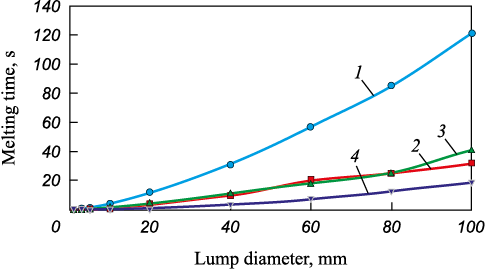
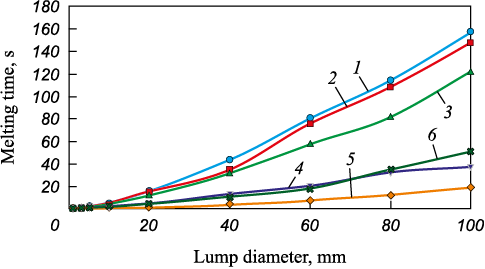
The results of mathematical modeling of the melting time of the ferroalloys considered in melts of 08Yu, 3sp, E3A, and S355MC steels are presented as graphical dependences in Figs. 1 – 4.
The ferroalloy size fraction has a significant effect on changes in melting (dissolution) time. As the lump size increases, the mass of the ferroalloy increases, which leads to an increase in the thickness of the frozen steel shell and, consequently, to an increase in its heat content. With increasing lump diameter, the total melting time of the ferroalloy increases in accordance with the dependences shown in Figs. 1 and 2.
Fig. 1. Dependence of melting time of the ferroalloys used on fractional composition
Fig. 2. Dependence of melting time of the ferroalloys used on fractional composition |
In the production of carbon steels, ferroalloys are added in the first half of metal tapping from the converter, that is, before the steel teeming ladle is 50 % filled. In this case, FeSi65 ferrosilicon lumps 70 mm in diameter melt within 40 s, while lumps 100 mm in diameter melt within 60 s (Fig. 1). The longest melting time is observed for manganese-containing ferroalloys: ferromanganese and ferrosilicomanganese. Lumps of high-carbon ferromanganese FeMn78 no larger than 70 mm dissolve within 100 s, whereas lumps 100 mm in diameter dissolve within 160 s. The melting time of the other alloys is significantly shorter. For example, for ferrosilicon, the melting time does not exceed 60 s over the entire fractional range. Aluminum, which has the lowest melting point among the materials considered, melts within 16 s when the lump diameter is 100 mm. Based on the data obtained, the maximum ferroalloy lump size was limited to 70 mm to ensure complete melting of the ferroalloys even at the minimum regulated tapping duration of 240 s.
The production technology for E3A transformer steel involves steel deoxidation and alloying during metal tapping from the converter. Among the ferroalloys used in this process (Fig. 3), ferrosilicomanganese is characterized by the longest melting time: at a lump diameter of 70 mm, its melting takes approximately 70 s. The melting time of aluminum in liquid steel is less than 20 s over the entire fractional range.
Fig. 3. Dependence of melting time of the ferroalloys used on fractional composition |
During the development of this technology in the converter shop, the addition of ferrosilicon in an amount of approximately 40 kg/t of steel sometimes led to the formation of “cakes”, which were located at the slag–metal interface in the steel teeming ladle. This caused major difficulties during further treatment at ladle treatment stand (MFUs), since, first, it prevented immersion of the lance for argon blowing and, second, caused difficulties in determining and, accordingly, adjusting the chemical composition of the steel. Increasing the holding time by 1 min and improving the uniformity of ferrosilicon addition eliminated this problem.
For 08Yu steel production, preliminary metal deoxidation during tapping with ferrosilicon was used to reduce aluminum consumption. The use of lumps up to 70 mm in diameter ensured their melting within no more than 20 s (Fig. 2). Thus, ferrosilicon addition at the beginning of tapping allows silicon to react rapidly and completely with oxygen during the first tapping period, before the steel teeming ladle is half filled. This provides a reduced metal oxidation level of 300 – 600 ppm without an increase in silicon content, which increases the degree of assimilation and reduces the amount of aluminum subsequently added. The studies performed, together with monitoring of metal oxidation after converter blowing, made it possible to adjust the ferrosilicon addition more precisely and, consequently, to reduce and stabilize aluminum consumption.
Steels with a silicon content of no more than 0.03 and 0.04 %, at a manganese concentration of up to 0.9 and 0.9 – 1.5 %, respectively, and with a sulfur content of no more than 0.015 %, were conventionally classified as low-silicon low-sulfur (LSLS) steels, for example S355MC steel. Their production involves desulfurization, including desulfurization in the steel teeming ladle, because under the existing conditions, taking into account the sulfur content in hot metal, the load on hot metal desulfurization units, and the quality of metal scrap, the required mass fraction of sulfur can only be achieved by comprehensively reducing its content at all technological stages. Thus, two contradictory tasks had to be solved: on the one hand, the degree of silicon assimilation by the metal from manganese-containing materials had to be minimized, which requires a fairly high metal oxidation level; on the other hand, complete metal deoxidation is required to remove sulfur.
Fig. 4. Dependence of melting time of the ferroalloys used on fractional composition |
At the beginning of tapping from the converter in the production of LSLS steels, a carbonaceous additive, coke fines, lime, and fluorspar for slag formation, as well as manganese-containing ferroalloys, were added. The required pause after addition of manganese-containing ferroalloys, depending on the grade used, is up to 100 s. The aluminum then introduced melts rather quickly: in less than 19 s (Fig. 4). Based on the melting-time data obtained, a pause was maintained after material addition to ensure melting of the ferroalloys and oxidation of the silicon introduced with these additions; aluminum AV87 was then added. Final deep deoxidation, and therefore the conditions required for desulfurization, were ensured at the next technological stage during secondary steel treatment.
Conclusions
Mathematical modeling of the melting time of FeMn78, FeMn88, MnSi17, FeSi65, FeSi75, and SiCa15 ferroalloys, as well as AV87, in melts of 08Yu, 3sp, E3A, and S355MC steels was used to study the features of the melting mechanism of lump ferroalloys. For each ferroalloy grade, dependences of the melting time of ferroalloys and aluminum in liquid steel on their fractional composition were plotted. It was shown that the main factor influencing the dissolution time of a lump ferroalloy in liquid steel is its fraction. Among the ferroalloys considered, ferromanganese grade FeMn78 is characterized by the longest melting time: the total melting time of a ferroalloy lump 100 mm in diameter in 08Yu steel can exceed 160 s at a bath temperature of 1650 °C. Reducing the lump diameter of this ferroalloy to 60 mm leads to a twofold reduction in its melting time. Based on the studies performed, rational conditions were developed and technological features were established for the addition of manganese- and silicon-containing ferroalloys in the production of 08Yu, 3sp, E3A, and S355MC steels.
1. Lozovaya E.Yu. Study of kinetics of ferroalloys melting in an iron-carbon melt: Extended Abstract of Cand. Sci. Diss. Yekaterinburg: 2001:23. (In Russ.).
2. Nikulin A.Yu. Mathematical modeling of kinetics of reagents dissolution in out-furnace treatment of ferrous metals. Extended Abstract of Dr. Sci. Diss. Magnitogorsk: 1997:44.
3. Zhuchkov V.I., Noskov A.S., Zav’yalov A.L. Dissolution of Ferroalloys in Liquid Metal. Sverdlovsk: Ural Branch of the USSR Academy of Sciences; 1990:134. (In Russ.).
4. Devyatov D.Kh. Mathematical Modeling and Optimal Control in Metallurgy: Monograph. Magnitogorsk: MSTU; 2007:350. (In Russ.).
5. Kel I.N., Zhuchkov V.I., Renev D.S., Lozovay E.Y., Galiahmetova R. Study of the physicochemical characteristics of complex boron-containing ferroalloys. AIP Conference Proceedings. 2020;2313(1):050015. https://doi.org/10.1063/5.0032689
6. Zayakin O.V., Kel’ I.N., Renev D.S., Sychev A.V., Mikhailova L.Yu., Dolmatov A.V. Physicochemical characteristics of new complex niobium-containing alloys. Izvestiya. Ferrous Metallurgy. 2023;66(5):616–622. https://doi.org/10.17073/0368-0797-2023-5-616-622
7. Radune M., Radune A., Assous F., Zinigrad M. Modelling and computer simulation of reagents diffusion in high temperature diffusion controlled heterogeneous reactions. Archives of Computational Materials Science and Surface Engineering. 2009;1(4):225–231.
8. Zhang L., Oeters F. Mathematical modelling of alloy melting in steel melts. Steel Research. 1999;70(4-5):128–134. https://doi.org/10.1002/srin.199905615
9. Arya A., Singh A.K. Effect of natural convection on formation and melting of shell around low melting point additives. Metallurgical and Materials Transactions B. 2025;56: 20167–2186. https://doi.org/10.1007/s11663-025-03466-2
10. Jardón-Pérez L.E., Ramírez-Argaez M.A., Conejo A.N. Melting rate of spherical metallic particles in its own melt: effect of particle temperature, bath temperature, particle size and stirring conditions. Transactions of the Indian Institute of Metals. 2019;72(9):2365–2373. https://doi.org/10.1007/s12666-019-01688-y
11. Petrov A.F., Snigura I.R., Golovko L.A., Cupa N.A. Predicting the melting time of complex ferroalloys by the method of physico-chemical modeling. Fundamental and Applied Problems of Ferrous Metallurgy. 2019;(33):205–214. (In Russ.). https://doi.org/10.52150/2522-9117-2019-33-205-214
12. Snegirev Yu.V., Tutarova V.D. Comparison of mathematical models of reagent creation in liquid steel. Bulletin of the National Technical University Kharkiv Polytechnic Institute. Series: Informatics and modeling. 2013;(39(1012)): 189–198. (In Russ.).
13. Wang J., Song S., Ke X., Nyembwe A., Xue Z. Characterization of LC/HC-FeMn alloys and their melting mechanism in the molten iron. Journal of Materials Research and Technology. 2023;27:7740–7747. https://doi.org/10.1016/j.jmrt.2023.11.211
14. Oeters F., Zhang L., Hauler C., Leitner J. Laboratory experiments and process modelling of the melting and dissolution of low-density ferro-molybdenum in steel melts. Steel Research. 2000;71(10):381–390. https://doi.org/10.1002/srin.200001333
15. Kumar R., Chandra S. Prediction of dissolution time of ferromanganese in hot metal and steel bath. In: Proceedings of the National Seminar on Computer Applications in Materials & Metallurgical Engineering. Jamshedpur: NML; 1996:81–86.
16. Argyropoulos S.A., Sismanis P.G. The mass transfer kinetics of niobium solution into liquid steel. Metallurgical Transactions B. 1991:22(4);417–427. https://doi.org/10.1007/BF02654280
17. Taniguchi S., Ohmi M., Ishiura S. A hot model study on the effect of gas injection upon the melting rate of solid sphere in a liquid bath. Transactions of the Iron and Steel Institute of Japan. 1983:23(7);571–577. https://doi.org/10.2355/isijinternational1966.23.571
18. Argyropoulos S.A., Guthrie R.I.L. The exothermic dissolution of 50 wt.% ferro-silicon in molten steel. Canadian Metallurgical Quarterly. 1979;18(3):267–281. https://doi.org/10.1179/cmq.1979.18.3.267
19. Sismanis P.G., Argyropoulos S.A. Modelling of exothermic dissolution. Canadian Metallurgical Quarterly. 1988; 27(2):123–133. https://doi.org/10.1179/cmq.1988.27.2.123
20. Petrov A.F., Vorona E.N. Modeling of thermophysical properties of various groups of ferroalloys. Fundamental and applied problems of ferrous metallurgy. 2005;(10):207–212. (In Russ.).
Aleksei I. Dagman, Cand. Sci. (Eng.), Head of the Expert Direction of the Directorate of Development of New Process Technologies
2 Metallurgov Sqr., Lipetsk 398040, Russian Federation
Vladimir S. Il’ichev, Head of Department, BOF Shop No. 1
2 Metallurgov Sqr., Lipetsk 398040, Russian Federation
Evgenii N. Tyulenev, Head of Department, Management of End-to-End Optimization of Technology and Regulation
2 Metallurgov Sqr., Lipetsk 398040, Russian Federation
Oleg V. Zayakin, Corresponding Member of RAS, Dr. Sci. (Eng.), Chief Researcher, Head of the Laboratory of Steel and Ferroalloys
101 Amundsena Str., Yekaterinburg 620016, Russian Federation
Vladimir I. Zhuchkov, Dr. Sci. (Eng.), Prof., Chief Researcher of the Laboratory of Steel and Ferroalloys
101 Amundsena Str., Yekaterinburg 620016, Russian Federation
Il’ya N. Kel’, Cand. Sci. (Eng.), Senior Researcher of the Laboratory of Steel and Ferroalloys
101 Amundsena Str., Yekaterinburg 620016, Russian Federation
Dmitrii S. Renev, Junior Researcher of the Laboratory of Steel and Ferroalloys
101 Amundsena Str., Yekaterinburg 620016, Russian Federation
Dagman A.I., Il’ichev V.S., Tyulenev E.N., Zayakin O.V., Zhuchkov V.I., Kel’ I.N., Renev D.S. Optimization of addition conditions for manganese- and silicon-containing ferroalloys in steel production. Izvestiya. Ferrous Metallurgy. 2026;69(2):128-135. https://doi.org/10.17073/0368-0797-2026-2-128-135
 Email this article (Login required)
Email the author (Login required)
Email this article (Login required)
Email the author (Login required) Publishing House of National University of Science and Technology "MISIS"
4, Leninskii prospekt, Moscow, 119991, Russia
Phone: +7 (495) 638-44-11, +7 (495) 784-58-66
E-mail: fermet.misis@mail.ru