Contents
Scroll to:
https://doi.org/10.17073/0368-0797-2026-1-75-83
Scroll to:
The article presents an integrated approach to the development and implementation of information modeling systems (IMS) designed to control blast furnace smelting technology. The main attention is paid to the creation of mathematical models of thermal, gas-dynamic and slag modes which allow more accurate prediction of the blast furnace behavior under conditions of changing raw material properties and combined blast parameters. The presented results demonstrate that the use of a modular architecture for building information systems and modern computing technologies allows expanding the set of process parameters for assessing the progress of blast furnace smelting, increasing the efficiency of monitoring production processes and reducing the costs of developing and maintaining software for information systems due to their automation. It is shown that the use of a modular architecture and microservice technologies provides flexibility, scalability and the ability to adapt software solutions to specific production tasks. The article presents the results of developing software for subsystems for calculating thermal and gas-dynamic modes, as well as predicting the silicon content in cast iron and the properties of the final slag. Practical implementation is carried out using modern .NET, PostgreSQL, Docker and DevOps tools. A comparative analysis of the subsystems’ operation confirmed their efficiency when integrated with the automated process control system and production databases. The tests were conducted on real industrial data. The obtained results indicate the high practical significance of implementation of the integrated management system for ensuring the stability and efficiency of blast furnace smelting in the context of digital transformation of metallurgical production.
Spirin N.A., Lavrov V.V., Gurin I.A., Shchipanov K.A. Development and implementation of information modeling systems for managing blast furnace smelting technology. Izvestiya. Ferrous Metallurgy. 2026;69(1):75-83. https://doi.org/10.17073/0368-0797-2026-1-75-83
Modern blast furnace production is a complex, energy-intensive process involving numerous physicochemical reactions that occur under conditions of high temperature and pressure. These processes have been extensively described in the fundamental works on pig iron metallurgy and blast furnace smelting by Vegman E.F. [1; 2], Yusfin Yu.S. [3], Tovarovskii I.G. [4; 5], Babarykin N.N. [6], Ramm A.N. [7], Shavrin S.V. [8], Dmitriev A.N. [9 – 11], and others [12 – 14]. Controlling this process requires the use of model-based decision support systems (DSS) that improve the efficiency of blast furnace operation, reduce the consumption of raw materials and fuel-and-energy resources, and ensure stable quality of the liquid products of blast furnace smelting [15 – 19].
Traditional approaches to blast furnace process control are largely based on the empirical experience of operators and the use of various mathematical models. However, given the relatively high variability of blast furnace process parameters and the complexity of their interrelationships [20; 21], these approaches are often insufficient. Information modeling systems (IMS) are specialized tools for analyzing, predicting, and optimizing processes in blast furnace production based on mathematical models and historical operational data. Functionally, they correspond to classical decision support systems, providing data acquisition, processing, analysis, and generation of operational recommendations. At the same time, IMS incorporate mathematical models describing the thermal, slag, and gas-dynamic modes of blast furnace smelting. These systems can integrate data from automated process control systems (APCS), analyze process parameters in real time, and generate optimal operational recommendations based on model calculations [15 – 19].
The use of decision support systems in blast furnace production is aimed at solving several key tasks:
• Optimization of resource utilization. The blast furnace process requires significant consumption of raw materials (ore, coke, fluxes) and energy resources (hot blast, natural gas, oxygen, etc.). A model-based DSS makes it possible to optimize the consumption of these resources through automated calculation of their required quantities and supply parameters. This is achieved using mathematical models that account for the current operating conditions of the blast furnace and predict the consequences of different operating modes.
• Stabilization of the technological process. A blast furnace operates under the simultaneous influence of thermal, slag, gas-dynamic, blast, and other smelting modes, which are continuously affected by external and internal disturbances. A model-based DSS enables engineering and technological personnel to stabilize the technological process in a timely manner by minimizing fluctuations in key operating parameters such as coke rate, furnace productivity, and the composition of pig iron and slag.
• Prediction of blast furnace operation under changing conditions. The system allows forecasting of blast furnace performance when the properties of burden materials, combined blast parameters, and other operating parameters change.
• Flexibility and adaptability to external economic changes. Under rapidly changing market and production conditions (for example, fluctuations in raw material prices, changes in product quality requirements, or variations in production volumes), a DSS enables prompt adjustment of process control parameters. Owing to models capable of incorporating new data and changes in real time, the system becomes more flexible and capable of responding rapidly to changing conditions.
• Integration with automated control systems. The DSS must be integrated with existing automated process control systems (APCS) to ensure continuous data exchange between the decision support system and the technological process. This makes it possible to create a control loop in which decisions are generated and implemented in an automated mode, thereby minimizing the influence of the human factor and improving the efficiency of process control.
Taken together, these aspects make the development and implementation of decision support systems for blast furnace production not merely a technological improvement but a necessary step toward increasing the competitiveness of metallurgical enterprises, enhancing their resilience to market changes, and transitioning to more efficient production.
The key concepts underlying the development of a model-based decision support system for blast furnace production include the following:
– development and application of mathematical models of the blast furnace process;
– the capability to solve optimization problems;
– integration of the DSS with real production data;
– provision of recommendations in real time and adaptation to changes in the technological process and external conditions.
Mathematical models of the blast furnace process make it possible to simulate individual aspects of blast furnace operation, such as thermal, slag, gas-dynamic, and blast modes of blast furnace smelting, as well as the mode of material movement along the furnace height and other phenomena. Experience in the development and application of mathematical models in blast furnace production has shown that the concept of reference-disturbance motion and the field-model approach to modeling, developed at the Siberian State Industrial University, have proven to be particularly effective [22; 23].
The reference-disturbance modeling concept is based on the use of a reference (baseline) model that mathematically describes the main characteristics of the blast furnace process, together with disturbance terms that represent deviations from normal operating conditions. The reference model may be static, while the disturbances are represented by dynamic variables – linearization coefficients that reflect changing operating conditions. These coefficients allow nonlinear relationships within the system to be approximated in a simplified linear form. Linearization of the nonlinear system equations around an equilibrium point or a selected operating state makes it possible to derive a linear model that adequately describes system behavior for small deviations from this operating point. In such a model, the linearization coefficients determine the sensitivity of the system output to small disturbances in the input parameters.
The field-model approach assumes that the real physical process is combined with its mathematical representation in order to improve modeling accuracy. Industrial data are used to verify and calibrate the model, thereby increasing its predictive reliability.
The applicability of the above approaches in the development of a computer system for blast furnace production includes several key areas:
– optimization of blast furnace operating parameters. Linearization of the models and the use of the reference-disturbance approach make it possible to develop adaptive control algorithms capable of promptly adjusting process parameters based on current production data;
– process prediction. The field-model approach enables more accurate prediction of future process states, which is essential for real-time decision making. This is particularly important under changing blast parameters, variations in the composition and consumption rates of burden materials and coke, and fluctuations in the composition of the liquid products of blast furnace smelting;
– diagnostics and monitoring. Linearization simplifies the models, allowing rapid analysis and detection of deviations from normal blast furnace operation. This facilitates the development of diagnostic and monitoring systems for thermal, slag, and gas-dynamic modes, as well as for assessing furnace operating conditions.
Decision support systems must support optimization tasks such as optimizing the composition and properties of the iron-ore burden and the consumption of raw materials and fuel-and-energy resources across a group of blast furnaces. Optimization is carried out using techno-economic models and by predicting furnace performance for different methods and process control parameters.
An important component of a decision support system is its integration with real production data obtained from automated process control systems (APCS) and enterprise resource planning (ERP) systems. This integration enables real-time model adjustment and ensures reliable predictive results.
A model-based system should provide engineering and technological personnel of the blast furnace department with real-time recommendations for process control, taking into account the current raw material and fuel-and-energy conditions as well as operational production objectives. In addition, the system must be capable of adapting to changes in the technological process and external conditions through the use of the reference-disturbance modeling approach and the presence of a regulatory and reference information module.
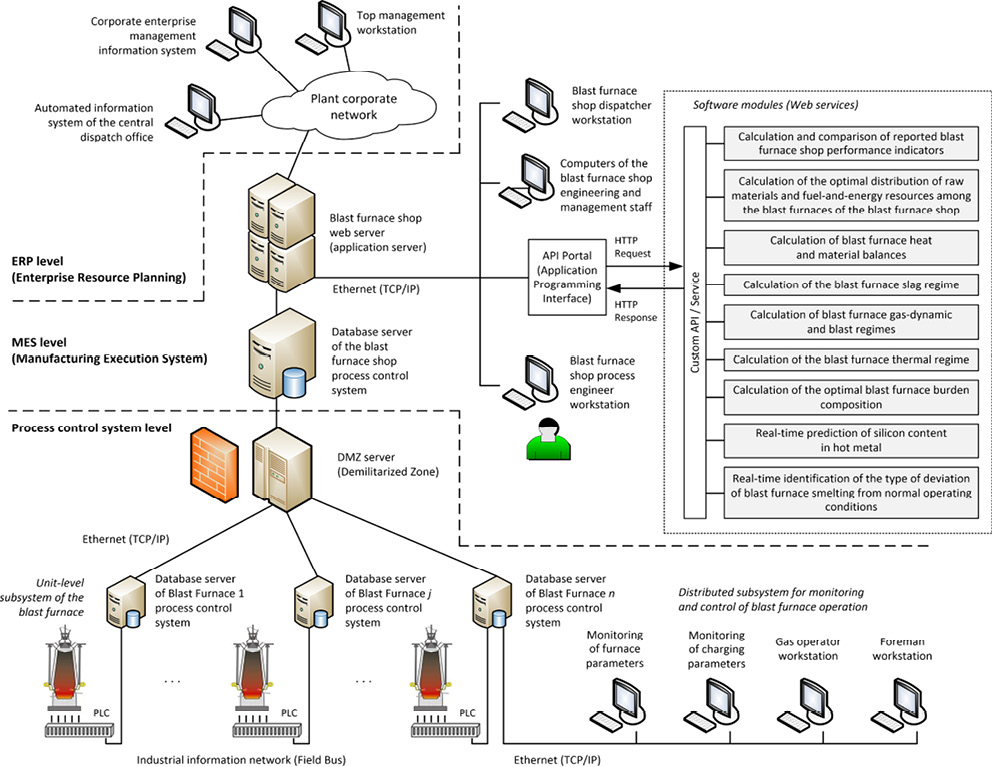
The article presents several subsystems of the software package “Analysis and Forecasting of Production Situations in a Blast Furnace Shop” (AIPPS BFS), whose architecture is shown in Fig. 1 [15]. The AIPPS BFS software package is a multifunctional information modeling system designed for operational monitoring and forecasting of production situations in blast furnace operation. Its development is aimed at solving key control tasks in metallurgical production while accounting for dynamic changes in technological parameters and the influence of external factors.
Fig. 1. Architecture of an automated system for analyzing and forecasting |
The paper describes the following subsystems:
– calculation of thermal mode indicators;
– calculation of gas-dynamic mode indicators;
– prediction of silicon content in cast iron;
– prediction of the composition and properties of the final slag.
Each subsystem addresses specific tasks related to the analysis and control of technological parameters of the blast furnace process. The integrated operation of these subsystems within a unified information-modeling environment significantly increases the level of automation and intelligent monitoring of metallurgical production.
The architecture of the software package is based on a modular design principle [24 – 26], which ensures flexibility, scalability, and the ability to adapt the system to specific production conditions. The main modules of the system include:
– a data acquisition and processing module that aggregates information from the APCS and ERP of the blast furnace shop;
– analytical modules (microservices [27 – 30]) that perform mathematical modeling of technological processes;
– a user interface module that provides operators and process engineers with convenient access to data and calculation results.
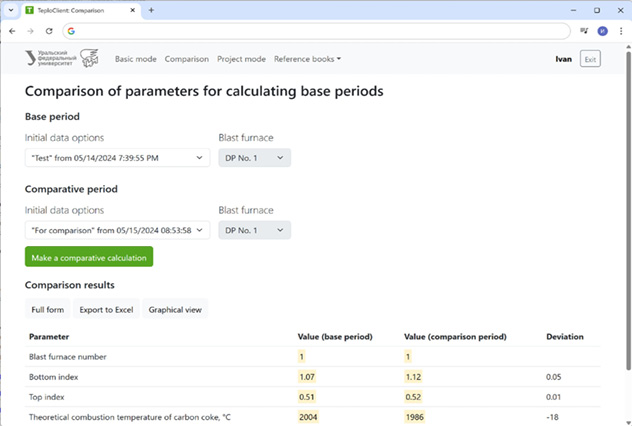
The subsystem for calculating thermal mode indicators of blast furnace smelting performs the calculation of the blast furnace heat balance, including heat consumption and its distribution across furnace zones. The heat balance equations integrate burden parameters (ore, coke, fluxes), blast characteristics (temperature, humidity, oxygen content), and the properties of liquid products. The software implementation is based on a three-tier architecture: a client module for visualization [31 – 34], an API server [35; 36] (.NET 8 with authentication via JWT), and a database management system (PostgreSQL [37; 38]). Swagger was used for system testing. The results are exported to Excel. A fragment of the user interface is shown in Fig. 2.
Fig. 2. Fragment of a web page of the subsystem for calculating the thermal mode indicators |
The subsystem for calculating gas-dynamic mode indicators is designed to prevent burden hanging in the blast furnace. The mathematical model includes calculations of the degree of burden equilibrium, the critical blast rate, and the gas filtration velocity in different furnace zones, and other parameters. The influence of process control parameters (for example, blast parameters and the properties of iron-ore materials and coke) is predicted by the model based on the reference-disturbance concept using linearized equations. The software implementation of the subsystem is based on a microservice architecture with a REST API [27 – 30] and is integrated with the API server [35; 36]. Visualization is implemented using Frappe.js. Docker Compose [30; 39 – 41] was used for system deployment. A fragment of the user interface is shown in Fig. 3.
Fig. 3. Fragment of a web page of the subsystem for calculating the gas-dynamic mode |
The subsystem for forecasting silicon content in cast iron is based on the superposition principle for calculating the influence of ore load, blast parameters, slag composition, and other process parameters. The model accounts for non-stationary processes and delays in furnace response to control actions [20; 21]. The software implementation is a web application based on ASP.NET MVC [33; 34] with an OLAP analysis module. Graphs of transient processes are generated using JavaScript libraries. A fragment of the user interface is shown in Fig. 4.
Fig. 4. Fragment of a web page of the subsystem for predicting silicon content in cast iron |
Analysis of accumulated measured data on silicon content [Si] showed that the root-mean-square deviation of silicon content in cast iron samples is 0.09 %. This deviation is explained by variations in blast characteristics, ore load, fluctuations in burden properties, and other factors. At the same time, the root-mean-square deviation between the predicted and measured silicon content in cast iron is also 0.09 %. The proportion of prediction errors within the interval of 0 – 0.1 % is 70 %, while errors in the interval of 0.11 – 0.20 % account for 26 %. These results indicate satisfactory agreement between predicted and measured values of silicon content in cast iron.
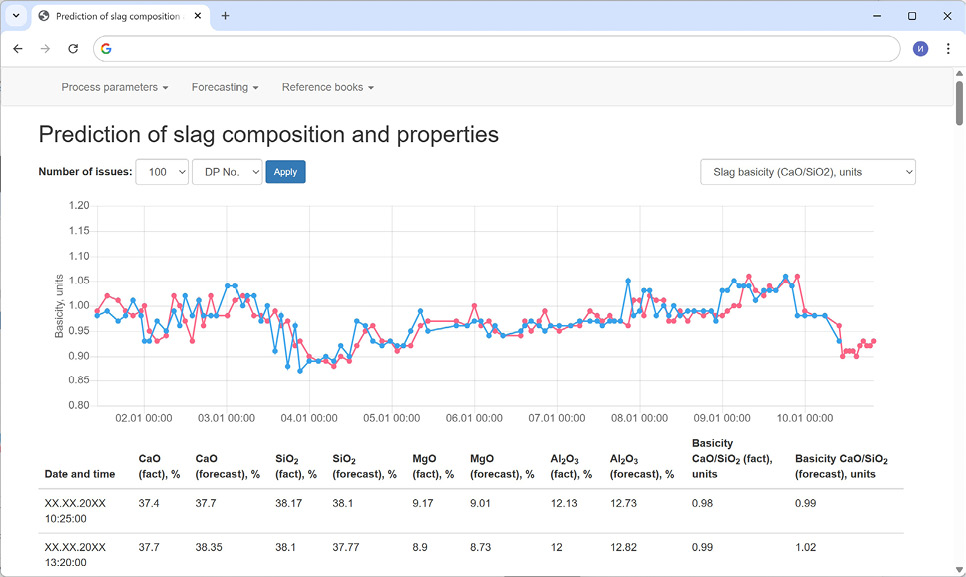
The subsystem for forecasting the composition and properties of the final slag makes it possible to assess the progress of reduction processes in the blast furnace (Fig. 5). The mathematical model calculates slag viscosity and basicity at temperatures of 1400 – 1500 °C, the slag viscosity polytherm, and viscosity gradients. The software implementation includes a console application for data collection and storage, as well as a web interface with diagnostic recommendations. Integration with Entity Framework and Docker [30; 39 – 41] is provided.
Fig. 5. Fragment of a web page of the subsystem for predicting the composition |
Integration of these subsystems into a single software package makes it possible to obtain a comprehensive assessment of the state of the blast furnace process, respond promptly to changes in operating parameters, and predict potential critical situations. Interaction between subsystems is ensured through a unified centralized data storage system as well as integration with process control systems.
Modern information systems and technologies used in implementing the software package include the following:
– big data storage and processing systems, enabling analysis of large volumes of measured and calculated indicators of the blast furnace process;
– a set of mathematical models and algorithms for processing stored data and visualizing key indicators to support their evaluation and generate recommendations for engineering and technological personnel of the blast furnace shop;
– web technologies and microservice architecture provide access to the system from various workstations and remote monitoring of the software application’s performance and log analysis;
– application programming interfaces (API) for integration with existing information systems of the metallurgical enterprise;
– automation of development, deployment, and monitoring of updated software versions using DevOps tools (GitHub, Docker, Jenkins, Prometheus, Grafana).
Conclusions
The application of the developed information modeling systems in the practical work of engineering and technological personnel in blast furnace operations makes it possible to increase blast furnace efficiency, reduce the consumption of raw materials and fuel-and-energy resources, and stabilize the quality of liquid smelting products. Analysis of the testing results shows that the integration of information modeling systems into the digital infrastructure of a metallurgical enterprise helps to reduce the process disturbances, lower operating costs, and improve the final product quality.
1. Vegman E.F., Zherebin B.N., Pokhvisnev A.N., etc. Pig Iron Metallurgy. Textbook. Moscow: Metallurgiya; 1989:512. (In Russ.).
2. Vegman E.F. Blast Furnace Production. Reference book. Vol. 1: Ore Preparation and Blast Furnace Process. Moscow: Metallurgiya; 1989:496. (In Russ.).
3. Yusfin Yu.S. Pig Iron Metallurgy. University textbook. Moscow: Akademkniga; 2004:774. (In Russ.).
4. Tovarovskii I.G. Evolution, Process Development, Problems and Prospects. Dnepropetrovsk: Porogi; 2003:596. (In Russ.).
5. Tovarovskii I.G. Blast Furnace Smelting. Dnepropetrovsk: Porogi; 2009:765. (In Russ.).
6. Babarykin N.N. Theory and Technology of Blast Furnace Process. Textbook. Magnitogorsk: MSTU; 2009:257. (In Russ.).
7. Ramm A.N. Modern Blast Furnace Process. Moscow: Metallurgiya; 1980:304. (In Russ.).
8. Shavrin S.V. Mathematical Modeling of Blast Furnace Process. Yekaterinburg: UB RAS; 1994:72. (In Russ.).
9. Dmitriev A.N., Shumakov N.S., Leont’ev L.I., etc. Fundamentals of Blast Furnace Theory and Technology. Yekaterinburg: UB RAS; 2005:547. (In Russ.).
10. Dmitriev A.N. Mathematical Modeling of Blast Furnace Process. Yekaterinburg: UB RAS; 2011:162. (In Russ.).
11. Dmitriev A.N., Chen K., Zolotykh M.O., etc. Mathematical Modeling of Blast Furnace Process. Yekaterinburg: AMB; 2023:232. (In Russ.).
12. Geerdes M., Chenault R., Kurunov I., Lingardi O., Ricketts D. Modern Blast Furnace Process. Moscow: Metallurgizdat; 2016:280. (In Russ.).
13. Gileva L.Yu., Kaplun L.I., Zagainov S.A. Pig Iron Metallurgy. Textbook. Yekaterinburg: UrFU; 2021:128. (In Russ.).
14. Yaroshenko Yu.G., Shvydkii V.S., Spirin N.A., etc. Thermophysical Fundamentals of Metallurgical Furnaces Thermal Operation. Yekaterinburg: AMK Den’ RA; 2019:464. (In Russ.).
15. Spirin N.A., Lavrov V.V., Gurin I.A. Decision Support Systems for Managing Pyrometallurgical Processes. Yekaterinburg: AMK Den’ RA; 2024:308. (In Russ.).
16. Spirin N.A., Lavrov V.V., Rybolovlev V.Yu., etc. Model Decision Support Systems in Automated Control of Blast Furnace Smelting. Yekaterinburg: UrFU; 2011:462. (In Russ.).
17. Pavlov A.V., Onorin O.P., Spirin N.A., etc. Some Issues of Technology, Management and Diagnostics of Blast Furnace Smelting. Yekaterinburg: AMK “Den’ RA”; 2023:282. (In Russ.).
18. Onorin O.P., Spirin N.A., Terent’ev V.L., etc. Computer Methods of Blast Furnace Process Modeling. Yekaterinburg: USTU-UPI; 2005:301. (In Russ.).
19. Spirin N.A., Lavrov V.V., Rybolovlev V.Yu., etc. Mathematical Modeling of Metallurgical Processes in Automated Process Control Systems. Yekaterinburg: UrFU; 2014:558. (In Russ.).
20. Ovchinnikov Yu.N., Moikin V.I., Spirin N.A., etc. Non-Stationary Processes and Improving the Efficiency of Blast Furnace Smelting. Chelyabinsk: Metallurgiya; 1989:120. (In Russ.).
21. Moikin V.I., Babushkin N.M., Bokovikov B.A. Dynamic characteristics of blast furnace based on mathematical modeling. In: Issues of Pig Iron Production in Blast Furnace. Moscow: Metallurgiya; 1984:46–52. (In Russ.).
22. Myshlyaev L.P., Evtushenko V.F. Forecasting in Control Systems. Novokuznetsk: SibGIU; 2002:358. (In Russ.).
23. Emel’yanov S.V., Korovin S.K., Myshlyaev L.P., etc. Theory and Practice of Forecasting in Control Systems. Moscow: Rossiyskie Universitety; 2008:487. (In Russ.).
24. Martin R.C. Clean Architecture: A Craftsman’s Guide to Software Structure and Design. Boston etc.: Prentice Hall; 2018:432.
25. Gandi R., Richards M., Ford N. Head First. Software Architecture. O’Reilly Media, Inc.; 2024:486.
26. Ford N., Richards M., Sadalage P.J., Dehghani Z. Software Architecture: The Hard Parts: Modern Trade-Off Analyses for Distributed Architectures. O’Reilly Media, Inc.; 2021:459.
27. Newman S. Monolith to Microservices: Evolutionary Patterns to Transform Your Monolith. O’Reilly Media, Inc.; 2019:270.
28. Newman S. Building Microservices: Designing Fine-Grained Systems. O’Reilly Media, Inc.; 2015: 280.
29. Bellemare A. Building Event-Driven Microservices. O’Reilly Media, Inc.; 2020:324.
30. Kocher P.S. Microservices and Containers. Addison-Wesley Professional; 2018:304.
31. Volkman M. Svelte and Sapper in Action. Simon and Schuster; 2020:456.
32. Freeman A. Pro Angular. Apress; 2017:778.
33. Freeman A. Pro ASP.NET Core MVC 2. Apress; 2017:1046.
34. Troelsen A., Japikse P. Pro C# 7. With .NET and .NET Core. Apress Berkeley, CA; 2017:1372. https://doi.org/10.1007/978-1-4842-3018-3
35. Arnaud L. The Design of Web APIs. Simon and Schuster; 2019:392.
36. Peralta J.H. Microservice APIs in Python: Using Python, Flask, Fastapi, Openapi and More. Manning Publications; 2023:425.
37. Rogov E.V. PostgreSQL 17 inside. Moscow: DMK Press; 2025:668. (In Russ.).
38. Dombrovskaya G., Novikov B., Beylikova A. Query Optimization in PostgreSQL. Moscow: DMK Press; 2022:278. (In Russ.).
39. Hering M. DevOps for the Modern Enterprise: Winning Practices to Transform Legacy IT. IT Revolution; 2018:288.
40. Kim D., Humble J., Debois P., Willis J. The DevOps Handbook: How to Create World-Class Agility, Reliability, and Security in Technology Organizations. IT Revolution; 2016:480.
41. Humble J., Farley D. Continuous Delivery: Reliable Software Releases through Build, Test, and Deployment Automation. Pearson Education, 2010:512.
Nikolai A. Spirin, Dr. Sci. (Eng.), Prof., Head of the Chair of Thermal Physics and Informatics in Metallurgy
28 Mira Str., Yekaterinburg 620062, Russian Federation
Vladislav V. Lavrov, Dr. Sci. (Eng.), Prof. of the Chair of Thermal Physics and Informatics in Metallurgy
28 Mira Str., Yekaterinburg 620062, Russian Federation
Ivan A. Gurin, Cand. Sci. (Eng.), Assist. Prof. of the Chair of Thermal Physics and Informatics in Metallurgy
28 Mira Str., Yekaterinburg 620062, Russian Federation
Kirill A. Shchipanov, Cand. Sci. (Eng.), Assist. Prof. of the Chair of Thermal Physics and Informatics in Metallurgy
28 Mira Str., Yekaterinburg 620062, Russian Federation
Spirin N.A., Lavrov V.V., Gurin I.A., Shchipanov K.A. Development and implementation of information modeling systems for managing blast furnace smelting technology. Izvestiya. Ferrous Metallurgy. 2026;69(1):75-83. https://doi.org/10.17073/0368-0797-2026-1-75-83
 Email this article (Login required)
Email the author (Login required)
Email this article (Login required)
Email the author (Login required) Publishing House of National University of Science and Technology "MISIS"
4, Leninskii prospekt, Moscow, 119991, Russia
Phone: +7 (495) 638-44-11, +7 (495) 784-58-66
E-mail: fermet.misis@mail.ru