Contents
Scroll to:
https://doi.org/10.17073/0368-0797-2026-1-59-66
Scroll to:
The oscillating-cup method is the most common method for studying the metallic melts viscosity at high temperatures. However, the data obtained by different authors using this method may differ by several tens of percent. The reasons for this lie in the features of the method which lead to the influence of experimental conditions on the measurement results. In this paper, the boundary conditions influence at the melt upper boundary and processes of preliminary sample preparation on the viscosity measurements results is considered. It is shown that under certain experimental conditions, anomalies of a methodological nature can occur on polytherms. The considered features of the experiment are a consequence of film effects, wetting phenomena and irreversible processes in the melt-crucible system. Methodological processes are proposed that allow us to identify and eliminate their influence on the viscometry results. Film effects are caused by changes in the melt surface condition as a result of formation of a viscous film. To eliminate them, viscosity measurements should be carried out using different boundary conditions at the melt upper boundary. The wetting phenomena influence is caused by the meniscus formation at the upper boundary of the melt. When measuring viscosity in crucibles with a lid on the melt, the wetting influence can be eliminated by selecting the modes of preliminary remelting or by selecting the lid mass. Irreversible processes in the melt-crucible system are associated with the crucible gradual destruction when the sample is cooled below the crystallization temperature due to the high adhesion of the alloy to the crucible walls and differences in their thermal expansion coefficients. To eliminate them, the authors proposed a mode of the sample remelting with overheating of the melt to the maximum temperature expected in the subsequent measurement cycle and cooling to a temperature 100 ºС below its solidification temperature.
Beltyukov A.L., Olyanina N.V. Features of viscosimetric experiment by the oscillating-cup method. Izvestiya. Ferrous Metallurgy. 2026;69(1):59-66. https://doi.org/10.17073/0368-0797-2026-1-59-66
Introduction
Viscosity measurements, due to the high sensitivity of viscosity to structural changes, are widely used in studies of the structure and in physicochemical analysis of liquid systems [1; 2]. The high efficiency of viscometry as a method of physicochemical analysis of liquids was noted as early as in the works of N.S. Kurnakov. Along with other structure-sensitive properties, viscosity measurements form the basis of the concept of experimental physicochemistry of metallic melts developed in the works of M.A. Samarin and his school [3]. Special attention in studies of physicochemical properties has traditionally been given to the methodological issues [4] aimed at improving the reliability of experimental results. These issues remain highly relevant in view of the steadily increasing requirements for experimental accuracy driven by the intensive development of liquid-state theory, modeling and prediction methods, including those based on machine learning [5], as well as by advances in materials processing technologies.
The most widespread and reliable method for determining the viscosity of metallic melts at high temperatures (1000 – 1800 °C) is the oscillating-cup method based on torsional oscillations of a cylindrical cup containing the melt. On the basis of this method, a number of experimental setups have been developed [6 – 9], which mainly differ in the techniques used for recording oscillation parameters and processing experimental data. Most commonly, viscosity calculations are performed using the mathematical framework developed by E.G. Shvidkovskii [10] and R. Roscoe [11]. According to various authors, the calculated total relative error in determining absolute viscosity values ranges from 0.7 to 15 %. Despite this seemingly high declared accuracy, viscosity data reported in different studies, especially for pure liquid metals, may differ by several tens of percent [12; 13]. This discrepancy may result from the strong influence of both small, uncontrolled impurity concentrations and experimental conditions, as well as data processing procedures.
With regard to viscometry results, the nature of anomalous behavior in the temperature dependence of viscosity remains a subject of debate. Such behavior manifests itself as abrupt changes (jumps) in property values during heating and/or cooling of the melt, breaks in the curves, inflection points, hysteresis in viscosity–temperature curves, and similar features. These anomalies are often attributed to structural changes in the melt. A discussion on the possibility and nature of structural transitions in metallic melts was conducted as early as 1985 in the journal Izvestiya. Ferrous Metallurgy [14 – 17]. Most proponents of the structural transition concept relied on anomalous behavior observed in various physicochemical properties of melts, including viscosity. Reports on anomalous features in the temperature dependence of viscosity associated with changes in melt structure continue to appear regularly [18 – 20]; however, no consensus on their nature has yet been reached. This is largely due to the contradictory nature of data obtained by different authors [21].
It has been shown in [21; 22] that anomalies in the temperature dependence of viscosity may be caused by methodological features of the viscometric experiment. Identification and elimination of such effects are of critical importance both for experimental physicochemistry of melts and for the further development of liquid-state theory.
In the present work, methodological approaches are considered that make it possible to identify and eliminate, directly in the experiment, the influence of such phenomena as film effects, wetting phenomena, and interaction between the melt and the crucible material (high adhesion) on the measured results. The described approaches were tested on a number of pure metals as well as on binary and multicomponent systems.
Measurement procedure
The viscosity of melts was determined using the oscillating-cup method in the version developed by E.G. Shvidkovskii [10] on an automated setup [23] equipped with an optical registration system. All measurements were carried out in a protective helium atmosphere. Cylindrical Al2O3 cups with an inner diameter of approximately 17 mm and a height of 42 mm were used as crucibles. All crucibles were checked for the absence of ellipticity and taper by measuring the inner diameter near the bottom and at mid-height of the crucible. The temperature dependence of viscosity was measured in the heating mode followed by cooling, with stepwise changes in temperature. In order to ensure that the melt reached an equilibrium state, isothermal holds of at least 10 min were performed before measurements at each temperature.
When calculating viscosity using numerical methods, the following equation was solved [10; 23]
\[f(\nu ) = {\mathop{\rm Re}\nolimits} (L) + \frac{\delta }{{2\pi }}{\mathop{\rm Im}\nolimits} (L) - 2I\left( {\frac{\delta }{\tau } - \frac{{{\delta _0}}}{{{\tau _0}}}} \right) = 0,\]
where I is the moment of inertia of the suspension system; δ, τ, δ0 , τ0 are the damping decrement and oscillation period of the suspension system with and without the melt, respectively; Re(L) and Im(L) are the real and imaginary parts of the friction function; and ν is the kinematic viscosity of the liquid. To eliminate the influence of external friction of the suspension system in the inert gas on the measurement results, δ0 and τ0 were determined experimentally under the same conditions as those used for measuring δ and τ. The melt height in the crucible was calculated using the formula
\[H = \frac{m}{{\pi {R^2}\rho }},\]
where m and R are the mass and radius of the sample, respectively, and ρ is the melt density. The radius and height of the sample were determined taking into account the thermal expansion coefficient of the crucible material.
During viscosity measurements, the following: conditions were satisfied H > 2R and \(\xi = R\sqrt {\frac{{2\pi }}{{\tau \nu }}} > 8.\) Fulfillment of the first condition makes it possible to exclude the influence of secondary flows in the melt on torsional oscillations [10]. Fulfillment of the second condition ensures minimal error in viscosity determination associated with the error in measuring the damping decrement [23].
The total relative error in determining kinematic viscosity values, calculated according to the procedure described in [23], does not exceed 4 %, with the error of a single experiment being no more than 2 %.
Results and discussion
Viscosity measurements in crucibles with a lid at the melt upper boundary
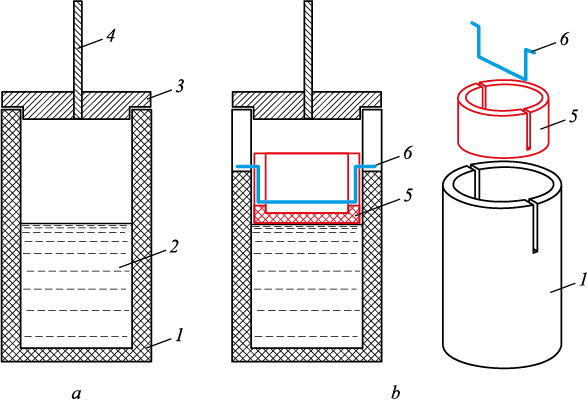
When measuring viscosity by the oscillating-cup method under standard experimental conditions, the liquid sample is contained within a cylindrical crucible and has a free upper boundary (Fig. 1, a). During the experiment, the melt is in contact with the side wall and the bottom of the crucible; thus, one lateral and one end friction surface are realized. However, during the experiment a viscous film (for example, an oxide film) may form on the melt surface. Since the viscosity of such a film is much higher than that of the melt itself, it effectively acts as a second end friction surface. The presence of a viscous film leads to additional dissipation of mechanical energy of the torsional oscillations of the viscometer suspension system and, consequently, to overestimated values of the logarithmic damping decrement and, correspondingly, of the calculated viscosity [24].
Fig. 1. Scheme of a crucible with the melt in experiments without (a) and with a lid (b) |
To identify film effects during viscosity measurements, crucibles with a lid floating on the melt were used (Fig. 1, b). The lids were fabricated from cylindrical Al2O3 cups with an outer diameter 0.5 – 0.8 mm smaller than the inner diameter of the crucible. The lid can move freely along the vertical axis of the crucible, compensating for thermal expansion of the melt. Rotation of the lid relative to the crucible is excluded. In experiments with a lid on the melt, boundary conditions with one lateral and two end friction surfaces are established [10].
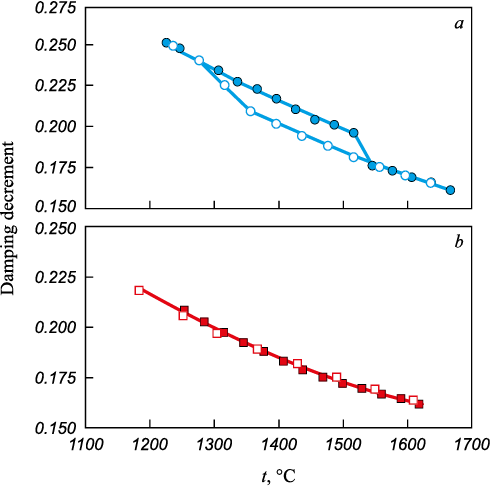
Fig. 2. Temperature dependences of the damping decrement |
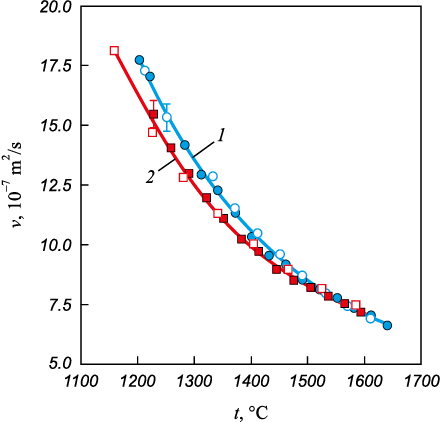
The influence of film effects on viscosity measurement results is demonstrated in Fig. 2 using the liquid alloy Fe70Si15B15 as an example. In the experiment without a lid (Fig. 2, a), anomalously abrupt changes in the damping decrement are observed in the temperature dependences near 1550 °C during heating and below 1370 °C during cooling of the melt. In the experiment with a lid at the melt upper boundary (Fig. 2, b), the temperature dependences of the damping decrement are monotonic and exhibit no special features. In experiments with a single end friction surface (the melt upper boundary assumed to be free), a viscous film is present on the sample surface, which leads to overestimated values of the damping decrement. The sharp decrease in the damping decrement during melt heating is associated with a change in boundary conditions at the melt upper boundary, i.e., a transition from two end friction surfaces to one. This change in boundary conditions is caused by destruction of the surface film during heating and its restoration during cooling of the melt. In the limiting case where the viscous film is immobile relative to the crucible, its presence can be taken into account in viscosity calculations by introducing a second end friction surface [10; 23]. Based on the δ(t) dependence shown in Fig. 2, a, the viscosity–temperature dependence was calculated assuming boundary conditions at the melt upper boundary that change during the experiment: during heating from the liquidus to 1550 °C, two end friction surfaces; from 1550 to 1680 °C, one end friction surface; during cooling from 1680 to 1370 °C, one end friction surface; and below 1300 °C, two end friction surfaces. The kinematic viscosity temperature dependence obtained using this calculation scheme (Fig. 3, curve 1) is monotonic and is in good agreement with the ν(t) dependence obtained in the experiment with a lid at the melt upper boundary (Fig. 3, curve 2).
Fig. 3. Temperature dependences of Fe70Si15B15 melt viscosity: |
Thus, viscosity measurements performed under different boundary conditions at the melt upper boundary (without a lid and with a lid) make it possible to identify and eliminate the influence of film effects on the measurement results. For a more reliable determination of viscosity values, measurements should be carried out both without a lid and with a lid at the melt upper boundary. Agreement between the obtained data confirms their reliability.
Influence of wetting phenomena on viscosity measurement results
Wetting phenomena are most pronounced when studying melts that exhibit either low or high wettability with respect to the crucible material, due to the formation of a meniscus at the interface between the melt and the side wall of the crucible [25; 26].
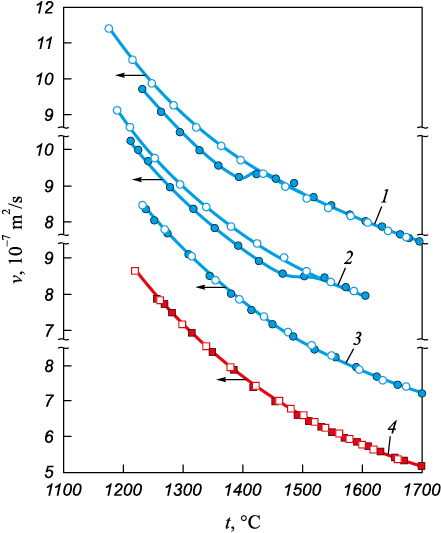
The influence of wetting phenomena on viscosity measurement results is illustrated in Fig. 4, which shows the temperature dependences of the viscosity of the Со81B10Si9 melt obtained under thermocycling conditions with repeated heating–cooling cycles performed on the same sample. Measurements were carried out in crucibles with a lid on the melt. During thermocycling, the temperature dependences obtained in the heating mode starting from room temperature exhibit an anomaly in the form of an inflection point, followed by hysteresis during cooling (Fig. 4, curves 1 and 2). In subsequent measurement cycles performed under identical experimental conditions, the anomaly shifts toward higher temperatures, while the magnitude of the effect decreases and eventually disappears completely (Fig. 4, curve 3). The viscosity–temperature dependences obtained in measurement cycles after cooling the sample to temperatures of 700 – 1100 °C exhibit a monotonic character without any specific features (Fig. 4, curve 4).
Fig. 4. Temperature dependences of liquid Co81B10Si9 alloy |
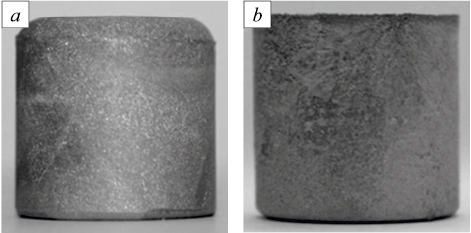
Fig. 5 presents photographs of alloy ingots obtained in a crucible with a lid after different degrees of melt superheating. In the ingot obtained after heating to 1380 °C (below the temperature corresponding to the inflection in the viscosity–temperature dependence), a region that does not contact the walls of the crucible and the lid is clearly visible. When the melt is heated only slightly above the liquidus temperature, poor wetting results in the absence of contact between the melt and the side wall near the lid, as well as partial loss of contact with the lid along its perimeter, leading to the formation of a meniscus in this region. In contrast, the ingot obtained after cooling a melt heated to 1600 °C (above the temperature corresponding to the inflection in the viscosity–temperature dependence) has a cylindrical shape; therefore, in this experiment the entire surface of the sample was in contact with the walls of the crucible and the lid. The mathematical model underlying the oscillating-cup method [10] assumes a cylindrical shape of the liquid sample and the absence of slip at the melt–crucible interface during measurements. Formation of a meniscus under conditions of low wettability leads to a reduction in the contact area between the melt and the crucible side wall and, consequently, to underestimation of the measured viscosity values. The inflection observed in the temperature dependences of viscosity shown in Fig. 4 results from an increase in the contact area between the melt and the walls of the crucible and the lid.
Fig. 5. Photographs of Co81B10Si9 alloy ingots obtained by cooling |
When measuring viscosity in crucibles with a lid at the melt upper boundary, the influence of wetting phenomena can be eliminated by selecting appropriate conditions for preliminary remelting of the melt or by adjusting the mass of the lid. When selecting the lid mass, it should be sufficient to to ensure a flat shape of the melt upper boundary, while preventing extrusion of the melt between the side walls of the crucible and the lid.
Investigation of melts with high adhesion to crucible walls
Typically, prior to viscosity measurements, a homogenizing remelting of the sample is performed with substantial superheating above the alloy liquidus, followed by cooling to room temperature. Subsequently, several measurement cycles are carried out, each cycle starting and ending at room temperature. However, for certain systems this experimental scheme cannot be implemented because of crucible destruction during the first heating–cooling cycles. In such cases, property measurements are usually performed only in the cooling mode after heating the melt to the maximum temperature. In particular, this problem arises when studying melts of the Co – Si system. The crucibles used in this work withstood no more than two measurement cycles. After the third cycle, cracks were observed on the crucible walls, and in some cases crucible failure occurred during the measurements.
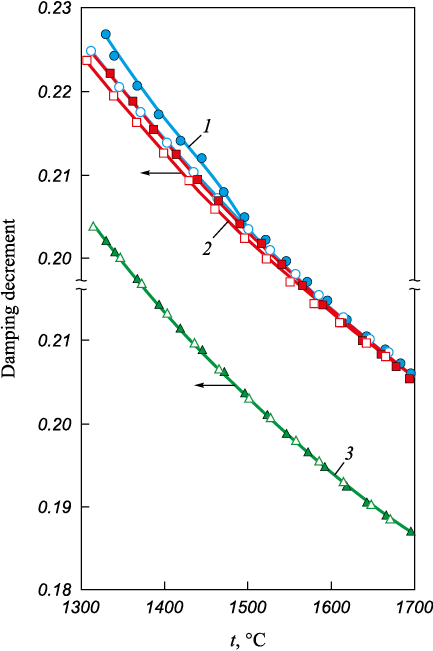
Fig. 6. Temperature dependences of the damping decrement |
Fig. 6 shows the temperature dependences of the damping decrement for a crucible containing the liquid Co68Si32 alloy, obtained during two heating–cooling cycles without preliminary remelting of the alloy. In the first measurement cycle (Fig. 6, curve 1), an inflection is observed in the temperature, dependence of the damping decrement during heating in the range 1450 – 1480 °C, along with hysteresis in the viscosity–temperature dependence during subsequent cooling below 1480 °C. Upon repeated heating (Fig. 6, curve 2), the temperature dependence of the damping decrement exhibits a monotonic character, and only a slight hysteresis is observed. After this experiment, visual inspection revealed the presence of cracks on the crucible walls. Following mechanical destruction of the crucible, tightly adhering particles of crucible material were found on the ingot surface. Based on these observations, it was concluded that crucible destruction begins already after the first measurement cycle and occurs predominantly during cooling of the sample below the crystallization temperature, owing to the high adhesion of the melt to the crucible walls and the significant difference in thermal expansion coefficients between the solid alloy and the crucible material. The onset of crucible destruction accounts for the slight hysteresis observed in the second measurement cycle (Fig. 6, curve 2). The hysteresis between the heating and cooling temperature dependences obtained in the first measurement cycle (Fig. 6, curve 1) indicates the presence of irreversible processes occurring in the melt. In particular, this behavior may result from melt inhomogeneity after melting associated with the metallurgical heredity of the initial charge materials [27]. In this experiment, the first measurement cycle effectively serves as a preliminary remelting of the sample.
To prevent crucible destruction, an experimental scheme was employed in which the sample was remelted in the crucible by heating to the maximum temperature expected in the subsequent measurement cycle, followed by cooling to a temperature 100 °C below the melt solidification temperature. Thereafter, measurements were carried out in the heating–cooling mode. The aggregate state of the sample was monitored using the damping decrement values. Fig. 6 presents the temperature dependence of the damping decrement for a crucible containing the Co68Si32 melt obtained after remelting the sample for 10 min at 1650 °C and cooling to 1150 °C prior to the measurement cycle. Under these experimental conditions, the temperature dependences of the damping decrement obtained during heating and subsequent cooling coincide and exhibit a monotonic character without any special features.
Conclusions
It has been demonstrated that boundary conditions at the melt upper boundary and the methods of preliminary sample preparation significantly affect the results of viscosity measurements of metallic melts performed using the oscillating-cup method. Under certain experimental conditions, anomalies of a methodological nature may arise in the viscosity–temperature dependences. The experimental features considered are a consequence of film effects, wetting phenomena, and irreversible processes occurring either in the melt itself or in the melt–crucible system.
Film effects are associated with changes in the state of the melt surface resulting from the formation or destruction of a viscous film. To identify and eliminate these effects during the experiment, viscosity measurements should be carried out under different boundary conditions at the melt upper boundary (without a lid and with a lid on the melt).
The influence of wetting phenomena on viscosity measurement results is caused by curvature of the melt upper boundary due to meniscus formation at low or high degrees of wettability of the crucible walls by the melt and, consequently, by changes in the contact area between the liquid and the crucible side wall. When measuring viscosity in crucibles with a lid at the melt upper boundary, the influence of wetting can be eliminated by selecting appropriate conditions for preliminary remelting of the melt or by adjusting the mass of the lid.
High adhesion of the alloy to the crucible walls combined with a significant difference in their thermal expansion coefficients leads to crucible destruction during cooling of the sample below the crystallization temperature. The onset of crucible destruction gives rise to irreversible processes in the melt–crucible system and manifests itself as hysteresis in the viscosity–temperature dependences. To eliminate these processes, a preliminary remelting mode is proposed that involves superheating the melt to the maximum temperature expected in the subsequent measurement cycle, followed by cooling to a temperature 100 °C below its solidification temperature.
1. Fialkov Yu.Ya. Physicochemical Analysis of Liquid Systems and Solutions. Kiev: Naukova Dumka; 1992:245. (In Russ.).
2. Sheshukov O.Yu., Nevidimov V.N., Nekrasov I.V., Metelkin A.A., Tsepelev V.S. Development of research on the physico-chemical properties of oxide and metal melts. Izvestiya. Ferrous Metallurgy. 2025;68(1):76–83. https://doi.org/10.17073/0368-0797-2025-1-76-83
3. Vertman A.A., Samarin A.M. Properties of Iron Melts. Moscow: Nauka; 1969:260. (In Russ.).
4. Vertman A.A., Samarin A.M. Methods for Studying the Properties of Metal Melts. Moscow: Nauka; 1969:197. (In Russ.).
5. Kondratyuk N., Ryltsev R., Ankudinov V., Chtchelkatchev N. First-principles calculations of the viscosity in multicomponent metallic melts: Al-Cu-Ni as a test case. Journal of Molecular Liquids. 2023;380:121751. https://doi.org/10.1016/j.molliq.2023.121751
6. Brooks R.F., Dinsdale A.T., Quested P.N. The measurement of viscosity of alloys – A review of methods, data and models. Measurement Science and Technology. 2005;16: 354–362. https://doi.org/10.1088/0957-0233/16/2/005
7. Kehr M., Hoyer W., Egry I. A New high-temperature oscillating cup viscometer. International Journal of Thermophysics. 2007;28:1017–1025. https://doi.org/10.1007/s10765-007-0216-9
8. Sato Y. Representation of the viscosity of molten alloy as a function of the composition and temperature. Japanese Journal of Applied Physics. 2011;50(11S):11RD01. https://doi.org/10.1143/JJAP.50.11RD01
9. Konashkov V.V., Tsepelev V.S., V’yukhin V.V., Povodator A.M., Podol’skaya A.I. A computer-aided plant for studying the kinematic viscosity of high-temperature metallic melts. Instruments and Experimental Techniques. 2011;54(2): 284–285. https://doi.org/10.1134/S0020441211020187
10. Shvidkovskii E.G. Some Questions of Viscosity of Molten Metals. Moscow: Gostekhizdat; 1955:208. (In Russ.).
11. Roscoe R. Viscosity determination by the oscillating vessel method I: Theoretical considerations. Proceedings of the Physical Society. 1958;72(4):576–584. http://iopscience.iop.org/0370-1328/72/4/312
12. Assael M.J., Kakosimos K., Banish R.M., Brillo J., Egry I., Brooks R., Quested P.N., Mills K.C., Nagashima A., Sato Y., Wakeham W.A. Reference data for the density and viscosity of liquid aluminum and liquid iron. Journal of Physical and Chemical Reference Data. 2006;35(1):285–300. https://doi.org/10.1063/1.2149380
13. Assael M.J., Armyra I.J., Brillo J., Stankus S.V., Wu J., Wakeham W.A. Reference data for the density and viscosity of liquid cadmium, cobalt, gallium, indium, mercury, silicon, thallium, and zinc. Journal of Physical and Chemical Reference Data. 2012;41(3):033101. http://dx.doi.org/10.1063/1.4729873
14. Ostrovskii O.I., Grigoryan V.A. On structural transformations in metallic melts. Izvestiya. Ferrous Metallurgy. 1985;28(5):1–12. (In Russ.).
15. Klimenkov E.A., Baum B.A. On the possibility of leap changes in structure of iron melts. Izvestiya. Ferrous Metallurgy. 1985;28(5):12–17. (In Russ.).
16. Bazin Yu.A., Zamyatin V.M., Nasyirov Ya.A., Emel’yanov A.V. On structural transformations in liquid aluminum. Izvestiya. Ferrous Metallurgy. 1985;28(5):28–33. (In Russ.).
17. Novokhatskii I.A., Kisun’ko V.Z., Lad’yanov V.I. Features of demonstration of various types of structural transformations in metal melts. Izvestiya. Ferrous Metallurgy. 1985;28(9): 1–9. (In Russ.).
18. Chu W., Shang J., Yin K., Ren N., Hu L., Zhao Y., Dong B. Generality of abnormal viscosity drop on cooling of CuZr alloy melts and its structural origin. Acta Materialia. 2020;196:690–703. https://doi.org/10.1016/j.actamat.2020.07.018
19. Tyagunov A.G., Baryshev E.E., Tyagunov G.V., Mushnikov V.S., Tsepelev V.S. Systematization of physical properties polytherms of metallic melts. Izvestiya. Ferrous Metallurgy. 2017;60(4):310–317. (In Russ.). https://doi.org/10.17073/0368-0797-2017-4-310-317
20. Bai Y., Hu L., Qin J., Wang Z., Song K. General role of rare earth elements in dynamic characteristic of series of FeB-based bulk-glass-forming liquids. Journal of Non-Crystalline Solids. 2021;572:121119. https://doi.org/10.1016/j.jnoncrysol.2021.121119
21. Bel’tyukov A.L., Goncharov O.Yu., Lad’yanov V.I. Features of polytherms of the viscosity of Fe–B melts. Russian Journal of Physical Chemistry A. 2017;91(10):1919–1924. https://doi.org/10.1134/S0036024417100065
22. Olyanina N.V., Beltyukov A.L., Goncharov O.Yu., Lad’yanov V.I. Influence of the surface film on the measurement results of viscosity of Co83B17 melt by method of torsional vibrations. Rasplavy. 2012;(2):83–90. (In Russ.).
23. Bel’tyukov A.L., Lad’yanov V.I. An automated setup for determining the kinematic viscosity of metal melts. Instruments and Experimental Techniques. 2008;51(2):304–310. https://doi.org/10.1134/S0020441208020279
24. Beskachko V.P., Vyatkin G.P., Pisarev N.M., Shcheka A.I. Influence of surface films on the results of viscosity measurements by the Shvidkovsky method I. Theory. Rasplavy. 1990;(6):3–8. (In Russ.).
25. Nunes V.M.B., Lourenco M.J.V., Santos F.J.V., Nieto de Castro C.A. The meniscus effect in viscosity determinations by the oscillating cup method. High Temperatures – High Pressures. 2003;35-6(1):75–80. https://doi.org/10.1068/htjr083
26. Bel’tyukov A.L., Olyanina N.V., Lad’yanov V.I. Torsional vibration measurement of the viscosity of a metallic melt. Russian Metallurgy (Metally). 2016;2016(2):156–161. https://doi.org/10.1134/S0036029516020026
27. Baum B.A., Khasin G.A., Tyagunov G.V., etc. Liquid Steel. Moscow: Metallurgiya; 1984:208. (In Russ.).
Anatolii L. Beltyukov, Cand. Sci. (Phys.–Math.), Leading Researcher
34 Tat’yany Baramzinoi Str., Izhevsk, Udmurtian Republic 426067, Russian Federation
Natalia V. Olyanina, Cand. Sci. (Phys.–Math.), Research Associate
34 Tat’yany Baramzinoi Str., Izhevsk, Udmurtian Republic 426067, Russian Federation
Beltyukov A.L., Olyanina N.V. Features of viscosimetric experiment by the oscillating-cup method. Izvestiya. Ferrous Metallurgy. 2026;69(1):59-66. https://doi.org/10.17073/0368-0797-2026-1-59-66
 Email this article (Login required)
Email the author (Login required)
Email this article (Login required)
Email the author (Login required) Publishing House of National University of Science and Technology "MISIS"
4, Leninskii prospekt, Moscow, 119991, Russia
Phone: +7 (495) 638-44-11, +7 (495) 784-58-66
E-mail: fermet.misis@mail.ru