Contents
Scroll to:
https://doi.org/10.17073/0368-0797-2026-1-39-50
Scroll to:
The work continues a series of two articles devoted to the study of cold resistance of new cast Cr – Mn – Ni – Mo – N steel including comparison with cold resistance of traditional Cr – Ni cast steel 12Kh18N10Т–CC (CC – centrifugally cast) published earlier in this journal. The mechanical properties of cast steels 05Kh21AG15N8MFL and 12Kh18N10Т–CC were studied in tensile tests at low temperatures. In particular, microstructures, engineering tensile curves at different temperatures were considered, microhardness measurements were carried out, and fractographic studies were conducted. The authors compared the results with the calculated and experimental estimates of austenite stability of the studied steels during cooling and deformation, with the results of impact bending tests. Using various methods that complement each other, it was revealed that under simultaneous static and impact loading: new austenitic cast steel alloyed with nitrogen retains austenite stability; in 12Kh18N10Т–CC steel, deformation-induced martensite is formed both under tension and under impact bending. The effect of deformation-induced martensite formation in this steel on the temperature dependence of mechanical properties was estimated. The research results were considered taking into account the available literary data including those on the mechanisms of deformation-induced martensite formation in metastable austenitic steels, the effect on the amount of deformation-induced martensite and the type of martensite depending on a decrease in test temperature, deformation rates under tension and impact bending, the relationship between the appearance of deformation-induced martensite and its type with the stacking fault energy level, the effect of deformation-induced martensite on mechanical properties during static and dynamic tests.
Kostina M.V., Kudryashov A.E., Rigina L.G., Kostina V.S., Permyakova I.E. Cold resistance of new cast Cr – Mn – Ni – Mo – N steel. Part 3. Stability of austenite during cooling and deformation. Izvestiya. Ferrous Metallurgy. 2026;69(1):39-50. https://doi.org/10.17073/0368-0797-2026-1-39-50
Introduction
This paper continues a series of publications devoted to investigating the behavior of austenitic cast steels with Cr – Ni and Cr – Mn – Ni – Mo – V – N alloying systems subjected to impact loading at low temperatures [1 – 3].
When exposed simultaneously to deformation and cooling, many austenitic steels – such as grades containing 17 – 19 wt. % Cr and 8 – 10 wt. % Ni – undergo partial martensitic transformation. Metastable austenitic stainless steels are thermodynamically unstable; therefore, transformation to martensite may be triggered by a reduction in temperature, elastic stresses, plastic deformation, or any combination of these factors [4]. A substantial body of literature has been devoted to the conditions that promote this transformation, its underlying mechanisms, its staged character, and its influence on the mechanical properties of steels. In particular, studies published in the 1980s [5; 6] focused on metastable Cr – Ni austenitic steels and described approaches to controlling deformation-induced martensitic transformation as well as deformation hardening of metastable austenite. A large number of studies addressing the effects of low temperatures and/or deformation on martensite formation appeared in the 2000s. For example, papers [7; 8] examined the formation of ε-martensite during plastic deformation, including deformation under cooling conditions [7]. The role of deformation in altering the structure and properties of austenite was investigated in [9 – 11], while [12] assessed martensite formation under the combined action of low temperatures and deformation. A review presented in [13] summarized studies on martensitic transformation in stainless steels, including seven papers on monotonic loading (tension, compression, and torsion) and thirteen papers on uniaxial cyclic loading. Martensite formation during such transformations has a pronounced effect on steel properties. It has been shown that the stress state near the tip of a growing or stationary crack depends on the occurrence of phase transformation, since volumetric expansion of the harder martensitic phase alters the local strength of the material [14]. Deformation-induced martensite effectively reduces stress levels and modifies the stress field at the crack tip, thereby enhancing the fracture toughness of the material [15; 16]. The austenite-to-martensite transformation typically initiates in regions where microcracks form. Although microcrack nucleation is accompanied by localized plastic deformation at the crack tip, this deformation promotes martensitic transformation, which locally increases strength and arrests crack propagation. This self-hardening effect during service enables components to operate for extended periods without failure [17].
In view of the above, this study aims to investigate the mechanical properties of austenitic cast steels 05Kh21AG15N8MFL (0.05C – 21Cr – 15Mn – 0.5N – (Mo,V) –C) and 12Kh18N10–CC (0.12C – 18Cr – 10Ni – CC) under static tensile and impact loading at low temperatures, as well as to analyze phase transformations in the metastable austenite of 18Cr – 10Ni steel under the combined effects of low temperature and deformation, using tensile and impact bending tests.
Materials and methods
Investigations of 05Kh21AG15N8MFL steel were carried out using metal from a laboratory cast plate with a thickness of 40 mm, which was solution-annealed at 1100 °C and subsequently water-quenched. The reference material was metal from an industrially produced centrifugally cast pipe made of 12Kh18N10–CC steel, with a chemical composition complying with the requirements of GOST 5632–2014.
The chemical compositions of the steels are presented in Table 1.
Table 1. Chemical composition of steels 05Kh21AG15N8MFL
|
Impact bending tests were performed in accordance with GOST 9454–78 and GOST 22848–77 using an Amsler RKP 450 (Zwick/Roell) impact testing machine with a pendulum energy of 450 J.
Miniature samples for tensile testing were machined from the halves of impact samples tested at room temperature. This approach ensured that tensile testing was conducted on material possessing the same cast microstructural features and phase composition as those involved in the impact bending tests. Tensile tests were carried out in accordance with GOST 1497–84 and GOST 11150–84 using a 10-ton Instron 3382 testing machine. The crosshead speed in all tests was 1 mm/min.
The microstructure was revealed using an etchant composed of 3 parts HCl, 1 part HNO3 , and 1 part glycerin. Microstructural examinations of polished sections were performed using an Olympus GX51 optical microscope and a Tescan Vega II SBU scanning electron microscope equipped with an INCA Energy 300 EDS system. The same SEM was employed for fractographic analysis.
The ferrite and martensitic phase contents in austenite were evaluated using a magnetometric method (MVP-2M ferritometer) and by microstructural analysis.
Calculated estimates of austenite stability for the studied steels were obtained by determining:
– Мs – the temperature corresponding to the onset of martensitic transformation;
– Мd (30/50) – the temperature at which 50 % martensite forms under a true strain of 30 %.
The Мs temperature was evaluated using the equation proposed by T. Gladman, W. Holmes, and F. Pickering [18] (Eq. 1). The Мd (30/50) temperature was calculated using the equation developed by T. Gladman, J. Hammond, and F. Marsh [19] (Eq. 2):
| Ms (°С) = 502 – 810 (% C) – 1230 (% N) – 13 (% Mn) – 30 (% Ni) – – 12 (% Cr) – 54 (% Cu) – 46 (% Mo), | (1) |
| Md (30/50) (°C) = 497 – 462 (% C + % N) – 9.2 (% Si) – 8.1 (% Mn) – – 13.7 (% Cr) – 20 (% Ni) – 18.5 (% Mo). | (2) |
Results
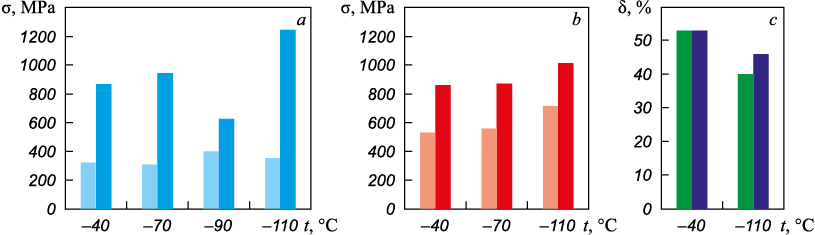
During tensile testing, samples of 12Kh18N10–CC cast steel exhibited a relatively low and nearly constant yield strength throughout the entire range of reduced temperatures (from 360 to 400 MPa, Fig. 1, a), which was lower than that of 05Kh21AG15N8MFL steel (Fig. 1, b). In particular, at –70 °C the yield strength of 12Kh18N10–CC steel was approximately 1.8 times lower than that of the nitrogen-alloyed steel, while at –110 °C the difference reached a factor of 2. With decreasing test temperature, the nitrogen-alloyed steel shows a smooth and moderate increase in strength, accompanied by a slight decrease in plasticity (Fig. 1, b, c). The plasticity of both steels remains high at –40 °C and –110 °C (Fig. 1, c). In contrast to the nitrogen-containing steel, the ultimate tensile strength of 12Kh18N10–CC steel increased markedly with decreasing test temperature and reached 1280 MPa at –110 °C.
Fig. 1. Strength (a, b) and plasticity (c) of 05Kh21AG15N8MFL and 12Kh18N10Т–CC steels |
The difference in the tensile behavior of the investigated steels at low temperatures is clearly illustrated by a comparison of their engineering stress–strain curves (Fig. 2). For the nitrogen-alloyed steel, the curve shapes did not differ from those observed during tensile testing at room temperature (Fig. 2, a). In contrast, for 12Kh18N10–CC steel, the stress–strain curves obtained at –40, –70, and –110 °C exhibited a distinct inflection point after reaching a certain level of uniform elongation. Beyond this point, the samples hardened more intensively, as evidenced by a change in the slope of the curves (Fig. 2, b). At –40 and –70 °C, the difference in strain hardening beyond the inflection point was minimal, whereas at a tensile test temperature of –110 °C, the intensification of strain hardening after the inflection point was substantially more pronounced than at –40 and –70 °C.
Fig. 2. Engineering curves of steels 05Kh21AG15N8MFL (a) and 12Kh18N10–CC (b) |
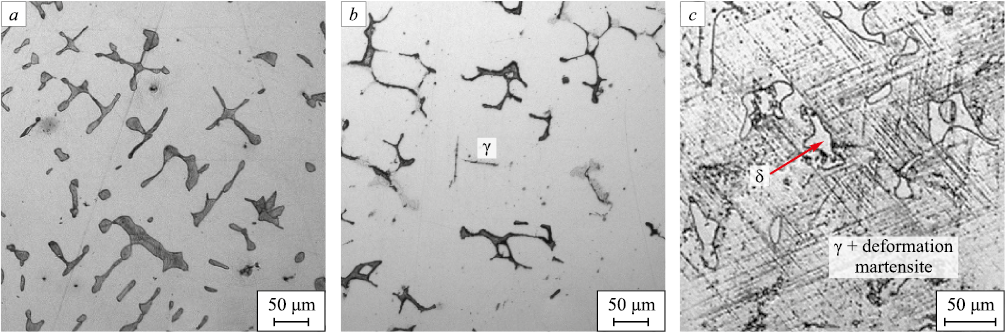
These differences in the shape of the engineering stress–strain curves – specifically, the presence of an inflection point and enhanced strain hardening in 12Kh18N10–CC steel, and the absence of this behavior in the nitrogen-alloyed steel – can be attributed to deformation-induced martensitic transformation occurring in the Cr – Ni steel, but not in the austenite of the Cr – Mn – Ni – Mo – V – N steel. As reported in the literature, this type of transformation is characteristic of metastable austenitic Cr – Ni steels under deformation. Prior to testing, both steels exhibited microstructures typical of conventionally cast and centrifugally cast steels after brief annealing (Fig. 3, a, b), characterized by an austenitic matrix containing δ-ferrite. However, unlike 05Kh21AG15N8MFL steel, the microstructure of 12Kh18N10–CC steel tested at –110 °C displayed features characteristic of this transformation process (Fig. 3, c).
Fig. 3. Structures of steels 05Kh21AG15N8MFL (a) and 12Kh18N10–CC (b) before tensile testing |
Austenite stability in both steels was assessed using Eqs. (1) and (2). For 05Kh21AG15N8MFL steel, the calculated Ms and Md (30/50) values lie far below absolute zero, indicating that martensitic transformation in the austenite is not thermodynamically feasible (Table 2). In contrast, the Ms and Md (30/50) values obtained for 12Kh18N10–CC steel confirm the inevitability of martensite formation in this indicate that martensite formation is expected both during cooling to cryogenic temperatures and during deformation under subzero conditions.
Table 2. Calculated temperatures of the onset of martensitic transformation Мs
|
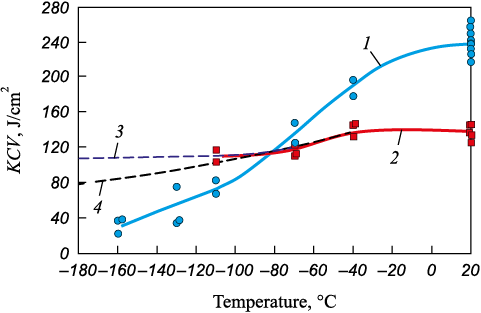
Martensite formation under the combined effects of deformation and cooling may have affected not only the tensile response and strength of 12Kh18N10–CC steel at reduced temperatures, but also the shape of its impact toughness–temperature curve. In the temperature range from –40 to –70 °C, this steel shows a gradual decrease in impact toughness (Fig. 4, curve 3); however, this trend does not continue with further temperature reduction, as evidenced by the results obtained at –110 °C (Fig. 4, curve 4). Based on the results discussed above, this behavior is attributed to deformation-induced martensitic transformation and associated surface-layer hardening in the crack propagation zone..
Fig. 4. Temperature dependence of impact strength of steels 05Kh21AG15N8MFL (1) |
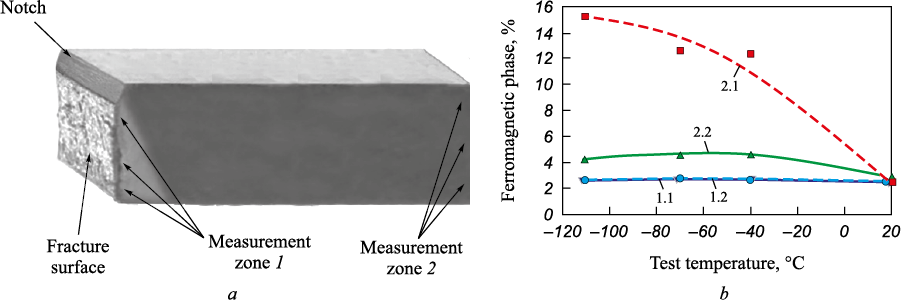
To verify the above conclusion, magnetometric measurements were carried out (Fig. 5, b) on halves of impact samples from both steels tested according to the scheme shown in Fig. 5, a, over a temperature range from +20 to –110 °C. Measurements were performed on the lateral surface of the impact sample halves in zone 1 (the region of plastic deformation beneath the fracture surface) and zone 2 (near the opposite edge of the sample, where no deformation occurred). For the 12Kh18N10–CC steel impact sample tested at +20 °C, measurements of the ferromagnetic phase content in zone 1 beneath the fracture surface and in zone 2 yielded identical results: the ferromagnetic phase content was approximately 3 % (Fig. 5, b). This phase corresponds to residual δ-ferrite, as confirmed by the microstructural observations shown in Fig. 3. With decreasing test temperature, the ferromagnetic phase content in zone 2 increased only slightly – by no more than 1.0 – 1.5 % relative to the initial value (Fig. 5, b). In contrast, for 12Kh18N10–CC steel in zone 1, a pronounced increase in the ferromagnetic phase content was observed as the test temperature decreased; for the sample tested at –110 °C, it reached approximately 12.5 %.
Fig. 5. Magnetometric measurements on the impact samples: |
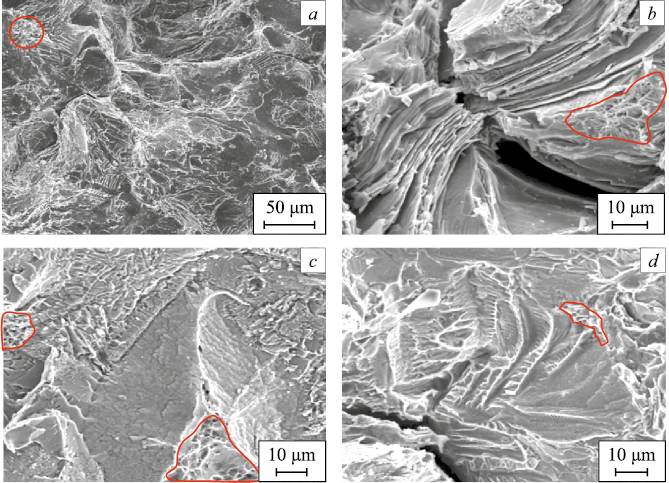
The formation of deformation-induced martensite was therefore expected to affect the fracture morphology of 12Kh18N10–CC steel tested in impact bending at –110 °C (Fig. 6).
Fig. 6. Fracture of the impact sample of cast steel 12Kh18N10–CC, tested at –110 °C: |
Under the combined effects of dynamic loading and low temperature, the fracture surface exhibits not only intragranular cleavage facets (Fig. 6, a) but also clear evidence of martensitic transformation. This transformation results in the formation of brittle lamellar packets in the near-surface layer, as shown in Fig. 6, b – d. As illustrated in Fig. 6, b, for a homogeneous austenitic structure characterized by very large cast austenite grains, the length of martensite plates formed at the initial stage of transformation is governed by the austenite grain size. Large austenite grains therefore promote the formation of coarse martensite, which is more prone to microcrack initiation. In addition, the fraction of regions displaying a ductile dimpled fracture morphology characteristic of austenite is small on the fracture surface (the most pronounced regions are outlined in the images). This observation indicates that deformation-induced martensite formed in the crack opening zone on the fracture surface.
Discussion of the results
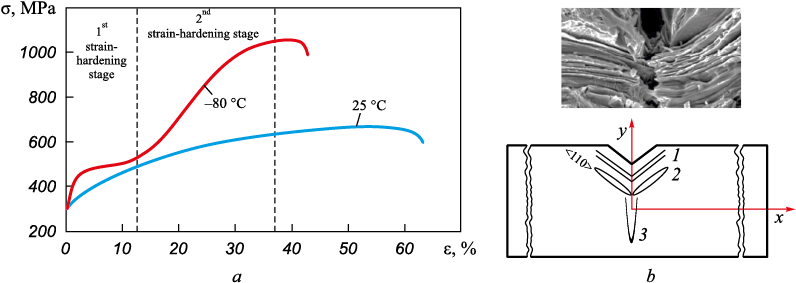
The behavior observed for 12Kh18N10 steel in the cast condition under static deformation and impact bending at reduced temperatures is broadly consistent with that of metastable Cr – Ni steels under comparable conditions. Engineering stress–strain curves similar to those shown in Fig. 2, b have been reported in a number of studies [10; 20; 21] (Fig. 7, a). As the deformation temperature decreases, the curve shape changes from parabolic at room temperature to sigmoidal. After the onset of yielding, a region of low slope or a plateau corresponding to the first stage of strain hardening is observed. Upon reaching the first inflection point, which corresponds to a critical strain, a pronounced increase in strain hardening occurs. This second hardening stage is substantial and is commonly interpreted as strain hardening associated with a phase transformation.
Fig. 7. Aspects of deformation martensite formation: |
Taken together, the detection of a ferromagnetic phase in the near-fracture-surface layer (Fig. 5) and the fracture morphology observed at –110 °C – which is uncharacteristic of fully austenitic steels – provide strong evidence that deformation-induced martensite forms in the deformed layer of 10.5 steel under the combined effects of deformation and low temperature. The formation of deformation-induced martensite in samples tested at –110 °C under both impact bending and tensile loading can account for the following observations:
– impact toughness values higher than would be expected from the smooth trend of the KCV = f (ttest) curve;
– an exceptionally high ultimate tensile strength of 12Kh18N10–CC steel, characteristic of martensitic steels.
Accordingly, both the shape of the engineering stress–strain curves shown in Fig. 2, b and the measured strength characteristics (Fig. 1, a) indicate that, as the deformation temperature decreases, the fraction of deformation-induced martensite increases, leading to a corresponding increase in steel strength.
For the 12Kh18N10–CC steel examined in this study, the threshold (critical) strain was determined to be εcr ≈ 22 % for samples subjected to tensile deformation at –40 and –70 °С. When the deformation temperature was further reduced to –110 °C, εcr decreased to approximately 15 % (Fig. 2, b). This trend is fully consistent with literature data [21 – 23], which demonstrate that decreasing the deformation temperature shifts the first inflection point on the σ – ε curve toward lower strain values.
With respect to impact bending tests, the authors propose that the fracture mechanism of an impact sample undergoing deformation-induced martensitic transformation (Fig. 7, b) [24] correlates with the development of microcracks in the fracture region shown in Fig. 6, b. According to [24], microcrack initiation occurs along the habit planes of martensitic packets and laths, while crack propagation proceeds preferentially along their boundaries. The characteristic dimensions of the microstructural components of a macrocrack correlate with the sizes of martensitic laths and packets. Although the direction of microcrack propagation changes upon crossing packet boundaries, it remains predominantly parallel to the <111> direction of martensite.
Several points should be noted when discussing the mechanisms of deformation-induced martensite formation. After the first inflection point is reached, austenitic steels undergo rapid strain hardening as a result of martensite plate formation within deformation bands, which effectively impedes further dislocation motion [22]. In [8], the deformation behavior of metastable Cr – Ni austenitized steels was examined for two material types:
– 10Kh18N9 steel containing a small amount of δ-ferrite (Type 1);
– 12Kh18N10T steel without δ-ferrite (Type 2).
It was shown that deformation did not induce ε-martensite formation in either case. Instead, austenite transformed according to the following schemes:
– Type 1 steel: γ + δ → γ′ + δ + α′;
– Type 2 steel: γ → γ′ → γ′ + α′.
In situ tensile experiments on 304 and 304L steels conducted in a transmission electron microscope over the temperature range from +25 to –100 °C [25] demonstrated that the austenitic γ phase (FCC) can transform into either ε-martensite (HCP) or α′-martensite (BCC), and that ε-martensite may subsequently transform into α′-martensite. Accordingly, three deformation-induced martensitic transformation mechanisms are currently recognized for metastable steels [26; 27]:
– γ → ε (1);
– γ → ε → α′ (2);
– direct γ → α′ transformation (3).
Transformations involving ε-martensite formation typically occur in materials with lower stacking fault energy (SFE), whereas direct γ → α′ transformation is characteristic of materials with higher SFE [28 – 31]. It has been reported [10] that shear bands may consist of ε-martensite, mechanical twins, dense stacking faults, or twin boundaries. However, with increasing plastic strain, ε-martensite ultimately transforms into α′-martensite, and at high strain levels only α′-martensite is observed in 304-series stainless steels. According to the data summarized in [25], deformation-induced martensite forms only when the SFE lies within the range of 10 – 20 mJ/m2. At SFE values of 20 – 50 mJ/m2, deformation twinning predominates, whereas at SFE ≥ 50 mJ/m2, slip becomes the dominant deformation mechanism.
In light of these considerations, an attempt was made to estimate the SFE of 12Kh18N10–CC steel at –110 °C. The SFE at room temperature was calculated using the empirical relationship proposed in [32]
| SFE = −35 + 6.2Ni + 0.7Cr + 3.2Mn + 9.3Mo. | (3) |
which yields a value of 41.3 mJ/m2 12Kh18N10–CC steel.
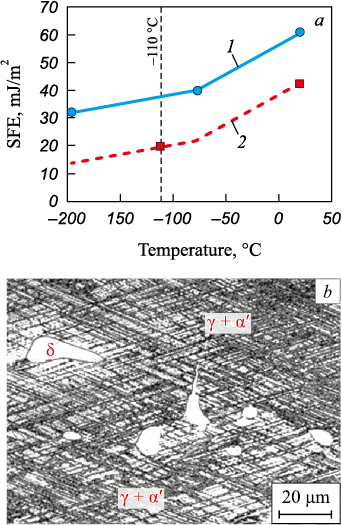
Based on calculated and experimental data reported in [30], which demonstrate the influence of temperature on the SFE of austenitic steels (curve 1 in Fig. 8, a), it was assumed that 12Kh18N10–CC steel exhibits a similar temperature dependence (dashed curve 2 in Fig. 8, a). Under this assumption, an SFE value of approximately 18 mJ/m2 corresponds to a temperature of –110 °C.
Fig. 8. Aspects of deformation martensite formation: |
Despite the approximate nature of this estimation, it is consistent with the experimentally observed formation of deformation-induced martensite in 12Kh18N10–CC steel, since martensitic transformation is expected when the SFE falls within the 10 – 20 mJ/m2 range [26]. As the SFE decreases at lower deformation temperatures, α′-martensite formation becomes energetically more favorable and is initiated at lower strain levels, implying accelerated transformation kinetics compared with higher deformation temperatures [31]. A comparison of the microstructures shown in Figs. 8, b and 3, b further supports the identification of the additional phase formed after deformation at –110 °C as deformation-induced martensite.
In addition to temperature and strain, the deformation rate is another important factor influencing martensite formation. In the present study, tensile tests were conducted at a crosshead speed of 1 mm/min, whereas during impact bending tests the effective deformation rate was significantly higher and may vary from 10–3 to ≥10–5 s–1. It is generally accepted that lower deformation rates favor dislocation motion and martensite formation. However, studies of metastable steels under impact loading remain limited. According to [33], martensite formed under static and dynamic elastic stresses differs in morphology. Under dynamic loading, martensite forms as blocks (packets) of parallel crystals with approximately uniform width, oriented according to the crystallographic direction of the applied stress. It has been reported that deformation-induced martensitic transformation can have a beneficial effect on fracture toughness by altering the fracture mechanism [35]. At the same time, experiments examining the combined effects of low temperature and deformation indicate that the high loading rates associated with impact testing may significantly suppress phase transformations, as observed for 12Kh18N10T steel [12], or reduce the extent of austenite-to-martensite transformation, as reported for 10Kh14AG20 steel [36]. Specifically, it was noted in [12] that under impact loading at low temperatures, 12Kh18N10T steel exhibits more ductile behavior than under static loading. This effect was attributed to sample heating resulting from high-rate deformation. Similarly, in [37], samples of a steel with the composition Fe – 30 wt. % Mn – 9 wt. % Al – 0.65 wt. % – which does not undergo phase transformation – showed an increase in impact toughness with increasing deformation rate, rising from 209.5 J/cm2 at an impact velocity of 7.5 m/s to a 15.5 % higher value at 30 m/s. Low-temperature impact toughness was also investigated in [38] for 07Kh17AG19 steel containing 0.53 % N, confirming the conclusions of [12]. At low loading rates during tensile testing, a γ → ε transformation was observed, whereas at high loading rates during impact testing the steel retained austenite stability. Fractographic and X-ray diffraction analyses revealed no evidence of ε-martensite formation.
In the present study, 12Kh18N10–CC steel was found to exhibit slightly higher impact toughness under low-temperature impact loading than would be expected based on the emerging trend of the KCV = f (tcool ) (Fig. 4). Given that low-temperature deformation-induced martensite was identified on the fracture surface, the retention of a relatively high impact toughness in this cast steel is attributed to the strengthening effect of deformation-induced martensite formed in the near-surface layer ahead of the advancing crack front.
Conclusions
The mechanical properties, microstructure, and phase composition of the 05Kh21AG15N8MFL and 12Kh18N10–CC cast steels were investigated under tensile testing at reduced temperatures. It was established that, in 05Kh21AG15N8MFL steel, the austenitic structure remains stable under static loading at cryogenic temperatures, whereas the austenite of 12Kh18N10–CC steel undergoes a martensitic transformation upon reaching a critical strain during low-temperature deformation. A comparison of the engineering stress–strain (σ – ε) curves with the measured strength characteristics showed that, with decreasing test temperature, the critical strain εcr triggering the onset of martensitic transformation decreases, while the amount of deformation-induced martensite increases.
The tendency toward deformation-induced martensite formation under dynamic impact loading at a cryogenic temperature of –110 °C was also evaluated. In 12Kh18N10–CC steel, deformation-induced martensite forms in the near-surface layer of the fracture surface ahead of the crack front, resulting in strengthening of the steel and contributing to a higher level of impact toughness at this temperature. In contrast, 05Kh21AG15N8MFL steel showed no tendency toward martensite formation on the fracture surface under cryogenic impact testing.
The observed austenite stability of 05Kh21AG15N8MFL steel and the metastability of austenite in 12Kh18N10–CC steel with respect to deformation-induced martensitic transformation under both static and impact loading are consistent with the calculated values of the martensite start temperature Мs and Мd (30/50) for both steels, as well as with the calculated stacking fault energy of 12Kh18N10–CC steel.
1. Kostina M.V., Polomoshnov P.Yu., Blinov V.M., Muradyan S.O., Kostina V.S. Cold resistance of new casting Cr – Mn – Ni – Mo – N steel with 0.5 % of N. Part. 1. Izvestiya. Ferrous Metallurgy. 2019;62(11):894–906. (In Russ.). https://doi.org/10.17073/0368-0797-2019-11-894-906
2. Kostina M.V., Kudryashov A.E., Rigina L.G., Muradyan S.O., Antonova O.S., Kostina V.S. Cold resistance of new cast Cr – Mn – Ni – Mo – N steel. Part 2. Studying non-metallic inclusion particles under static and impact loading at low temperatures. Izvestiya. Ferrous Metallurgy. 2022;65(3):190–199. (In Russ.). https://doi.org/10.17073/0368-0797-2022-3-190-199
3. Kostina M.V., Muradyan S.O., Rigina L.G., Kostina V.S., Kudryashov A.E. Cold resistance of high-strength corrosion-resistant Cr – Mn – Ni – Mo austenitic steel alloyed with 0.5 % nitrogen in cast and deformed versions. Valve Industry. 2022;(1(136)):36–41. (In Russ.).
4. Olson G.B., Cohen M. A general mechanism of martensitic nucleation: Part II. FCC → BCC and other martensitic transformations. Metallurgical and Materials Transactions A. 1976;7:1905–1914. https://doi.org/10.1007/BF02659823
5. Murr L.E., Staudhammer K.P., Hecker S.S. Effects of strain state and strain rate on deformation-induced transformation in 304 stainless steel: Part II. Microstructural study. Metallurgical and Materials Transactions A. 1982;13(4):627–635. https://doi.org/10.1007/BF02644428
6. Filippov M.A., Litvinov V.S., Nemirovskii Yu.R. Steels with Metastable Austenite. Moscow: Metallurgiya; 1988:255. (In Russ.).
7. Datta K., Delhez R., Bronsveld P.M., Beyer J., Geijselaers H.J.M., Post J. A low-temperature study to examine the role of ε-martensite during strain-induced transformations in metastable austenitic stainless steels. Acta Materialia. 2009;57(11):3321–3326. https://doi.org/10.1016/j.actamat.2009.03.039
8. Snezhnoi G.V., Snezhnoi V.L., Ol’shanetskii V.E. On the features of the formation and transformation of ε-martensite during plastic deformation of austenitic chromium-nickel steels. Novi materiali i tekhnologii v metallurgii ta mashinobuduvanni. (In Russ.).
9. Okayasu M., Fukui H., Ohfuji H., Shiraishi T. Strain-induced martensite formation in austenitic stainless steel. Journal of Materials Science. 2013;48(18):6157–6166. https://doi.org/10.1007/s10853-013-7412-8
10. De A.K., Speer J.G., Matlock D.K., Murdock D.C., Mataya M.C., Comstock R.J. Deformation-induced phase transformation and strain hardening in type 304 austenitic stainless steel. Metallurgical and Materials Transactions A. 2006;37(6):1875–1886. https://doi.org/10.1007/s11661-006-0130-y
11. Bubnov V.A. A mechanism of transition of austenite to martensite during cold plastic deformation of austenitic steels. BMSTU Journal of Mechanical Engineering. 2018;(11(704)):14–19. https://doi.org/10.18698/0536-1044-2018-11-14-19
12. Vologzhanina S.A., Igolkin A.F., Petkova A. Study of effect of low temperature and deformation on properties of austenitic steel 12Kh18N10T. Scientific and technical statements of SPbPU. Natural and engineering sciences. 2019;25(4): 83–93. (In Russ.). https://doi.org/10.18721/JEST.25407
13. Li Y., Yu D., Li B., Chen X. Martensitic transformation of an austenitic stainless steel under non-proportional cyclic loading. International Journal of Fatigue. 2019;124:338–347. https://doi.org/10.1016/j.ijfatigue.2019.03.020
14. Hallberg H., Ristinmaa M. Modeling of crack behavior in austenitic steel influenced by martensitic phase transformation. Key Engineering Materials. 2010;452–453:637–640. https://doi.org/10.4028/www.scientific.net/KEM.452-453.637
15. Hallberg H., Banks-Sills L., Ristinmaa M. Crack tip transformation zones in austenitic stainless steel. Engineering Fracture Mechanics. 2012;79:266–280. https://doi.org/10.1016/j.engfracmech.2011.11.004
16. Xiong F., Liu Y. Effect of stress-induced martensitic transformation on the crack tip stress-intensity factor in Ni–Mn–Ga shape memory alloy. Acta Materialia. 2007;55(16): 5621–5629. https://doi.org/10.1016/j.actamat.2007.06.031
17. Oglezneva S.A. Materials Science and Technology of Modern and Advanced Materials: Textbook. Perm: Perm National Research Polytechnic University; 2012:307. (In Russ.).
18. Gladman T., Holmes B., Pickering F.B. Work hardening of low carbon steels. The Journal of the Iron and Steel Institute. 1970;208(2):172–183.
19. Gladman T., Hammond J., Marsh F.W. Austenitic stainless steels for cold forming. Sheet Metal Industries. 1974;(5): 219–239.
20. Lee K.J., Chun M.S., Kim M.H., Lee J.M. A new constitutive model of austenitic stain-less steel for cryogenic applications. Computational Materials Science. 2009;46(4):1152–1162. https://doi.org/10.1016/j.commatsci.2009.06.003
21. Alsultan S., Quitzke C., Cheng Z., Krüger L., Volkova O., Wendler M. Strain-induced martensite formation and mechanical properties of Fe–19Cr–4Ni–3Mn–0.15N–0.15C austenitic stainless steel at cryogenic temperature. Steel Research International. 2021;92(6):2000611. https://doi.org/10.1002/srin.202000611
22. Wendler M., Hauser M., Motylenko M., Mola J., Krüger L., Volkova O. Ultra high strength stainless steels obtained by quenching‐deformation‐partitioning (QDP) processing. Advanced Engineering Materials. 2018;21(5):1800571. https://doi.org/10.1002/adem.201800571
23. Cios G., Tokarski T., Żywczak A., Dziurka R., Stępień M., Gondek Ł., Marciszko M., Pawłowski B., Wieczerzak K., Bała P. The investigation of strain-induced martensite reverse transformation in AISI 304 austenitic stainless steel. Metallurgical and Materials Transactions A. 2017;48:4999–5008. https://doi.org/10.1007/s11661-017-4228-1
24. Eterashvili T.V., Kutelia E.R., Dzigrashvili T., Vardosanidze M. SEM study of high-chromium martensitic steel LCF fracture. Key Engineering Materials. 2011;465:298–301. https://doi.org/10.4028/www.scientific.net/KEM.465.298
25. Liu J. Deformation Induced Martensitic Transformation In 304 Stainless Steels. (Master’s thesis). University of South Carolina. Retrieved from https://scholarcommons.sc.edu/etd/3804. 2016.
26. Fan Z., Gong X., Li B., Yu P., Liu X., Zhou H., He Y., Zheng W. The formation of strain-induced martensite and its influence on hydrogen compatibility of metastable austenitic stainless steels: A state-of knowledge review. Journal of Science: Advanced Materials and Devices. 2025; 10(1):100842. https://doi.org/10.1016/j.jsamd.2024.100842
27. Sadeghpour S., Javaheri V., Kermanpur A., Kömi J. Insight to the influence of Ti addition on the strain-induced martensitic transformation in a high (about 7 wt.%) Mn stainless steel. Metals. 2020;10(5):568. https://doi.org/10.3390/met10050568
28. Pickering F.B. Physical Metallurgy and the Design of Steels. Applied Science Publishers; 1978:275.
29. Olson G.B., Cohen M. Kinetics of strain-induced martensitic nucleation. Metallurgical Transactions A. 1975;6(4):791–795. https://doi.org/10.1007/BF02672301
30. Spencer K., Véron M., Yu-Zhang K., Embury J.D. The strain induced martensite transformation in austenitic stainless steels: Part 1 – Influence of temperature and strain history. Materials Science and Technology. 2009;25(1):7–17. https://doi.org/10.1179/174328408X293603
31. Curtze S., Kuokkala V.-T., Oikari A., Talonen J., Hänninen H. Thermodynamic modeling of the stacking fault energy of austenitic steels. Acta Materialia. 2011;59(3):1068–1076. https://doi.org/10.1016/j.actamat.2010.10.037
32. Soleimani M., Kalhor A., Mirzadeh H. Transformation-induced plasticity (TRIP) in advanced steels: A review. Materials Science and Engineering: A. 2020;795:140023. https://doi.org/10.1016/j.msea.2020.140023
33. Bondarevskaya N.A., Vovk Ya.N., Oshkaderov S.P. Features of martensite formation under elastic deformation conditions. In: “Thermomechanical Processing of Metal Materials” – Bernstein Readings dedicated to the 85th Anniversary of prof. Bernstein M.L.: Proceedings of the Sci. and Pract. Conf. (October 26–27, 2004). Moscow: MISiS; 2004:12. (In Russ.).
34. Qi Z., Chen G., Hu H., Zheng W., Wan X., Xue Z., Xu G. Temperature dependence of the deformation behavior and mechanical properties of a Fe–Mn–Al–C low-density steel for cryogenic application. Journal of Materials Research and Technology. 2024;33:3418–3426. https://doi.org/10.1016/j.jmrt.2024.10.063
35. Qiu H., Wang L.N., Qi J.G., Zuo H., Hiraoka K. Enhancement of fracture toughness of high-strength Cr–Ni weld metals by strain-induced martensite transformation. Materials Science and Engineering: A. 2013;579:71–76. https://doi.org/10.1016/j.msea.2013.05.012
36. Vologzhanina S.A., Igolkin A.F., Peregudov A.A., Baranov I.V., Martyushev N.V. Effect of the deformation degree at low temperatures on the phase transformations and properties of metastable austenitic steels. Metal Working and Material Science. 2022;24(1):73–86. (In Russ.). https://doi.org/10.17212/1994-6309-2022-24.1-73-86
37. Śmiglewicz A., Jabłońska M.B. The effect of strain rate on the impact strength of the high-Mn steel. Archives of Metallurgy and Materials. Metalurgija. 2015;54(4):631–634. https://doi.org/10.1515/amm-2015-0176
38. Narkevich N., Vlasov I., Volochaev M., Gomorova Y., Mironov Y., Panin S., Berto F., Maksimov P., Deryugin E. Low-temperature deformation and fracture of Cr-Mn-N stainless steel: Tensile and impact bending tests. Metals. 2023;13(1):95. https://doi.org/10.3390/met13010095
Mariya V. Kostina, Dr. Sci. (Eng.), Assist. Prof., Leading Researcher, Head of the Laboratory of Physicochemistry and Mechanics of Metallic Materials, Baikov Institute of Metallurgy and Materials Science of the Russian Academy of Sciences; Prof., Moscow Aviation Institute (National Research University)
49 Leninskii Ave., Moscow 119334, Russian Federation
4 Volokolamskoe Route, Moscow 125993, Russian Federation
Aleksandr E. Kudryashov, Junior Researcher, Baikov Institute of Metallurgy and Materials Science of the Russian Academy of Sciences; Postgraduate, Moscow Aviation Institute (National Research University)
49 Leninskii Ave., Moscow 119334, Russian Federation
4 Volokolamskoe Route, Moscow 125993, Russian Federation
Lyudmila G. Rigina, Cand. Sci. (Eng.), Leading Researcher, Baikov Institute of Metallurgy and Materials Science of the Russian Academy of Sciences; Leading Researcher, JSC Russian State Research Center “CNIITMASH”
49 Leninskii Ave., Moscow 119334, Russian Federation
4 Sharikopodshipnikovskaya Str., Moscow 115088, Russian Federation
Valentina S. Kostina, Cand. Sci. (Eng.), Researcher of the Laboratory “Physicochemistry and Mechanics of Metallic Materials”
49 Leninskii Ave., Moscow 119334, Russian Federation
Inga E. Permyakova, Dr. Sci. (Phys.-Math.), Leading Researcher of the Laboratory of Physicochemistry and Mechanics of Metallic Materials
49 Leninskii Ave., Moscow 119334, Russian Federation
Kostina M.V., Kudryashov A.E., Rigina L.G., Kostina V.S., Permyakova I.E. Cold resistance of new cast Cr – Mn – Ni – Mo – N steel. Part 3. Stability of austenite during cooling and deformation. Izvestiya. Ferrous Metallurgy. 2026;69(1):39-50. https://doi.org/10.17073/0368-0797-2026-1-39-50
 Email this article (Login required)
Email the author (Login required)
Email this article (Login required)
Email the author (Login required) Publishing House of National University of Science and Technology "MISIS"
4, Leninskii prospekt, Moscow, 119991, Russia
Phone: +7 (495) 638-44-11, +7 (495) 784-58-66
E-mail: fermet.misis@mail.ru
 ,
,  yield strength,
  ,
,  tensile strength;
 ), 12Kh18N10–CC (
 )
)