Contents
Scroll to:
https://doi.org/10.17073/0368-0797-2026-1-23-30
Scroll to:
Low-alloyed low-carbon steels are widely used in the manufacture of objects for various purposes due to the excellent combination of their service and technological properties. The desire of manufacturers to use material resources in the most economical way determines the relevance of searching for optimal chemical compositions and corresponding technological modes. The article presents the results of a study of hot-rolled low-carbon steels microalloyed with Nb, Ti, V and Mo in various combinations and concentrations produced in laboratory conditions. Optical and electron microscopy methods were used to study the structural state. An analysis was made of the influence of the final stage of thermo-deformation treatment and the microalloying system on the structural state, including formation of nanosized phase precipitates of different types, implementation of strengthening mechanisms and, accordingly, the mechanical properties of the rolled products. Different combinations of the values of temperature of hot rolling end, the cooling rate to the coiling temperature, and the coiling temperature with the microalloying system lead to implementation of different strengthening mechanisms. At high cooling rates in steels with molybdenum, the microstructure of bainitic ferrite is formed, but interphase precipitates do not have time to form. For steels microalloyed with vanadium, these rates do not prevent the precipitation of carbides by the interphase mechanism, since due to the small size vanadium atom has a higher diffusion mobility compared to niobium. The amount of interphase precipitates in Nb – Ti microalloyed steels is less than in steels with molybdenum. The amount of precipitates formed in austenite is also greater in the case of complex Nb – Ti – V – Mo microalloying. Elevated temperatures of the rolling end and coiling contribute to implementation of the precipitation hardening mechanism due to interphase precipitates. At too low values of these temperatures, the diffusion mobility of atoms during cooling of the wound roll is low, which limits the formation of nanosized precipitates in an amount sufficient for effective precipitation hardening.
Dagman A.I., Koldaev A.V., Naumenko V.V., Arutyunyan N.A., Matrosov M.Yu., D’yakonov D.L. Effect of microalloying system and thermo-deformation treatment parameters on the strength of low-carbon steels. Izvestiya. Ferrous Metallurgy. 2026;69(1):23-30. https://doi.org/10.17073/0368-0797-2026-1-23-30
Introduction
Low-alloyed low-carbon steels are widely used in the manufacture of products for various applications. Their widespread use is attributed to a favorable combination of high strength, ductility, formability, fatigue resistance, corrosion resistance, and advantageous technological properties [1 – 3]. Manufacturers of modern automotive sheet steels of this class aim to achieve the highest possible strength while ensuring efficient use of energy and material resources. Accordingly, current research efforts are focused on identifying optimal concentration ranges of alloying and microalloying elements, as well as corresponding technological modes [4 – 6]. Despite the progress achieved, the full potential of these steels has not yet been fully realized. For example, the production of hot-rolled steels of grades S315MC–S700MC for mechanical engineering applications is carried out in accordance with the requirements of the European standard EN 10149–2:1995, which specifies only the upper limits for elements such as carbon, manganese, silicon, niobium, titanium, and vanadium. This drives the development of cost-effective alloying and microalloying systems and necessitates systematic investigation of the regularities governing the formation of the structural state and, consequently, the level of mechanical properties of steel as a function of alloying and microalloying element content and the parameters of thermo-deformation treatment.
Enhancement of the strength characteristics of the steels under consideration is achieved through the combined action of several strengthening mechanisms. The primary mechanisms – grain refinement and precipitation hardening – are controlled by precipitates of excess phases formed by microalloying elements. Among these, titanium, vanadium, and niobium are the most widely used, forming carbides, nitrides, and carbonitrides in steel [7 – 12]. However, the contribution of these precipitates to strengthening differs, as it depends on the temperature intervals over which they form [13]. For instance, titanium nitride does not dissolve in austenite at reheating temperatures prior to rolling and therefore acts as a phase that inhibits austenite grain growth during heating. NbC and NbN compounds can precipitate in austenite during hot deformation, contributing to grain refinement [3; 7]; however, their formation is kinetically retarded [14]. In contrast, vanadium carbide and vanadium nitride exhibit the highest solubility. Strengthening via the precipitation hardening mechanism is associated with precipitates formed during or after the γ → α phase transformation. These precipitates are conventionally classified as interphase and ferritic precipitates, respectively. Interphase precipitates are arranged in rows, whereas precipitates formed in ferrite are distributed in a non-ordered manner [9; 12; 13]. The extent of strengthening is governed by both the number of precipitates and their size [15].
Recent studies have demonstrated the significant role of molybdenum in achieving high strength levels [3; 16 – 20]. This effect is attributed to suppression of proeutectoid ferrite formation and the development of a bainitic structure [18], as well as to the precipitation of Mo2C carbide and (M, Mo)(C, N) carbonitride, where M denotes a microalloying element [16].
Thus, various temperature intervals and kinetic features of nitride, carbonitride, and carbide formation of microalloying elements determine their different roles in strengthening mechanisms. The aim of the present study was to identify the regularities governing the influence of thermo-deformation treatment parameters on the level of mechanical properties for various combinations of microalloying elements.
Materials and methods
Three series of hot-rolled low-carbon steels produced under laboratory conditions and microalloyed with Nb, Ti, V, and Mo in various combinations and concentrations were investigated. The first series included the Nb – Ti, Nb – Ti – Mo, and Nb – Ti – V – Mo microalloying systems; the second series comprised Ti – Mo, V – Mo, and Nb – V – Mo; and the third series involved V – Mo, Nb – V, Nb – V – Mo, Ti – V – Mo, Nb – Ti – Mo, and Nb – Ti – V – Mo systems. The concentration ranges of the main elements are listed in Table 1. It should be noted that the manganese concentration and the total content of microalloying elements (Nb + Ti + V) were highest in the steels of the first series.
Table 1. Composition of the main elements of the studied steels, wt. %
| ||||||||||||||||||||||||||||||||||||||||||||||
Steel melting was carried out in a vacuum induction furnace, while hot rolling was performed on a DUO-300 laboratory rolling mill using three technological modes of the final stage of thermo-deformation treatment (Table 2). Prior to rolling, the billets were reheated to 1250 °C and held at this temperature for at least 1 h.
Table 2. Main parameters of the final stage of thermo-deformation treatment
|
Hot rolling of the steels in Series 1 was conducted using the highest temperatures of the hot rolling end (Тend ) and coiling (Тcoil ). All strips were cooled in an air flow to Тcoil subsequently subjected to slow furnace cooling with the furnace preheated to Тcoil , thereby simulating the cooling of a strip coiled into a roll. For Series 2 and Series 3, both the hot rolling end and coiling temperatures were lower. Cooling to Тcoil was slower in Series 2 and faster in Series 3 compared with Series 1. Variations in the technological modes of the final stage of thermo-deformation treatment led to the activation of different mechanisms governing the formation of the structural state and, consequently, the level of mechanical properties.
Mechanical properties were determined in accordance with GOST 1497 using a HECKERT FP-100/1 tensile testing machine. Metallographic analysis was performed using an Axiovert 40MAT Carl Zeiss optical microscope. Transmission electron microscopy (TEM) studies were carried out on a JEOL JEM-200CX microscope at magnifications ranging from 15,000 to 30,000 and accelerating voltages of 160 and 120 kV.
Results and discussion
The ranges of mechanical property values are presented in Table 2. It can be seen that the strength characteristics (σ0.2 and σu ) of the obtained rolled products vary over a fairly wide range. For the steels of Series 3, this range is considerably broader, which is attributed to a wider range of carbon and microalloying element concentrations (Table 1), as well as to differences in cooling rates. Within each series, an increase in the concentrations of the microalloying elements Nb, Ti, V, and Mo is accompanied by an increase in σ0.2 and σu . For the steels of Series 1, the highest strength values were obtained for complex Nb – Ti – Mo microalloying with a high titanium content (0.17 wt. %), at Тend = 900 °C and Тcoil = 650 °C. For Series 2, the maximum strength characteristics were achieved for the Ti – Mo system with the highest molybdenum content (0.24 wt. %), at Тend = 860 – 870 °C and Тcoil = 570 – 590 °C. For Series 3, the highest values correspond to the Nb – V – Mo system with simultaneously high carbon (0.083 wt. %) and molybdenum (0.165 wt. %) contents, at Тend = 850 – 870 °C and Тcoil = 510 – 530 °C. No correlation was observed between the elongation values and the strength characteristics.
Metallographic examination revealed that all samples of Series 1 and Series 2 cooled at lower rates exhibited similar ferritic microstructures, whereas the microstructure of Series 3 samples cooled at higher rates consisted predominantly of bainitic ferrite. An exception was the rolled products of molybdenum-free steels, which contained a relatively high carbon content and exhibited a two-phase ferrite–bainite microstructure.
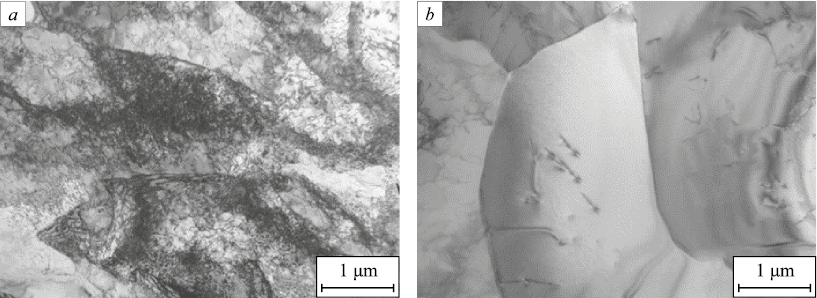
More detailed TEM investigations made it possible to identify characteristic microstructural features. In the rolled products of Series 1 and Series 2, the metallic matrix consisted of ferrite of two morphological types: block ferrite (occasionally observed as “acicular” ferrite) and polygonal ferrite (Fig. 1). In some steels, cementite precipitates with sizes not exceeding several micrometers were observed along grain boundaries.
Fig. 1. Typical image of ferrite in rolled steels of series 1 and 2 of two morphological types: |
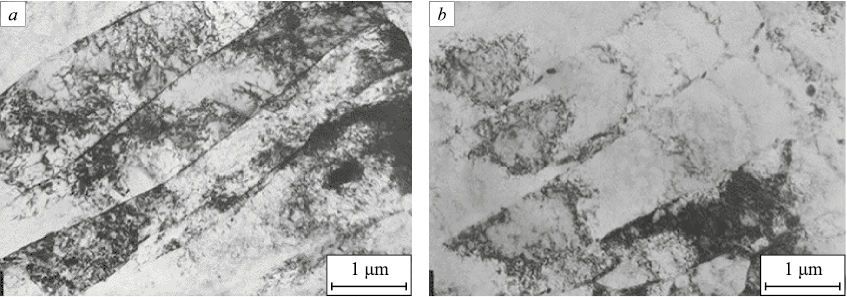
Most rolled products of Series 3 exhibited a microstructure predominantly composed of bainitic ferrite (Fig. 2, a). The carbon-containing constituent was low-carbon bainite (Fig. 2, b); in some cases, small amounts of high-carbon bainite and cementite were also present. In molybdenum-free steels, the matrix consisted of a combination of polygonal and bainitic ferrite, while the carbon-containing phase – whose fraction was higher due to the increased carbon content – comprised bainite and degenerate pearlite. The predominance of bainitic ferrite in the microstructure of molybdenum-containing steels is most likely associated with the ability of molybdenum to promote bainitic structure formation [18].
Fig. 2. Typical structural components of rolled steels of series 3 containing molybdenum: |
Submicron carbonitride precipitates were detected in most samples. Their number was limited; typical particle sizes were approximately 100 – 200 nm, although individual finer and coarser particles (up to ~300 nm) were also observed.
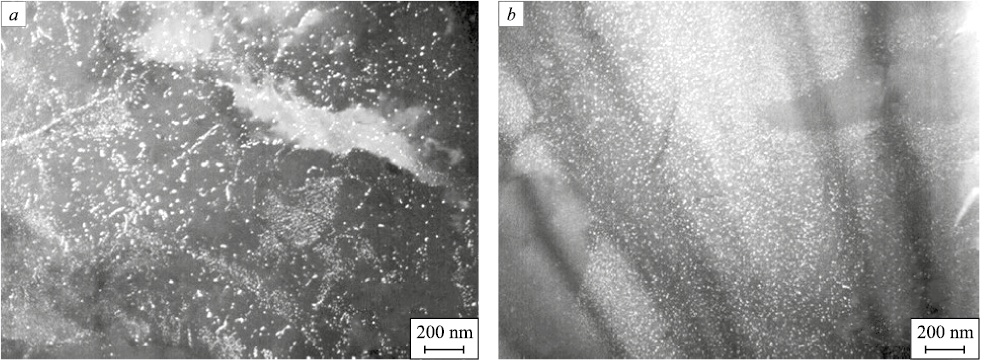
Nanosized carbide and carbonitride precipitates were most representative in the steels of Series 1 and belonged to two types: those formed in austenite (hereinafter referred to as austenitic precipitates) and interphase precipitates. Mixed-type precipitates were also observed, formed by the interphase mechanism but subsequently coarsened in ferrite. No ferritic precipitates were detected. Austenitic precipitates exhibited an elongated morphology, with lengths up to ~10 nm (in some cases up to ~15 nm) and widths not exceeding 3 – 4 nm (Fig. 3, a). Nanosized interphase and mixed-type precipitates were systematically present both in grains/blocks containing austenitic precipitates (Fig. 3, a) and in those where such precipitates were absent (Fig. 3, b). In most regions, the size of these precipitates did not exceed 3 – 4 nm; only rarely were areas observed where interphase precipitates reached sizes of 5 – 6 nm. According to [7], the presence of niobium in steel promotes the formation of nanosized precipitates in austenite and via the interphase mechanism. However, despite the maximum niobium concentration (0.11 wt. %) in the Nb – Ti steel, the number of such precipitates was relatively small compared with steels additionally containing molybdenum, which is consistent with reported data on the favorable effect of molybdenum on carbide nucleation [3; 18]. The highest number of precipitates was observed in steels with the complex Nb – Ti – Mo – V microalloying system and maximum component concentrations.
Fig. 3. Typical images of austenite (a) and interphase (a, b) precipitates. |
In contrast to the steels of Series 1 and Series 2, the rolled products of Series 3 contained fewer nanosized precipitates, and neither austenitic nor interphase precipitates were detected. Only nanosized precipitates formed in ferrite were present, with sizes below 2 nm and, in some cases, up to 3 nm. An exception was the rolled product of the V – Mo steel with the highest vanadium content. In this steel, a high number density of nanosized interphase and mixed-type carbonitride precipitates with sizes of 2 – 5 nm was observed within ferrite grains, whereas larger carbonitride precipitates, up to 10 – 12 nm in size, were detected along grain boundaries. Ferritic precipitates were scarce.
Apparently, at high cooling rates after hot deformation completed at low temperatures, the γ → α phase transformation proceeds too rapidly, while the diffusion mobility of microalloying elements and carbon is reduced. As a result, precipitate formation at the moving phase boundary does not have sufficient time to occur, and nanosized carbide precipitates form in ferrite instead. At the same time, vanadium exhibits a higher tendency toward interphase carbide precipitation because, owing to its smaller atomic size compared with niobium, it possesses higher diffusion mobility. This enables precipitation to occur even at higher γ → α transformation rates [21]. Consequently, despite the high cooling rate, a large number of interphase and mixed-type precipitates are observed in vanadium-containing steels.
For the steels of this series, the dominant factor governing strength is the formation of a bainitic ferrite microstructure with a high dislocation density, resulting from the high cooling rate. The maximum tensile strength (737 MPa) and yield strength (678 MPa) are attributed to the simultaneously high contents of carbon and molybdenum in the steel.
Thus, the strengthening mechanism operative in this series of rolled products differs from that in the previous two series, in which precipitation hardening played a substantial role.
Conclusions
The application of different technological modes at the final stage of thermo-deformation treatment, in combination with the microalloying system, leads to the activation of different strengthening mechanisms.
For the steels of Series 1, the highest strength characteristics were achieved through complex Nb – Ti – Mo microalloying with a high titanium content (0.17 wt. %). In Series 2, maximum strength was obtained for the Ti – Mo system with the highest molybdenum content (0.24 wt. %), whereas in Series 3 the highest values corresponded to the Nb – V – Mo system with simultaneously high carbon (0.083 wt. %) and molybdenum (0.165 wt. %) contents.
Higher cooling rates after hot rolling in molybdenum-containing steels promote the formation of a bainitic ferrite microstructure with a significantly higher dislocation density and, consequently, enhanced strength. However, under these conditions, the γ → α phase transformation proceeds too rapidly for interphase precipitation to develop, and nanosized precipitates therefore form predominantly in ferrite.
Elevated Тend and Тcoil temperatures favor the attainment of high strength through precipitation hardening via the interphase precipitation mechanism. The number of austenitic carbide and carbonitride precipitates is higher in steels with complex Nb – Ti – V – Mo microalloying. Conversely, excessively low Тend and Тcoil values reduce the diffusion mobility of microalloying elements and carbon during cooling of the coiled strip, thereby limiting the formation of nanosized precipitates required for effective precipitation hardening.
1. Kvackaj T., Bidulská J., Bidulský R. Overview of HSS steel grades development and study of reheating condition effects on austenite grain size changes. Materials. 2021;14(8):1988. https://doi.org/10.3390/ma14081988
2. Belato Rosado D., De Waele W., Vanderschueren D., Hertelé S. Latest developments in mechanical properties and metallurgical features of high strength line pipe steels. International Journal of Sustainable Construction and Design. 2013;4(1):1–10. https://doi.org/10.21825/scad.v4i1.742
3. Zaitsev A., Arutyunyan N. Low-carbon Ti-Mo microalloyed hot rolled steels: Special features of the formation of the structural state and mechanical properties. Metals. 2021;11(10):1584. https://doi.org/10.3390/met11101584
4. Baker T.N. Titanium microalloyed steels. Ironmaking & Steelmaking. 2019;46(1):1–55. https://doi.org/10.1080/03019233.2018.1446496
5. Dagman A.I., Koldaev A.V., Kazarin A.Yu., Arutyunyan N.A. Assessment of the prospects for replacing niobium with vanadium in high-strength microalloyed steels. Problemy chernoi metallurgii i materialovedeniya. 2024;(2): 82–90. (In Russ.).
6. Almatani R.A., DeArdo A.J. Rational alloy design of niobium-bearing HSLA steels. Metals. 2020;10(3):413. https://doi.org/10.3390/met10030413
7. DeArdo A.J. Niobium in modern steels. International Materials Review. 2003;48(6):371–402. https://doi.org/10.1179/095066003225008833
8. Garcia C.I., Hua M., Cho K., DeArdo A.J. On the strength of microalloyed steels. An interpretive review. Materials Science and Technology. 2009;25(9):1074–1082. https://doi.org/10.1179/174328409X455233
9. Zhang Y., Miyamoto G., Furuhara T. Enhanced hardening by multiple microalloying in low carbon ferritic steels with interphase precipitation. Scripta Materialia. 2022;212:114558. https://doi.org/10.1016/j.scriptamat.2022.114558
10. Cai Y., Wei R., Jin D., Cheng L., Wan X., Wu K. Complex precipitation behavior and mechanism of NbC during ferrite transformation in a HSLA steel. Metallurgical and Materials Transactions A. 2024;55:3208–3213. https://doi.org/10.1007/s11661-024-07515-4
11. Salahshoor M., Bardelcik A., Zhou T.T., Cathcart C. The effect of low temperature and strain rate on the mechanical behavior of precipitation-strengthened HSLA steels alloyed with Ti and Nb. JOM. 2025;77:3561–3575. https://doi.org/10.1007/s11837-025-07277-3
12. Zaitsev A.I., Rodionova I.G., Arutyunyan N.A., Dunaev S.F. Investigation of regularities of phase precipitation formation, structural state and properties of microalloyed low-carbon steels of ferritic class. Metallurg. 2020;(8):21–27. (In Russ.).
13. Lagneborg R., Siwecki T., Zajac S., Hutchinson B. The role of vanadium in microalloyed steels. Scandinavian Journal of Metallurgy. 1999;28:186–241.
14. Koldaev A.V., D’yakonov D.L., Zaitsev A.I., Arutyunyan N.A. Kinetics of the formation of nanosize niobium carbonitride precipitates in low-alloy structural steels. Metallurgist. 2017;60:1032–1037. https://doi.org/10.1007/s11015-017-0404-1
15. Gladman T. Precipitation hardening in metals. Materials Science and Technology. 1999;15(1):30–36. https://doi.org/10.1179/026708399773002782
16. Zhang K., Wang H., Sun X.-J., Sui F.-L., Li Z.-D., Pu E.-X., Zhu Z.-H., Huang Z.-Y., Pan H.-B., Yong Q.-L. Precipitation behavior and microstructural evolution of ferritic Ti–V–Mo complex microalloyed steel. Acta Metallurgica Sinica (English Letters). 2018;31:997–1005. https://doi.org/10.1007/s40195-018-0726-4
17. Zhang K., Li Z., Wang Z., Sun X., Yong Q. Precipitation behavior and mechanical properties of hot-rolled high strength Ti–Mo-bearing ferritic sheet steel: The great potential of nanometer-sized (Ti, Mo)C carbide. Journal of Materials Research. 2016;31:1254–1263. https://doi.org/10.1557/jmr.2016.154
18. Bu F.Z., Wang X.M., Yang S.W., Shang C.J., Misra R.D.K. Contribution of interphase precipitation on yield strength in thermomechanically simulated Ti–Nb and Ti–Nb–Mo microalloyed steels. Materials Science and Engineering: A. 2014; 620:22–29. https://doi.org/10.1016/j.msea.2014.09.111
19. Chen C.Y., Chen C.C., Yang J.R. Microstructure characterization of nanometer carbides heterogeneous precipitation in Ti–Nb and Ti–Nb–Mo steel. Materials Characterization. 2014; 88:69–79. https://doi.org/10.1016/j.matchar.2013.11.016
20. Park D.-B., Huh M.-Y., Shim J.-H., Suh J.-Y., Lee K-H., Jung W.-S. Strengthening mechanism of hot rolled Ti and Nb microalloyed HSLA steels containing Mo and W with various coiling temperature. Materials Science and Engineering: A. 2013;560:528–534. https://doi.org/10.1016/j.msea.2012.09.098
21. Oono N., Nitta H., Iijima Y. Diffusion of niobium in α-iron. Materials Transactions. 2003;44(10):2078–2083. https://doi.org/10.2320/matertrans.44.2078
Aleksei I. Dagman, Cand. Sci. (Eng.), Head of the Expert Direction of the Directorate of Development of New Process Technologies
2 Metallurgov Sqr., Lipetsk 398040, Russian Federation
Anton V. Koldaev, Cand. Sci. (Phys.–Math.), Director of the Scientific Center for Physico-Chemical Foundations and Technologies of Metallurgy
23/9 Radio Str., Moscow 105005, Russian Federation
Vitalii V. Naumenko, Cand. Sci. (Eng.), Head of the Program of the Directorate of Development of New Process Technologies
2 Metallurgov Sqr., Lipetsk 398040, Russian Federation
Nataliya A. Arutyunyan, Cand. Sci. (Phys.–Math.), Senior Researcher, I.P. Bardin Central Research Institute of Ferrous Metallurgy; Research Associate, M.V. Lomonosov Moscow State University
23/9 Radio Str., Moscow 105005, Russian Federation
1 Leninskie Gory Str., Moscow 119991, Russian Federation
Maksim Yu. Matrosov, Cand. Sci. (Eng.), Deputy Director of the Scientific Center for Quality Steel
23/9 Radio Str., Moscow 105005, Russian Federation
Dmitrii L. D’yakonov, Senior Researcher
23/9 Radio Str., Moscow 105005, Russian Federation
Dagman A.I., Koldaev A.V., Naumenko V.V., Arutyunyan N.A., Matrosov M.Yu., D’yakonov D.L. Effect of microalloying system and thermo-deformation treatment parameters on the strength of low-carbon steels. Izvestiya. Ferrous Metallurgy. 2026;69(1):23-30. https://doi.org/10.17073/0368-0797-2026-1-23-30
 Email this article (Login required)
Email the author (Login required)
Email this article (Login required)
Email the author (Login required) Publishing House of National University of Science and Technology "MISIS"
4, Leninskii prospekt, Moscow, 119991, Russia
Phone: +7 (495) 638-44-11, +7 (495) 784-58-66
E-mail: fermet.misis@mail.ru