Contents
Scroll to:
https://doi.org/10.17073/0368-0797-2026-3-258-264
Scroll to:
In conditions of the Scientific and Production Center “Welding Processes and Technologies” of the Siberian State Industrial University, the developed flux-cored wires of the Co – Cr – Fe – Mn – Ni system were surfaced by automatic arc welding under a layer of flux. Chemical composition of the deposited coating samples was determined using the atomic emission method on the DFS-1 spectrometer and the X-ray fluorescence method on the XRF-1800 spectrometer. The research results indicate the possibility of obtaining coatings consisting of 60 – 70 % iron and 30 – 40 % alloying elements. Microstructural studies of the samples were carried out using the metallographic microscope METAM RV-34 and the NEXSYS ImageExpert software package. The deposited samples contain point oxides of grade 2a, non-deformable silicates of grade 4a, b. Compared with the substrate (09G2S steel), the resulting deposited layers of the samples are noticeably cleaner, however, K4 sample has less contamination. Microstructure of the first deposited layers is represented by needle-like martensite, which is confirmed by the results of microhardness measuring. Subsequent layers of the deposited samples are represented by an austenitic crystal structure. Moreover, the structure has an elongated (dendritic) structure, which is inherent in structures obtained by arc welding. The authors studied the microhardness distribution using the HVS-1000 microhardness tester according to Micro-Vickers GOST 9450 – 76. The results indicate the production of an alloy with a hardness slightly higher than that of the substrate used, while it is worth noting that the deposited layer contains zones with twice hardness. Most often, an increase in hardness is observed on the first deposited layers.
Kryukov R.E., Konovalov S.V., Mikhno A.R., Panchenko I.A. Metallographic studies of the alloy of Co – Cr – Fe – Mn – Ni system. Izvestiya. Ferrous Metallurgy. 2026;69(3):258-264. https://doi.org/10.17073/0368-0797-2026-3-258-264
Introduction
For more than half a century since the first flux-cored wire was developed, welding and surfacing technologies using high-alloy welding consumables have been applied to metallic components [1 – 3]. The most widely used surfacing consumables are Fe–C-based flux-cored wires additionally containing various refractory elements, such as chromium, tungsten, molybdenum, titanium, and boron [4 – 6]. The use of these materials for surfacing can substantially improve the service properties and reliability of components, including strength, hardness, ductility, and wear resistance [7; 8], while also reducing manufacturing costs through the use of secondary raw materials in the flux-cored wire charge [9; 10].
Under the high-energy action of an electric arc, whose column temperature may reach 6200 K, the metal of the permanent joint formed by the substrate (the worn surface being restored) and the arc-deposited coating undergoes a complex set of interrelated physical, physicochemical, and thermophysical phenomena and processes. These processes involve changes in the state of matter, micro- and macrostructure, dislocation substructure, and chemical and phase compositions of the substrate and coating, thereby determining the resulting set of properties [11 – 13].
Alloying additions to the flux-cored wire charge can modify the chemical composition of the deposited coating and, consequently, the mechanical properties of the component [14; 15].
For example, molybdenum steels used in combination with several other alloying materials promote the formation of a high-hardness coating suitable for high-speed cutting tools[16; 17].
Chromium steels containing more than 12 % Cr are corrosion- and heat-resistant at temperatures up to 600 °C. Depending on their carbon-to-chromium ratio, these steels may have ferritic, martensitic, or ferritic-martensitic structures. Chromium steels are used to surface components for various applications, including hydraulic press plungers, rolling-mill rolls, dies, and start-up and control valves [18; 19].
Austenitic steels are used for different applications depending on their alloying-element content. Metastable austenitic steels are used to surface components subjected to severe impact and dynamic loading, which induces austenite transformation and increases hardness [20 – 22].
The aim of this study was to fabricate and perform metallographic characterization of a metal layer deposited using a Co – Cr – Fe – Mn – Ni system flux-cored wire.
Materials and methods
Charge component quantities for the developed flux-cored wire were calculated according to the procedure described in [23]. The wire was fabricated using the following powdered metallic materials: PKh-1S chromium powder (TU 14-1-1474-75), MR-0 manganese powder (GOST 6008-82), PK-1u cobalt powder (GOST 9721-79), and PNK 1L5 nickel powder (GOST 9722-97). The wire sheath was made from a 0.5-mm-thick, 15-mm-wide AISI 304 stainless steel strip. The flux-cored wire was produced on a laboratory unit at the Scientific and Production Center “Welding Processes and Technologies” of the Siberian State Industrial University (SibSIU). The manufactured wire had a diameter of 4 mm.
Four to five passes were deposited on a structural low-alloy 09G2S steel substrate using an AOTAI ASAW-1250 welding tractor and AN-348A welding flux. The following previously optimized surfacing mode was used: current, 420 A; voltage, 38 V; and travel speed, 15 cm/min.
Samples were prepared for examination using a REALREZ M51 band saw and a MODUL MP-1000 grinding and polishing machine.
The chemical composition of the deposited coatings was determined using the equipment of the Materials Science Shared Research Center of SibSIU by the atomic emission method on a DFS-71 spectrometer and by the X-ray fluorescence method on an XRF-1800 spectrometer.
Metallographic examinations were performed using a METAM RV-34 metallographic microscope and NEXSYS ImageExpert software. Non-metallic inclusions in the deposited layers were evaluated in accordance with GOST 1778-2022 at 100× magnification. The microstructure was examined at 100×, 400×, and 1000× magnification.
Microhardness was measured using an HVS-1000 tester by the Micro-Vickers method (GOST 9450-76) with a diamond pyramidal indenter. The test load was 9.8 N, and the dwell time was 10 s.
Results and discussion
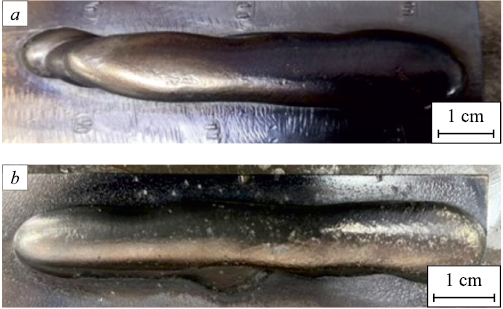
Samples differing in the concentration of alloying elements in the powder wire were manufactured by multi-pass surfacing (Fig. 1; Table 1).
Fig. 1. Characteristic appearance of deposited samples:
Table 1. Compositions of flux-cored wire charge
| |||||||||||||||||||
The chemical analysis results for the deposited layer are presented in Table 2. The deposited metal contained 60 – 70 % Fe and 30 – 40 % alloying elements.
Table 2. Chemical composition of deposited samples
| |||||||||||||||||||||||||||||||||||||||||||||||||||||||
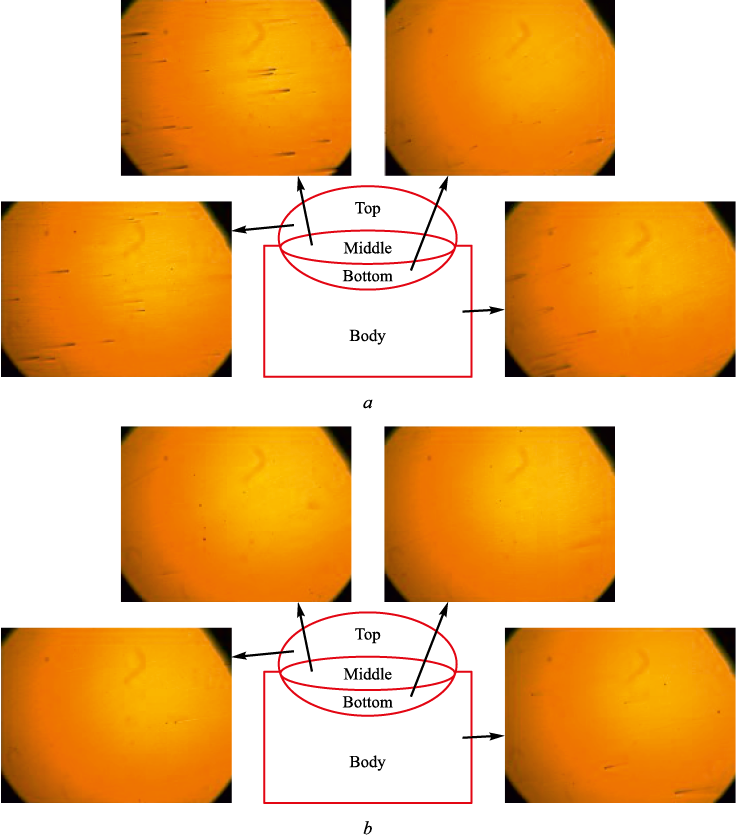
The non-metallic inclusion content of the deposited layer (Fig. 2) was assessed on the end face of each sample. According to the GOST 1778-2022 reference charts, the deposited samples contained grade 2a point oxides and grade 4a and 4b non-deformable silicates. Sample K4 had a lower inclusion content than sample K3, however, the deposited layers of both samples were considerably cleaner than the 09G2S steel substrate.
Fig. 2. Contamination of samples K3 (a) and K4 (b) with nonmetallic inclusions |
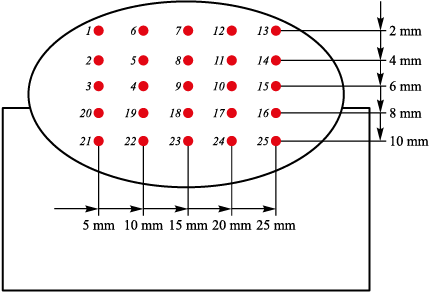
Fig. 3 presents the arrangement of the microhardness measurement points.
The microhardness measurement results (Table 3) show that the layers deposited using Co – Cr – Fe – Mn – Ni system flux-cored wires had slightly higher microhardness than the substrate. The deposited layer also contained regions with approximately twice the microhardness. These regions were most frequently observed in the first deposited layers.
Fig. 3. Arrangement of microhardness measuring points
Table 3. Results of measurement of microhardness (HV) of deposited samples
| ||||||||||||||||||||||||||||||||||||||||||||||||||||||||||||||||||||||||||||||||||||||||||||||||||||||||||||||||||||||||||||||||||||||||||
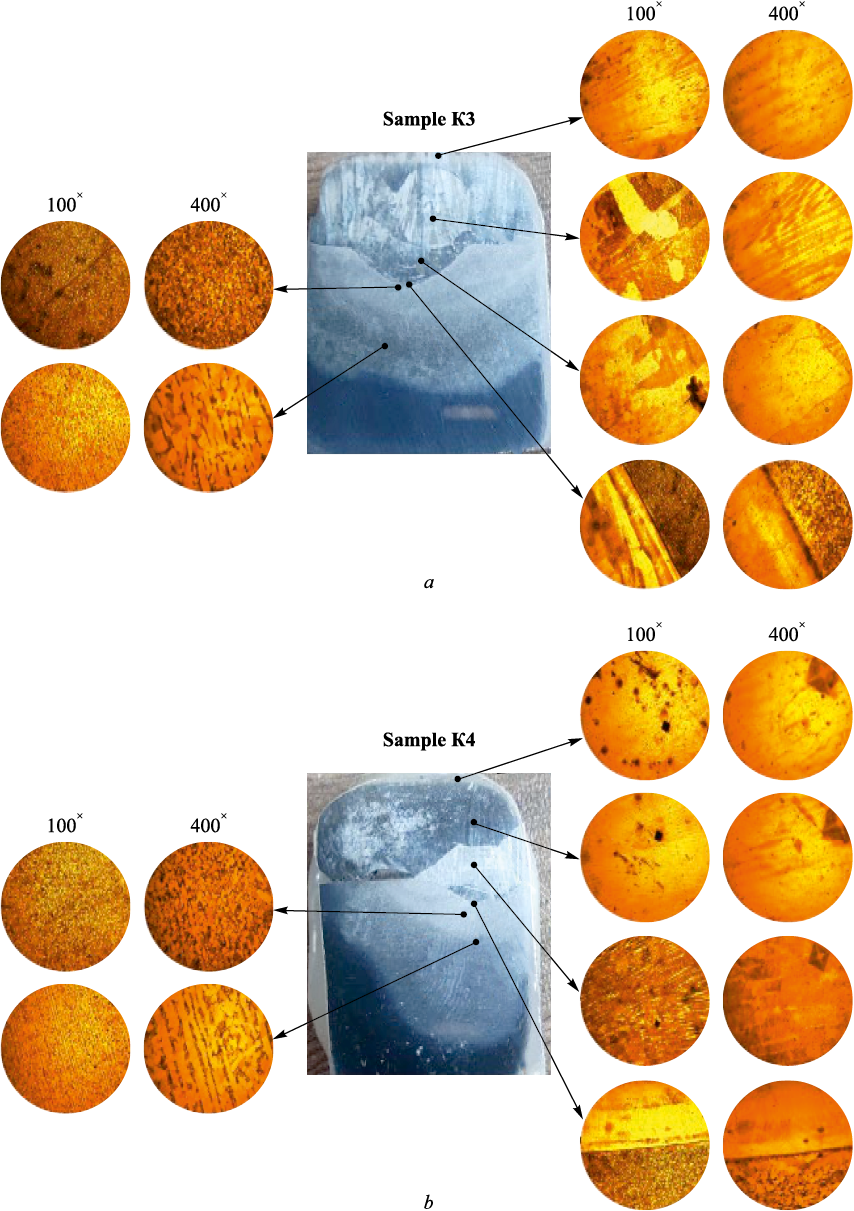
Microstructural analysis (Fig. 4) was performed after etching the deposited samples with aqua regia. The substrate had a ferrite-pearlite structure. Needle-like martensite was observed in the first deposited layers, consistent with the microhardness measurement results. The subsequent layers of the deposited samples had an austenitic structure with elongated (dendritic) morphology characteristic of the samples produced by arc welding.
Fig. 4. Microstructure of samples K3 (a) and K4 (b) |
Conclusions
The study confirmed the feasibility of producing Co – Cr – Fe – Mn – Ni system coatings using flux-cored wires, with an Fe content of 60 – 70 % and a total alloying-element content of 30 – 40 %.
Evaluation of non-metallic inclusions showed that the deposited samples contained grade 2a point oxides and grade 4a and 4b non-deformable silicates. Sample K4 had a lower inclusion content than sample K3, while the deposited layers of both samples were substantially cleaner than the 09G2S steel substrate.
The microhardness of the deposited metal was slightly higher than that of the substrate. Localized regions, predominantly in the first layers, exhibited approximately twice the microhardness; this was associated with the formation of needle-like martensite.
Microstructural analysis showed that the initial deposited layers contained needle-like martensite, whereas the subsequent layers had an austenitic crystal structure with elongated dendritic morphology characteristic of arc welding.
1. Mikhailitsyn S.V., Zvereva I.N., Sheksheev M.A. Welding and Surfacing Materials. Moscow: Infra-Engineering; 2020:228. (In Russ.).
2. Raikov S.V., Gromov V.E., Kryukov R.E., Knyazev A.S. Wear-Resistant Deposited Layers: Properties, Structure and Phase Composition. Novokuznetsk: Polygraphist; 2024:179. (In Russ.).
3. Barinov S.V., Zagorodskikh B.P., Simdyankin A.A. A study of the wear resistance of parts with an inhomogeneous friction surface. Journal of Friction and Wear. 2003;24(5):568–572.
4. Kozyrev N.A., Shurupov V.M., Kushnarenko N.N., Kozyreva O.E., Titov D.A. The usage of tungsten-containing ores at welding. Izvestiya. Ferrous metallurgy. 2015;58(8): 567–571. (In Russ.). https://doi.org/10.17073/0368-0797-2015-8-567-571
5. Kumar V.A., Murty S.V.S.N., Gupta R.K., Rao A.G., Prasad M.J.N.V. Effect of boron on microstructure evolution and hot tensile deformation behavior of Ti-5Al-5V-5Mo-1Cr-1Fe alloy. Journal of Alloys and Compounds. 2020;831:154672. https://doi.org/10.1016/j.jallcom.2020.154672
6. Artem’ev A.A., Sokolov G.N., Zorin I.V., Dubtsov Yu.N., Antonov A.A., Lysak V.I. Formation of structure in clad abrasion-resistant alloys of the Fe – Cr – C – Mo – Ni – Ti – B system under the effect of ultrafine particles of titanium nitride. Metal Science and Heat Treatment. 2020;61(11-12): 724–730. https://doi.org/10.1007/s11041-020-00490-8
7. Winkelmann H., Badisch E., Varga M., Danninger H. Wear mechanisms at high temperatures. Part 3: Changes of the wear mechanism in the continuous impact abrasion test with increasing testing temperature. Tribology Letters. 2010;37(2):419–429. https://doi.org/10.1007/s11249-009-9534-3
8. Kolokolov E.I., Pirozhkov R.V., Tomilin S.A. Applicability of 110G13P type powder steel for production of consolidation details of high parameters power fittings. In the World of Scientific Discoveries, Series B. 2014;2(2):29–35.
9. Kozyrev N.A., Titov D.A., Starovatskaya S.N., Shurupov V.M., Goryushkin V.F. The influence of the introduction of the charge flux-cored wire system with C – Si – Мn – Сr – W – V carbon-fluorine-containing additives and nickel. Izvestiya. Ferrous Metallurgy. 2014;57(6):31–33. (In Russ.). https://doi.org/10.17073/0368-0797-2014-6-31-33
10. Kozyrev N.A., Kryukov R.E., Shurupov V.M., Kibko N.V., Bashchenko L.P. Tungsten recovery from oxide during flux cord wire surfacing. Izvestiya. Ferrous Metallurgy. 2019;62(3):215–221. (In Russ.). https://doi.org/10.17073/0368-0797-2019-3-215-221
11. Tseng S.F., Hung T.Y., Chang C.M. Mechanical and microstructural properties of additively manufactured Ti–6Al–4V stents with CO2 laser postannealing treatment. The International Journal of Advanced Manufacturing Technology. 2022;119(9-10):6571–6581. https://doi.org/10.1007/s00170-021-08381-9
12. Grigorenko G.M., Korzhik V.N., Adeeva L.I., Tunik A.Yu., Stepanyuk S.N., Karpets M.V., Doroshenko L.K., Lyutik N.P., Chaika A.A. Peculiar features of metallurgical processes at plasma-arc spraying of coatings, made of steel wire with powder fillers В4С and B4C+ZrO2 . Bulletin of the Azov State Technical University. Series: Technical Sciences. 2016;(32):125–137. (In Russ.).
13. Peleshenko S., Korzhyk V., Voitenko O., Khaskin V., Tkachuk V. Analysis of the current state of additive welding technologies for manufacturing volume metallic products (review). Eastern-European Journal of Enterprise Technologies. 2017;3(1(87)):42–52. https://doi.org/10.15587/1729-4061.2017.99666
14. Sheksheev M.A., Shiriaeva E.N., Mikhailitsyn S.V. Investigation of the influence of ultrafine particles of refractory materials on the formation of the structure and properties of the deposited metal. AIP Conference Proceedings. 2022;2503(1):060007. https://doi.org/10.1063/5.0099350
15. Krokhalev A.V., Kharlamov V.O., Kuz’min S.V., Lysak V.I., Grinberg B.A. Fine structure of interphase boundaries in hard alloys of the chromium carbide–titanium system. Russian Journal of Non-Ferrous Metals. 2016;57(5):504–508. https://doi.org/10.3103/S1067821216050096
16. Malushin N.N., Romanov D.A., Kovalev A.P., Osetkovskii V.L., Bashchenko L.P. Structural-phase state of a high-hardness heatresistant alloy formed by plasma cladding in a nitrogen atmosphere and high-temperature tempering. Russian Physics Journal. 2020;62(10):1865–1870. https://doi.org/10.1007/s11182-020-01917-8
17. Malushin N.N., Valuev D.V. Plasma surfacing and nitriding of deposited parts of the mining and metallurgical complex. Mining Information and Analytical Bulletin (scientific and technical journal). 2012;(12):105–108. (In Russ.).
18. Belkahla Y., Mazouzi A., Lebouachera S.El.I., Hassan A.J., Fides M., Hvizdoš P., Cheniti B., Miroud D. Rotary friction welded C45 to 16NiCr6 steel rods: statistical optimization coupled to mechanical and microstructure approaches. The International Journal of Advanced Manufacturing Technology. 2021;116(7):2285-2298. https://doi.org/10.1007/s00170-021-07597-z
19. Liu J.-Z., Zhang L.-J., Yang H.-X., Xie M.-X., Shang X.-T., Zhang J.- X. Enhancement of corrosion protection performance of SUS304/Q235B dissimilar metals lap joint through fiber laser. The International Journal of Advanced Manufacturing Technology. 2018;96(1-4):789–802. https://doi.org/10.1007/s00170-018-1634-5
20. Zavdoveev A., Pozniakov V., Baudin T., Kim H.S., Klochkov I., Motrunich S., Heaton M., Aquier P., Rogante M., Denisenko A., Gajvoronskiy A., Skoryk M. Optimization of the pulsed arc welding parameters for wire arc additive manufacturing in austenitic steel applications. The International Journal of Advanced Manufacturing Technology. 2022;119(7-8):5175–5193. https://doi.org/10.1007/s00170-022-08704-4
21. Yadaiah N., Bag S., Paul C.P., Kukreja L.M. Influence of self-protective atmosphere in fiber laser welding of austenitic stainless steel. The International Journal of Advanced Manufacturing Technology. 2016;86(1-4):853–870. https://doi.org/10.1007/s00170-015-8194-8
22. Liu H.H., Wang L.B., Liu W.J., Li L.Y., Yue J.F. Influence of AC magnetic field on the cladding layer during the micro beam plasma welding of austenitic stainless steel. The International Journal of Advanced Manufacturing Technology. 2018;97(9):3459–3468. https://doi.org/10.1007/s00170-018-2182-8
23. Tabatchikov A.S., Korobov Yu.S., Razikov N.M., Onishchenko L.A. Development of Technology for Manufacturing Electrodes and Powder Wires for Welding and Related Processes. Yekaterinburg: Ural Publishing House University; 2023:112. (In Russ.).
Roman E. Kryukov, Dr. Sci. (Eng.), Prof. of the Chair of Mechanics and Machine Engineering
42 Kirova Str., Novokuznetsk, Kemerovo Region – Kuzbass 654007, Russian Federation
Sergei V. Konovalov, Dr. Sci. (Eng.), Vice-Rector for Research and Innovation
42 Kirova Str., Novokuznetsk, Kemerovo Region – Kuzbass 654007, Russian Federation
Aleksei R. Mikhno, Director of the Scientific and Production Center “Welding Processes and Technologies”
42 Kirova Str., Novokuznetsk, Kemerovo Region – Kuzbass 654007, Russian Federation
Irina A. Panchenko, Cand. Sci. (Eng.), Senior Researcher of the Department of Scientific Research
42 Kirova Str., Novokuznetsk, Kemerovo Region – Kuzbass 654007, Russian Federation
Kryukov R.E., Konovalov S.V., Mikhno A.R., Panchenko I.A. Metallographic studies of the alloy of Co – Cr – Fe – Mn – Ni system. Izvestiya. Ferrous Metallurgy. 2026;69(3):258-264. https://doi.org/10.17073/0368-0797-2026-3-258-264
 Email this article (Login required)
Email the author (Login required)
Email this article (Login required)
Email the author (Login required) Publishing House of National University of Science and Technology "MISIS"
4, Leninskii prospekt, Moscow, 119991, Russia
Phone: +7 (495) 638-44-11, +7 (495) 784-58-66
E-mail: fermet.misis@mail.ru