Contents
Scroll to:
https://doi.org/10.17073/0368-0797-2026-2-149-154
Scroll to:
JSC Ural Steel is a large full-cycle metallurgical enterprise, which celebrated its 70th anniversary in 2025, and in 2024 the Ural Steel Shaped Castings Shop (SCS) celebrated its 65th anniversary. Since its foundation, SCS mastered the technology of producing castings from gray cast iron weighing up to 6 tons in accordance with GOST 1412 – 85. In 2018, SCS organized a large-scale casting site (LSCS SCS) for production of steel large-scale metallurgical castings, and in 2022, as part of the expansion of the large-scale site range, it was decided to develop the technology for the production of castings weighing more than 110 tons from high-strength ductile iron (DCI). The team began to solve this task sequentially dividing it into the stages that gradually revealed the additional potential of the enterprise. In 2022 the production of castings from DCI weighing up to 6 tons was mastered at the small casting site in SCS. In 2023 – 2024 the technology for the production of castings weighing up to 6 tons from DCI was tested as a part of commercial orders, a unique technology for the production of gray cast iron for large castings (more than 30 tons) in electric arc flexible modular furnaces of the EAF-shop from hot metal from the blast-furnace shop was developed and tested. In 2024 – 2025 further development of the technology for the production of hot metal for castings was carried out, as well as the development of technology for modifying the melt with magnesium-containing materials in the conditions of the LSCS SCS for the production of large-scale castings from DCI weighing more than 40 tons. Testing of the technology for production of castings weighing up to 100 tons was carried out within the framework of commercial orders. Analysis of the experimental castings material showed that the developed production technology ensured the production of DCI grade HC40 according to the State standard GOST 7293. This large work resulted in expansion of the product line of JSC Ural Steel.
Lazeev V.V., Vereshchagina O.P. JSC Ural Steel today: Development of foundry production. Izvestiya. Ferrous Metallurgy. 2026;69(2):149-154. https://doi.org/10.17073/0368-0797-2026-2-149-154
Introduction
Small metallurgical enterprises, commonly referred to as casting-and-rolling complexes, are becoming increasingly widespread in modern metallurgy worldwide. Such plants typically include one melting furnace, most often an electric arc furnace of various designs, a secondary metallurgy section with a ladle furnace, a casting section equipped with a continuous casting machine (CCM), and a plate or long-product rolling complex [1]. Their main advantage is the relatively low capital cost of production setup, which allows them to be located close to major consumers and raw material sources, primarily scrap.
At the same time, these facilities also have limitations. Their narrowly specialized production routes make them dependent on scrap suppliers, while their limited product range increases their exposure to regional market fluctuations.
For full-cycle integrated steel plants, the growing number of such enterprises creates new competitive challenges. The key market advantage of large metallurgical plants is the flexibility of their production systems, which allows them to respond quickly not only to demand for steel products but also to changes in raw material availability.
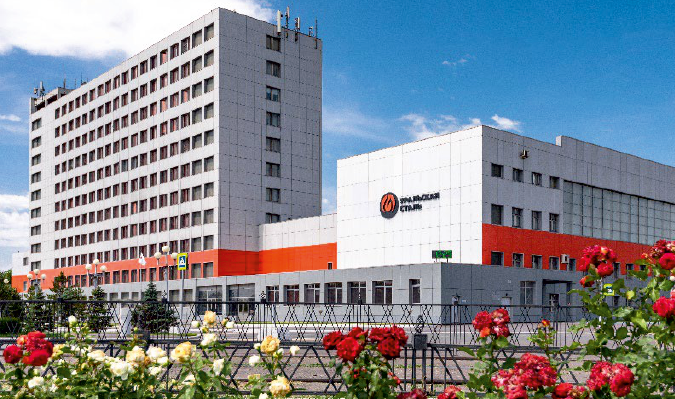
One example of a modern full-cycle integrated steel plant is JSC Ural Steel, formerly the Orsk-Khalilovo Metallurgical Combine (Fig. 1). The plant’s official foundation date is March 5, 1955, when Blast Furnace No. 1 produced its first hot metal, although construction had begun before World War II. During the economic transition at the turn of the millennium, the plant, like many large industrial enterprises in Russia, went through a difficult period: several production facilities were closed, and some subsidiaries responsible for social infrastructure were lost. However, the workforce overcame these challenges and kept the enterprise operating. A new stage in the plant’s development began after its merger with Zagorsk Pipe Plant (JSC ZTZ) into a single group of companies. Today, JSC Ural Steel Group is one of the key players in the Russian metallurgical market. In 2025, the plant celebrated its 70th anniversary.
Fig. 1. JSC Ural Steel |
The plant’s output in 2024 was as follows:
– more than 2.7 million tons of cast iron, including 1.4 million tons of merchant pig iron and 1.2 million tons for internal consumption;
– more than 1.5 million tons of steel, including more than 440 thousand tons of merchant continuous-cast billet and more than 1.1 million tons of slabs for further plate production;
– more than 900 thousand tons of heavy plate in thicknesses of 8 – 50 mm;
– more than 10 thousand tons of cast steel and iron products.
Compared with 2023, pig iron production at JSC Ural Steel decreased slightly; however, in steelmaking and other steel product segments, the workforce continues to reach new performance levels.
Today, JSC Ural Steel is one of the industry leaders in the production of bridge steel. In synergy with JSC ZTZ, it supplies strip steel and large-diameter pipes for the oil and gas sector and is also among the leading producers of large-scale metallurgical castings, including slag pots.
A full-cycle integrated steel plant is a complex production system capable of manufacturing not only finished products, namely rolled steel, but also many types of by-products. For example, it serves as a raw material base for cement production and fertilizer producers, supplies valuable gases to various industries, including medicine, and provides other products for a wide range of industrial applications.
The development of new grades of rolled steel in cooperation with major research institutes, design organizations, and direct consumers is one of the company’s priority areas. In recent years, new grades of bridge steel [2; 3], cryogenic steel [4], strip steel, and high-strength rolled products [5] have been developed [5].
However, the development of a large metallurgical enterprise is not limited to the modernization of existing shops and the construction of new ones, or to the production of new types of plate products. It also includes the development of additional products, such as merchant metallurgical coke of the 60+ mm fraction and large-scale cast iron products.
Foundry production is one of the oldest branches of human metallurgical craft [6]. Today, the foundry industry is a separate area of modern metallurgy, with its own objectives, challenges, and achievements. The problems and tasks of foundry production are closely related to metallurgy as a whole, but at times they lie in fundamentally different areas. The goals, values, and priorities of conventional metallurgy often differ markedly from those of the foundry industry. In conventional metallurgy, the key priorities are process standardization, automation, and reduction of production time and material costs, in line with the principle “Faster, more, cheaper”. In foundry production, however, because each casting has individual characteristics, this principle is applicable only to large-scale serial production of similar castings, and even then with reservations. Each casting requires individual molding, and production conditions may differ even within a single heat. For all other types of casting, the decisive factors are not equipment productivity, automation, or reduced downtime, but the competence of engineers, designers, process engineers, foundry specialists, and the qualifications of production personnel, including molders, melters, and teemers.
Foundry production at JSC Ural Steel was established in 1965 and was initially focused exclusively on manufacturing spare parts for the plant’s own needs. Over time, however, as the planned economy gave way to a market economy, the plant was able to bring its cast products to the external market.
Unfortunately, in the 2000s, the plant’s foundry production received little attention and was partially optimized. As a result, the equipment and the technology for cupola melting of cast iron were lost, and its capabilities for medium-sized casting production were limited.
Today, the small and medium casting site is equipped with a six-ton electric arc furnace (EAF) for iron and steel melting and a 2-ton induction furnace for bronze production. The plant also has its own pattern-making facilities.
During the 2013 – 2015 modernization, flask molding using the A-set no-bake process was introduced [7]. In 2017 – 2018, the plant mastered the production of castings from manganese steels for mining and processing plants, including excavator bucket teeth, armor plates, and linings for ore mills. It also obtained certification from PJSC Gazprom and mastered the production of a range of cast iron pipeline weights.
In 2018, a unique large-scale casting site was organized within the shaped castings shop (LSCS SCS). Initially, it was established to meet the plant’s internal demand for metallurgical castings, primarily slag pots – steel castings weighing 25 – 30 tons. However, the site was created with future market expansion in mind, and in 2019 – 2020 slag pots began to be supplied to enterprises in Russia, the CIS, and Europe.
By 2022, the new site had reached its design capacity of 10 thousand tons per year and had become one of the country’s leading producers of large-scale metallurgical castings. In 2023, a shot-blasting chamber with a 5 m rotary table was commissioned.
The unique feature of the large-scale casting site is its production route: metal for the castings is supplied by the plant’s electric steelmaking shop (EAF shop), which is currently one of the plant’s most dynamically developing shops. Following the latest modernization of its melting units, namely two 120-ton flexible modular furnaces, in 2018 – 2019, the shop gained the capability to produce steel in an electric arc furnace not only from scrap but also with 100 % hot metal charged as the primary raw material. In addition to significantly reducing metal cost, this route also lowers the content of undesirable impurities.
Against the background of the global shift toward electric steelmaking at mini-mills, the gradual accumulation of elements such as copper, zinc, and tin in internationally traded scrap has become a growing problem, as these elements are often undesirable in steelmaking [8]. Producing steel from 100 % hot metal, not only in converters but also in electric furnaces at full-cycle integrated steel plants, helps reduce the severity of this problem.
The EAF shop includes:
– two ladle furnace units, with 100 % of the metal subjected to homogenizing argon lancing;
– a tank degasser, in which up to 95 % of all metal is treated.
Steel is cast on a slab CCM with a slab cross section of 220/270×1200 mm for plate production. It is also cast as merchant billet up to 11 m long, with a cross section of 300×300 mm or diameters of 450, 540, and 600 mm, on a billet/bloom CCM. In addition, the EAF shop produces metal to order for foundry operations. Accordingly, the liquid steel supplied from the EAF shop to the LSCS SCS for large-scale castings is of higher quality than that typically used in conventional foundries, owing to the shop’s advanced equipment and modern production technologies.
The global situation has required domestic enterprises to adapt to new market conditions. This, in turn, has promoted the development of in-house competencies and technologies within the country. Thus, in 2022, JSC Ural Steel identified a new area for the development of its foundry production: cooperation with Russian companies in the production of large-scale castings weighing more than 110 tons from high-strength ductile iron (DCI) [9].
Based on an audit of major foundry enterprises, JSC Ural Steel was selected as the priority site for launching this new production area. The decision was based on the plant’s optimal and, in some respects, unique production parameters, its simple organizational structure, and the commitment of its personnel. The initial audit and subsequent negotiations showed the plant’s team the potential of the SCS large-scale casting site and of casting production technology as a whole.
In mastering the new products, the steelmaking and foundry specialists at JSC Ural Steel faced the following challenges:
– no experience in producing castings weighing more than 40 tons;
– no experience in producing DCI;
– no experience or established technology for producing hot metal for large-scale castings using the steelmaking units of the EAF shop;
– no experience in producing large-scale heavy-section castings with wall thicknesses greater than 130 mm;
– no experience in laboratory studies and testing for DCI qualification.
Materials and methods
To address this task, the plant’s team proceeded systematically, dividing the work into stages that gradually revealed the enterprise’s additional production potential.
In 2022, work began with mastering the production of high-strength ductile iron (DCI) castings at the small casting site. A process route for melt treatment was developed, the ladle lining design was selected, and suitable modifying agents were chosen. The first pilot trials produced VCh40 grade cast iron castings according to GOST 7293 for the plant’s own needs [10]. One of the first trial castings later became an exhibit in the plant museum (Fig. 2).
Fig. 2. Casting from high-strength ductile iron in the plant museum |
In 2023 – 2024, the plant began accepting customer orders and further refining the production technology through the production of castings for commercial customers. To date, the small and medium casting site has successfully produced and shipped castings made of VCh40 and VCh50 grades of cast iron weighing more than 4 tons.
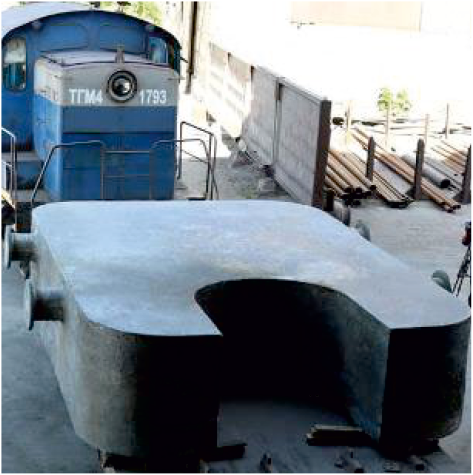
At the same time, the technology for producing large-scale cast iron castings was being developed. Solving the problem of producing hot metal for castings, while taking into account the specific features of metal production for the large-scale casting site, became a major challenge for the team. This work began in 2022 with the production of an 87.5-ton “anvil-block” casting made of 08GDNFL steel (Fig. 3).
Fig. 3. Casting “anvil-block”, weight 87.5 tons |
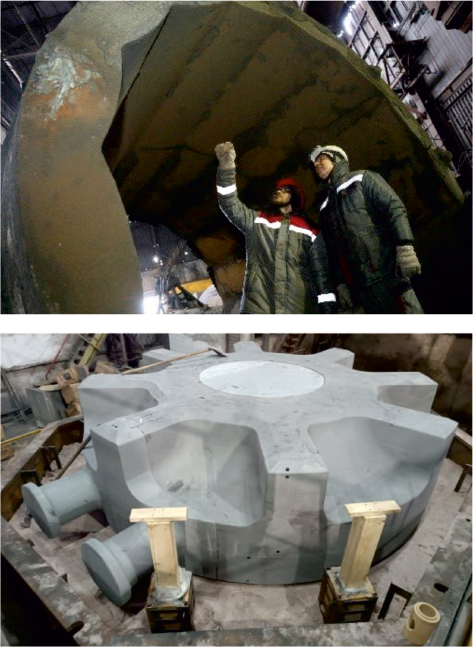
The next step was the development and testing of a unique technology for producing hot metal for castings in the flexible modular arc furnaces of the EAF shop using hot metal supplied by the blast furnace shop. The development of this production route resulted in several patent applications and has already enabled the launch of a new product line for the plant – large-tonnage gray cast iron castings – as well as another foundry production record: castings weighing 92 and 114 tons (Fig. 4). In 2023 – 2024, more than 500 tons of large-scale cast iron castings were shipped [11].
Fig. 4. Casting “mold”, 92 tons (а) |
The next stage was to master the production of large-scale DCI castings in 2024. This task created new challenges for the team. In particular, because the modifying effect is short-lived, it was necessary to reduce the time between melt treatment with magnesium-containing materials and the start of pouring, as well as to shorten mold filling time.
To address this challenge, unique technical solutions developed jointly with Russian companies from Tula and Magnitogorsk were implemented. This work resulted in the successful production of cast DCI tooling components: four castings weighing more than 40 tons each. These components were intended for the subsequent manufacture of a permanent mold, marking the next stage: mastering permanent-mold casting of DCI castings weighing more than 120 tons. Castings with a poured weight of more than 50 tons were produced in pairs under conditions as close as possible to those planned for the next production stage. Studies of the mechanical properties and microstructure of the DCI castings confirmed the formation of spheroidal graphite and showed that the castings met the requirements for VCh40 grade cast iron according to GOST 7293.
Conclusions
At present, JSC Ural Steel is developing dynamically, with foundry production expansion among its key priorities. The Novotroitsk metallurgists keep pace with current industry needs, are ready to address complex customer requirements, and are focused on long-term, mutually beneficial cooperation.
Analysis of the DCI castings showed that the developed production technology ensured the production of VCh40 grade DCI. Machining of the castings in Petrozavodsk and subsequent ultrasonic testing confirmed the absence of casting defects.
This large-scale effort has resulted not only in an expanded product range at JSC Ural Steel, but also in stronger technological sovereignty for the country through the development of new competencies by the plant’s specialists.
Foundry production development is continuing. Measures to expand the usable production area of the large-scale casting site have already been planned and are being implemented. This will allow the plant to start serial production of large-scale cast iron castings without reducing the output of steel castings. As part of the development of the small casting site, options for mastering new products and further production modernization are also under consideration.
1. Rudskoi A.I., Platov S.I., Terent’ev D.V., Tochilkin V.V. Design of Equipment for Foundry and Rolling Complexes. St. Petersburg: POLYTECH PRESS; 2025:374. (In Russ.).
2. Babanakov V.V., Yakushev E.V., Zyryanov V.V., Vostrikov V.G., Pemov I.F., Morozov Yu.D. Method of plates production. Patent RF no. 2434951 RU, MPC C21D 8/02 (2006.01). Byulleten’ izobretenii. 2011:33. (In Russ.).
3. Zubov S.P., Vostrikov V.G., Pemov I.F., Kormishin A.M., Pridein A.A., Kulikov V.V., Bedrinov A.I. Method of plates production. Patent RF no. 2572270 RU, IPC C21D 8/02 (2006.01). Byulleten’ izobretenii. 2016:1. (In Russ.).
4. Kunitsyn G.A., Pridein A.A., Prokopenko L.V., Samokhina O.V., Osipov D.V., Yakushev E.V., Bagirova L.V., Kharin P.A., Skol’tsov V.I., Oreshkin A.N. Sheet of structural cryogenic high-strength steel and the method of its production. Patent RF no. 2833571 RU, IPC C21D 8/02 (2006.01). Byulleten’ izobretenii. 2025:3. (In Russ.).
5. Efendiev N.T., Yakushev E.V., Zyryanov V.V., Pemov I.F., Morozov Yu.D., Kruchinkin A.V., Paryshev D.N., Kopyrin V.I. Method of sheet metal production. Patent RF no. 2465347 RU, MPC C21D 8/02 (2006.01). Byulleten’ izobretenii. 2012:30 (In Russ.).
6. Wal’ter A.I., Protopoppov A.A. Fundamentals of Foundry Production. Moscow: Infra- Inzheneriya; 2019:332. (In Russ.).
7. Zhukovskii S.S. Cold-Hardening Binders and Mixtures for Casting Rods and Molds: Handbook. Moscow: Mashinostroenie; 2010:256. (In Russ.).
8. Mysik V.F., Zhdanov A.V. Resources and Scrap Preparation for Steel Smelting. Yekaterinburg: UrFU; 2017:337. (In Russ.).
9. Zakharchenko E.V., Levchenko Yu.N., Gorenko V.G., Varenik P.A. Castings from Cast Iron with Spherical and Vermicular Graphite. Kiev: Naukova Dumka; 1986:247. (In Russ.).
10. Lazeev V.V., Skokov K.S., Nizhelsky D.V., Evsina L.G., Pudovkina O.P. Mastering the technology for production of high-strength cast iron with nodular graphite for manufacture of castings in the conditions of JSC Ural Steel. Chernye metally. 2023;(7):9–14. (In Russ.). https://doi.org/10.17580/chm.2023.07.01
11. Lazeev V.V., Vereshchagina O.P., Nizhelskiy D.V., Skokov K.S., Evsina L.G. Development and mastering of technology for production of large-sized cast products from gray cast iron in the conditions of JSC Ural Steel. Chernye metally. 2025;(2):23–29. (In Russ.). https://doi.org/10.17580/chm.2025.02.03
Vasilii V. Lazeev, Head of the Division of Sales Technical Support of the Department of New Products
1 Zavodskaya Str., Novotroitsk, Orenburg Region 462351, Russian Federation
Ol’ga P. Vereshchagina, Engineer of the 1st Category of the Division of New Products of the Department of New Products
1 Zavodskaya Str., Novotroitsk, Orenburg Region 462351, Russian Federation
Lazeev V.V., Vereshchagina O.P. JSC Ural Steel today: Development of foundry production. Izvestiya. Ferrous Metallurgy. 2026;69(2):149-154. https://doi.org/10.17073/0368-0797-2026-2-149-154
 Email this article (Login required)
Email the author (Login required)
Email this article (Login required)
Email the author (Login required) Publishing House of National University of Science and Technology "MISIS"
4, Leninskii prospekt, Moscow, 119991, Russia
Phone: +7 (495) 638-44-11, +7 (495) 784-58-66
E-mail: fermet.misis@mail.ru