Contents
Scroll to:
https://doi.org/10.17073/0368-0797-2026-1-31-38
Scroll to:
The Baikov Institute of Metallurgy and Materials Science of the Russian Academy of Sciences (IMET RAS) developed an autoclave lime-alkali desiliconization method for titanium concentrates from the Pyzhemskoye and Yaregskoye deposits (Sredny and Yuzhny Timan, Komi Republic). The ores of these deposits are quartz-leucoxene and quartz-ilmenite-leucoxene sandstones. The formation of the titanium component of these deposits is associated with the leucoxenization of ilmenite. The geological process involved the removal of iron from the parent titanium minerals and the filling of the resulting voids with quartz through its crystallization from hydrothermal solutions. This resulted in the ultra-dispersed size of inclusions (1 – 20 µm) of SiO2 and its structure characterized by weaker (unsaturated) Si – O (Si) bonds. As a result, a high degree of desiliconization of leucoxene and ilmenite concentrates is achieved at 220 °C under autoclave conditions due to the almost complete removal of quartz from titanium grains. At the same time, hydrothermal synthesis of calcium metasilicate hydrates (tobermarite, xonotlite) takes place, the morphological properties of which depend on the conditions of autoclave leaching. In the autoclave, during a relatively short duration of the process, at a ratio of CaO/SiO2 = 0.7 – 1.0, calcium silicate with a needle-like habit is obtained, which forms predominantly radially radiant sinters. Upon subsequent calcination, their complete dehydration occurs with the crystallization of β-wollastonite (CaSiO3 ) increasingly gaining practical application in various fields, including science-intensive ones.
Zablotskaya Yu.V., Tuzhilin A.S., Sadykhov G.B. Features of joint lime autoclave desiliconization of quartz-titanium concentrates and hydrothermal synthesis of calcium hydrosilicates. Izvestiya. Ferrous Metallurgy. 2026;69(1):31-38. https://doi.org/10.17073/0368-0797-2026-1-31-38
Introduction
Worldwide, including in Russia, titanium is regarded as a strategically important mineral within national resource policy frameworks1, 2 [1]. At the same time, titanium raw materials fall into the category of deficit resources, for which domestic demand is largely satisfied through forced imports and/or accumulated stockpiles3 [2]. Although the Russian Federation ranks second globally in terms of explored titanium reserves, its major operating enterprises producing metallic titanium (VSMPO-AVISMA, Berezniki) and pigment-grade titanium dioxide (Russian Titanium LLC, Armyansk, Crimea) are compelled to rely on imported feedstock. This situation not only disrupts the stable operation and long-term development of these enterprises but also weakens the country’s raw-material security and economic independence.
One promising approach to addressing this challenge is the involvement of domestic titanium resources, in particular the utilization of quartz-leucoxene and quartz-ilmenite-leucoxene sandstones of the Timan region (Komi Republic), represented by the Pyzhemskoye (Middle Timan) and Yaregskoye (Southern Timan) deposits [3 – 7]. According to the State Balance of Reserves of the Russian Federation for 2022, these deposits account for 50.2 % of the country’s balance titanium reserves [2]. Located less than 230 km apart, they constitute unique titanium resources distinguished by exceptionally high quartz contents, reaching up to 90 % in the primary ore and 40 – 45 % in the beneficiated concentrates [3; 8].
The Yaregskoye deposit is composed of oil-bearing sandstones enriched in leucoxene and also serves as a reservoir of high-viscosity oil. Productive horizons occur at depths of 200 – 250 m and contain 9 – 12 % TiO2 . The principal titanium-bearing mineral in the Yaregskoye sandstones is leucoxene, which occurs as a sagenite-type structure of rutile (anatase) finely intergrown with ultra-dispersed quartz. In the first half of the 1960s, the Yaregskaya pilot-industrial beneficiation plant was commissioned. Its operation yielded a high-silica leucoxene flotation concentrate containing 45 – 50 % TiO2 and 40 – 45 % SiO2 . However, titanium recovery remained relatively low, at only 75 – 85 %. The high quartz content precludes the use of this concentrate as feedstock for the production of pigment-grade TiO2 and metallic titanium. At present, the Yaregskoye deposit is exploited solely for heavy oil production using a thermal mining method.
The Pyzhemskoye quartz-leucoxene sandstones are characterized by a polymineral composition, with titanium present in the form of leucoxene and leucoxenized ilmenite [3; 4]. In the Middle Timan region, these sandstones occur at relatively shallow depths, while their titanium reserves exceed those of the Yaregskoye deposit. The Pyzhemskoye deposit exhibits a layered structure. The upper layer consists of gray-colored sandstones with a low content of siderite and other iron-bearing minerals, whereas the lower layer is composed of ferruginous red-colored (siderite-leucoxene) sandstones. The TiO2 content ranges from 5 to 10 % in the gray-colored sandstones and from 3 to 5 % in the red-colored sandstones [4].
Since the discovery of the Timan deposits, extensive research on the beneficiation of these sandstones has been conducted in the USSR by leading scientific organizations. However, the low contrast between titanium-bearing minerals containing ultra-dispersed inclusions of lighter phases (quartz and aluminosilicates) and quartz itself severely limits the applicability of conventional physical beneficiation methods [3; 8]. As a result, the proposed beneficiation schemes for these deposits were never implemented.
Given the critical importance of establishing a domestic raw-material base for the titanium industry, fundamental research on the beneficiation of Timan quartz-leucoxene and quartz-ilmenite-leucoxene sandstones has been carried out at the Baikov Institute of Metallurgy and Materials Science of the Russian Academy of Sciences (IMET RAS) since 2001. This research resulted in the development of a new integrated beneficiation technology capable of producing high-quality titanium concentrates, including artificial rutile and high-titanium ilmenite [3; 9]. According to this technology, quartz-leucoxene concentrates obtained during beneficiation are subjected to lime autoclave desiliconization using lime milk in the presence of a small amount of NaOH, which acts as a catalyst or activator. During autoclave leaching, desiliconization of the concentrates proceeds simultaneously with the hydrothermal synthesis of calcium hydrosilicate. The latter serves as an intermediate product for the subsequent production of high-quality synthetic wollastonite [10; 11].
The aim of this study is to obtain generalized results of lime autoclave leaching of quartz-titanium concentrates from the Southern and Middle Timan deposits during desiliconization, with the possibility of simultaneous hydrothermal synthesis of calcium metasilicate hydrate, as well as to investigate the features of calcium hydrosilicate formation with a needle-like habit.
Materials and methods
The ores of the Yaregskoye and Pyzhemskoye deposits are represented by quartz-leucoxene and quartz-ilmenite-leucoxene sandstones. A characteristic feature distinguishing the Pyzhemskoye sandstones from those of the Yaregskoye deposit is the presence of up to 5 – 6 % altered ilmenite which, unlike non-magnetic leucoxene, exhibits weak magnetic properties. During preliminary ore preparation and beneficiation, a magnetic quartz-ilmenite fraction is obtained. At the same time, leucoxene is concentrated in the non-magnetic fraction, which consists predominantly of free quartz. In order to increase the contrast in physical properties between these fractions in the concentrates, the application of magnetizing roasting was proposed at IMET RAS to reduce iron oxides associated with TiO2 (1 – 3 % Fe2O3 ) in leucoxene to the metallic state [9]. As a result, the grains acquire magnetic properties, which makes it possible to separate leucoxene from free quartz by magnetic separation. In the resulting leucoxene concentrate, the quartz content decreases from 80 – 90 % to 25 – 30 %, while the TiO2 content increases from 5 – 10 % to 60 – 66 %.
Two types of concentrates from the Southern and Middle Timan deposits were used for the study: quartz-leucoxene and quartz-ilmenite concentrates, the chemical compositions of which are presented in the Table. As noted above, the Pyzhemskoye deposit is characterized by a layered structure; therefore, data are provided separately for gray-colored and red-colored sandstones. The particle size of the initial materials was 0.315 mm.
Chemical composition of quartz-titanium concentrates, %
| |||||||||||||||||||||||||||||||||||||||
Desiliconization of the concentrates was carried out in a high-temperature Premex Reactor AG autoclave (Switzerland). Leaching was performed at a temperature of 220 °C for 2 – 3 h under saturated steam pressure, using a stoichiometric amount of lime as well as under lime-deficient conditions (СаО/SiO2 = 0.7 – 1.0). The solid-to-liquid ratio was maintained at 1:5–1:7. Microscopic examination of the initial concentrate and the products of its desiliconization was carried out using an Axio Scope A1 optical microscope (Carl Zeiss) and a JEOL JXA-ISP100 scanning electron microscope.
Results and discussion
Desiliconization of quartz-leucoxene and quartz-ilmenite concentrates was performed in an autoclave at 220 °C using lime milk, with NaOH added at concentrations of 5 – 15 g/L. Under these conditions, the alkaline reagent functions as a conditional catalyst or activator of quartz dissolution. Owing to a two-stage desiliconization mechanism, continuous circulation of the alkali within the CaO – SiO2 – NaOH – H2O system is maintained [10 – 12]. As a result, in contrast to conventional alkaline methods, the consumption of costly alkaline reagents is largely eliminated [13 – 15]. An additional advantage of the proposed approach is the simultaneous synthesis of silicate products during autoclave treatment, in particular wollastonite (β-CaSiO3 ).
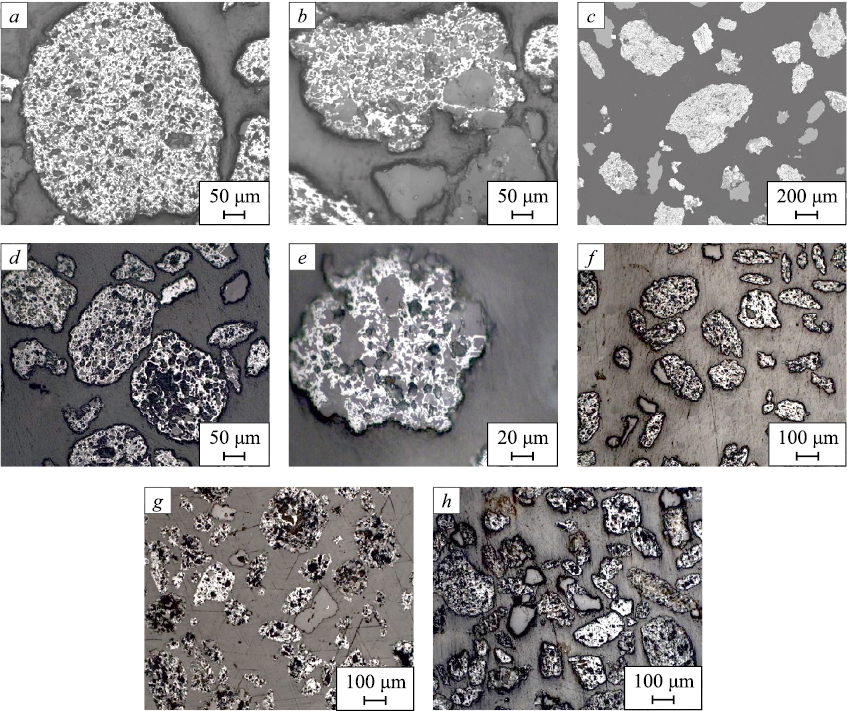
As noted above, a distinguishing feature of Timan titanium concentrates is their high quartz content. In the initial ore, free quartz occurs over a wide particle-size range, from −3.0 to +0 mm [3; 4; 8]. Microscopic examination was therefore used to assess the distribution of quartz in quartz-leucoxene and quartz-ilmenite concentrates from the Yaregskoye and Pyzhemskoye deposits (Fig. 1.
Fig. 1. Microphotographs of the initial quartz-titanium concentrates: |
As shown in Fig. 1, quartz in the initial concentrates occurs as free grains of various morphologies and sizes, as intergrowths with titanium-bearing grains (20 – 40 µm), and as ultra-dispersed inclusions within leucoxene and ilmenite (internal quartz) with sizes of 1 – 20 µm.
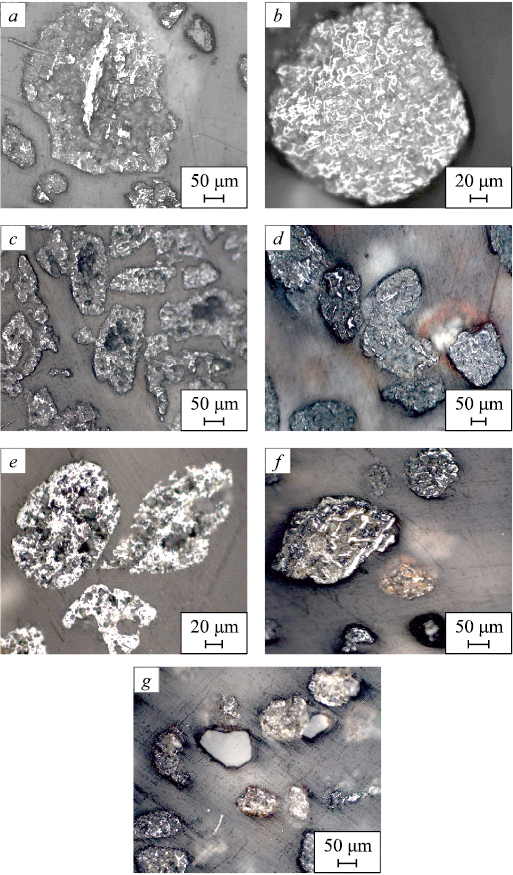
Autoclave leaching of quartz-leucoxene and quartz-ilmenite concentrates achieves the highest degree of desiliconization at 220 °C over 2 – 3 h at a molar CaO/SiO2 ratio of 0.7 – 1.0. Microscopic analysis of titanium-bearing products after autoclave treatment shows that leaching is accompanied by selective dissolution of internal quartz, resulting in the near-complete liberation of leucoxene and ilmenite grains from quartz (Fig. 2). The high degree of SiO2 dissolution (>80 %) is attributable to the ultra-dispersed size of quartz inclusions and to the genetic features of the Timan sandstones associated with ilmenite leucoxenization [3; 4; 8]. During this transformation, iron was removed from the parent titanium minerals by hydrothermal solutions, while the resulting voids were filled by finely dispersed quartz crystallized from these solutions. Under hydrothermal conditions, authigenic quartz formed that is characterized by a highly developed specific surface area and enhanced reactivity. This increased reactivity arises from the presence of weaker (unsaturated) Si – O (Si) bonds in the siloxane bridges of silicon dioxide, which are a consequence of the described genesis [16].
Fig. 2. Microphotographs of leached grains of leucoxene from the Yaregskoye (a, b) |
Under optimal autoclave leaching conditions, a desiliconization degree of 90 – 95 % can be achieved for the leucoxene concentrate, with residual SiO2 contents of 1.2 – 2.0 % (Fig. 2, a – d). Treatment of the quartz-ilmenite concentrate allows removal of 80 – 87 % of SiO2 and yields high-titanium ilmenite containing up to 67 % TiO2 (Fig. 2, e – g). In both cases, part of the residual SiO2 is associated with undissolved free quartz grains (Fig. 2, a, f), which exhibit lower reactivity and therefore require longer interaction times and higher alkaline reagent concentrations.
As discussed above, autoclave desiliconization of quartz-leucoxene and quartz-ilmenite concentrates is accompanied by the simultaneous synthesis of calcium hydrosilicate. At 220 °C and CaO/SiO2 ratios of 0.7 – 1.0, xonotlite with the stoichiometric composition 6CaO·6SiO2·H2O or Ca6[Si6О17](OH)2 is predominantly formed. Xonotlite is a transitional phase between calcium hydrosilicates rich in lattice-bound water and wollastonite, sharing a common structural framework with the latter. Paired wollastonite-like chains of [SiO4 ] tetrahedra form xonotlite ribbons with a repeat unit of [Si6O17]10– [17 – 20]. Upon dehydration, xonotlite transforms into β-wollastonite (CaSiO3 ). Synthetic xonotlite and wollastonite are widely used in various industrial sectors, including ceramics, construction materials, paint production, and metallurgy.
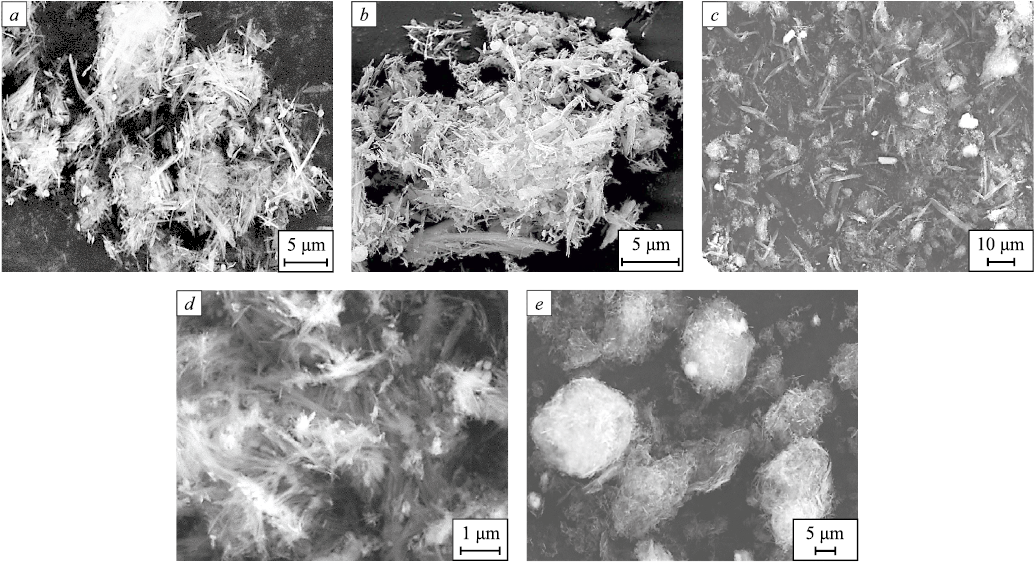
Scanning electron microscopy was employed to examine calcium silicates synthesized during the hydrothermal desiliconization of quartz-leucoxene and quartz-ilmenite concentrates (Fig. 3).
Fig. 3. Microphotographs of calcined calcium hydrosilicates synthesized by autoclave desiliconization |
As shown in Fig. 3, depending on the initial raw material, calcium silicates crystallize with a needle-like habit and differ in the length (L) to diameter (D) ratio of the “needles”. Predominantly, radially radiant agglomerates composed of individual crystals with L/D = 10 – 20 are formed (Fig. 3, a – c). In contrast, when calcium hydrosilicates form in which the “needles” are characterized by an L \( \gg \) D ratio, the agglomerates exhibit a tangled fibrous morphology (Fig. 3, e). Crystal morphology is influenced by both the content of crystallized water and the formation of calcium hydrosilicates in the form of tobermorite (5CaO·6SiO2·5H2O or Ca10[Si12О31](OH)6 ), which has a fibrous structure and also represents a hydrated wollastonite phase. Tobermorite is thermodynamically stable at lower temperatures and tends to transform into xonotlite at 200 – 220 °C, whereas xonotlite may revert to tobermorite at lower temperatures in the presence of water [18; 21].
Calcium silicates with stoichiometric compositions, particularly xonotlite (6CaO·6SiO2·H2O) and wollastonite (CaSiO3 ), exhibit a number of advantageous physicochemical properties, including high chemical resistance (and thus non-combustibility), stable dielectric characteristics, low thermal conductivity, and environmental safety. These properties underpin their broad application in ceramics (30 – 40 %), polymer, plastics, and rubber production (30 – 35 %), paint manufacturing (10 – 15 %), construction, metallurgy, friction materials, and the production of pharmaceutical and cosmetic products [19]. At present, however, wollastonite production in Russia is minimal, and domestic demand is largely met through imports.
The identified features of quartz-leucoxene and quartz-ilmenite concentrate desiliconization accompanied by simultaneous calcium hydrosilicate synthesis should be taken into account when developing process parameters and equipment design for autoclave leaching [22].
Conclusions
This study demonstrates that implementation of the integrated process developed at the Baikov Institute of Metallurgy and Materials Science of the Russian Academy of Sciences (IMET RAS), which combines desiliconization of quartz-leucoxene and quartz-ilmenite concentrates with hydrometallurgical synthesis of calcium hydrosilicate, enables comprehensive utilization of the Pyzhemskoye and Yaregskoye sandstones with the production of high-quality artificial rutile and high-titanium ilmenite. On average, 100 t of concentrate contains approximately 20 – 30 t of ultra-dispersed quartz, which serves as a silica source for the associated autoclave synthesis of calcium hydrosilicate. Following thermal treatment of the calcium hydrosilicates, dehydration makes it possible to obtain 30 – 50 t of synthetic needle-like wollastonite. It is noted that the proposed hydrometallurgical desiliconization method can be applied to the removal of SiO2 from both quartz-leucoxene and quartz-ilmenite concentrates obtained during beneficiation of sandstones from the Southern and Middle Timan regions, including concentrates derived from both the gray-colored and red-colored layers of the Pyzhemskoye deposit.
1. Schulz K.J., DeYoung J., Seal R., Bradley D. Critical mineral resources of the United States – Economic and environmental geology and prospects for future supply: U.S. Geological Survey Professional Paper; 2017:797. https://doi.org/10.3133/pp1802
2. State Report on the State and Use of Mineral Resources of the Russian Federation in 2020. Moscow: Rosnedra; 2021:568.
3. Sadykhov G.B., Anisonyan K.G., Zablotskaya Yu.V., Olyunina T.V., Kop’ev D.Yu., Goncharov K.V., Balmaev B.G., Tuzhilin A.S. Fundamental problems of enrichment of quartz-leucoxene sandstones of Timan obtaining high-quality titanium raw materials. Titan. 2023;(1(77)):4–20. (In Russ.)
4. Makeev A.B., Skublov S.G., Galankina O.L., Vasil’ev E.A., Krasotkina A.O. Pseudorutyl-leucoxene quartz ores of Timan – a new genetic type of titanium raw materials: prospects for industrial development. Georesoursy. 2023;25(3):163–174. (In Russ.). https://doi.org/10.18599/grs.2023.3.10
5. Leontev L.I. Prospects for the development of the titanium potential of the Yareg deposit. Prospect and protection of mineral resources. 2021;(8):56–60. (In Russ.).
6. Kuzin E.N., Mokrushin I.G., Kruchinina N.E. Assessment of the possibility of using leucoxene-quartz concentrate as raw material for production of aluminium and magnesium titanates. Journal of the Mining Institute. 2023;264:886–894. (In Russ.). https://doi.org/10.31897/PMI.2023.15
7. Smetannikov A.F., Onosov D.V., Korotchenkova O.V., Onosova E.F. Desilication of quartz–leucoxene concentrate of oil and titanium ore middlings. Gornyi Zhurnal. 2023;(11):103–108. (In Russ.). https://doi.org/10.17580/gzh.2023.11.18
8. Ignatiev V.D., Burtsev I.N. Timan’s Leukoxene. St. Petersburg: Nauka; 1997:215. (In Russ.).
9. Sadykhov G.B., Anisonyan K.G., Zablotskaya Yu.V., etc. Method for processing quartz-leucoxene concentrates to produce artificial porous rutile, synthetic needle-like wollastonite and calcined quartz sand. Patent RF no. 2779624. IPC C22B 34/12, C22B3/06, C01G 23/047. Bulleten’ izobretenii. 2021. (In Russ.).
10. Zablotskaya Yu.V., Sadykhov G.B., Goncharenko T.V., Olyunina T.V., Anisonyan K.G., Tagirov R.K. Features of autoclave leaching of leucoxene concentrate with participation of Ca(OH)2 . Metally. 2011;(6):9–14. (In Russ.).
11. Zablotskaya Yu.V., Sadykhov G.B., Tuzhilin A.S., Olyunina T.V. Effects of desilication conditions on the formation of wollastonite during the autoclave leaching of silica–titanium concentrates. Theoretical Foundations of Chemical Engineering. 2024;58(1):95–100. https://doi.org/10.1134/S0040579524700192
12. Baltakys K., Siauciunas R. The infuence of γ-Al2O3 and Na2O on the formation of calcium silicate hydrates in the CaO–quartz–H2O system. Mater Science – Poland. 2007;25(1):185–198.
13. Zanaveskin K.L., Maslennikov A.N., Zanaveskina S.M., Dmitriev G.S., Zanaveskin L.N., Politova E.D., Vlasenko V.I. Leaching SiO2 and Al2O3 impurities from leucoxene from the Yaregskoe deposit by sodium hydroxide solution. Theoretical Foundations of Chemical Engineering. 2019;53(4): 669–679. https://doi.org/10.1134/S0040579519040110
14. Deleuze M., Goiffon A., Ibanez A., Phillipot E. Solvent influence on kinetics and dissolution mechanism of quartz in concentrated basic media (NaOH, KOH, LiOH). Journal of Solid State Chemistry. 1995;118(2):254–260. https://doi.org/10.1006/jssc.1995.1341
15. Waleed T. Rashid. Optimization alkaline leaching of silicon element from bauxite ore. Al-Qadisiyah Journal for Engineering Sciences. 2021;14(3):174–179. https://doi.org/10.30772/qjes.v14i3.890
16. Zulumyan N., Isahakyan A., Melikyan S. The influence of NaOH on the synthesis of calcium silicates. Journal of Inorgamic and Organometric Polymers and Materials. 2017;27:1323–1332. https://doi.org/10.1007/s10904-017-0586-9
17. Taylor H.F.W. Cement Chemistry. London: Thomas Telford; 1997:480.
18. Black L., Garbev K., Stumm A. Structure, bonding and morphology of hydrothermally synthesised xonotlite. Advances in Applied Ceramics. 2009;108(3):137–144. https://doi.org/10.1179/174367608X353638
19. Gladun V.D., Akatieva L.V., Kholkin A.I. Synthetic Calcium Silicates. Moscow: IRISBOOK; 2011:232. (In Russ.).
20. Smalakys G., Siauciunas R. Peculiarities of xonotlite synthesis from the raw materials with diferent SiO2 activities. Journal of Thermal Analysis and Calorimetry. 2020;142: 1671–1679. https://doi.org/10.1007/s10973-020-09744-2
21. Baltakys K., Siauciunas R. Physically and chemically bound H2O in the gyrolite structure. Materials Science – Poland. 2009;27(1):255–263.
22. Naboichenko S.S., Ni L.P., Schneerson Ya.M., Chugaev L.V. Autoclave Hydrometallurgy of Non-Ferrous Metals. Yekaterinburg: USTU-UPI; 2002:940. (In Russ.).
Yuliya V. Zablotskaya, Cand. Sci. (Eng.), Senior Researcher
49 Leninskii Ave., Moscow 119334, Russian Federation
Aleksei S. Tuzhilin, Cand. Sci. (Eng.)
49 Leninskii Ave., Moscow 119334, Russian Federation
Gusein B. Sadykhov, Dr. Sci. (Eng.), Head of the Bardin Laboratory of Metallurgy of Complex Ores
49 Leninskii Ave., Moscow 119334, Russian Federation
Zablotskaya Yu.V., Tuzhilin A.S., Sadykhov G.B. Features of joint lime autoclave desiliconization of quartz-titanium concentrates and hydrothermal synthesis of calcium hydrosilicates. Izvestiya. Ferrous Metallurgy. 2026;69(1):31-38. https://doi.org/10.17073/0368-0797-2026-1-31-38
 Email this article (Login required)
Email the author (Login required)
Email this article (Login required)
Email the author (Login required) Publishing House of National University of Science and Technology "MISIS"
4, Leninskii prospekt, Moscow, 119991, Russia
Phone: +7 (495) 638-44-11, +7 (495) 784-58-66
E-mail: fermet.misis@mail.ru