Contents
Scroll to:
https://doi.org/10.17073/0368-0797-2026-1-6-13
Scroll to:
The paper provides a brief description of the metallurgical process at PJSC Severstal, demonstrates the practical experience of reducing the consumption of dry skip coke from 415 to 350 kg/t of pig iron over the period 2014 – 2024, a decrease of 15.7 abs. %, and identifies the potential for further reduction of solid fuel consumption in blast furnace smelting. Research directions and tasks were formulated to adjust the technology in order to reduce the specific consumption of solid carbon fuel (including by replacing coke and its solid carbon substitutes with injected natural gas), improve the metallurgical properties of iron ore charges, and determine the optimal level of secondary resources use in the charge. The authors presented the results of laboratory studies of the processes of liquid phase formation during the melting of ordinary (SiO2 content 4.9 – 7.2 %) and low-silica (SiO2 content 2.8 – 3.0 %) pellets. The temperature level of the softening zone, complete loss of gas permeability of the iron ore layer, and drip flow of primary slag melts in low-silica pellets increases by 45 – 50 °C compared to ordinary pellets. The article considers the production results of using 3 – 5 mm iron ore screening directly in the blast furnace process (200,000 tons, or 22.3 kg/t of pig iron in 2017). Based on the results of the studies of coke samples taken from operating blast furnaces at a depth of 10 – 12 m from the charge level and in the tuyere zones, it was concluded that it is possible to use solid fuel with increased reactivity in conditions of iron smelting with a low alkali load (reduced from 3.2 kg/t of pig iron to 2.8 kg/t of pig iron). Based on laboratory studies, the effect of various compositions of reducing gases with variable hydrogen content on the reduction process of sinter and pellets was established. The reduction factor (Rf , %) increases by 2.5 – 3.0 % for every 5.0 % increase in hydrogen content in the gas mixture. The indicator “carbon consumption during ironmaking in blast furnaces” was determined, which allows to assess the real efficiency of blast furnace smelting from the point of view of the climate agenda, and the results of reducing this indicator by 12.4 kg/t of iron (3.0 rel. %) for the period of 2014 – 2023 were presented. The authors formulated the directions for the development of PJSC Severstal first processing stage, including the gradual abandonment of the sintering stage with an increase in the share of pellets in the blast furnace charge to 90 %, a reduction in consumption of coke in the blast furnace to 270 kg/t of pig iron, and an increase in the consumption of gas-based coke substitute (natural gas) to 300 m3/t of pig iron.
Vinogradov E.N., Leont’ev L.I., Kal’ko A.A. Achievements and development prospects of sintering and blast furnace division of PJSC Severstal. Izvestiya. Ferrous Metallurgy. 2026;69(1):6-13. https://doi.org/10.17073/0368-0797-2026-1-6-13
Introduction
A large vertically integrated mining and metallurgical company operating under intense competition and increasing climate-related pressures must identify economically viable ways to reduce specific greenhouse-gas emissions in steel production while maintaining and strengthening its cost advantage over its closest competitors.
The Severstal Russian Steel Division of PJSC Severstal is one of the largest steel producers in Russia and operates a world-class production complex with an annual output exceeding 11 million tons of steel. The first processing stage is represented by coke-sinter-blast furnace production, which includes eight operating coke oven batteries (seven with gravity charging and one with coal charge stamping), five sintering machines, and five blast furnaces with useful volumes ranging from 1007 to 5500 m3. Steelmaking from pig iron is carried out in the metallurgical production facilities using three basic oxygen converters (420-t capacity), as well as an electric arc furnace and a shaft furnace (each with a capacity of 150 t). This equipment enables the production of both standard and high-grade steels for the construction, energy, and mechanical engineering industries.
Globally, pig iron production in blast furnaces continues to dominate as the principal method of supplying metal to oxygen steelmaking units [1]. Improving the efficiency of the first processing stage therefore requires solutions that ensure a sufficient supply of primary molten metal to steelmaking units with the required quality characteristics, while maintaining low production costs and minimizing greenhouse-gas emissions.
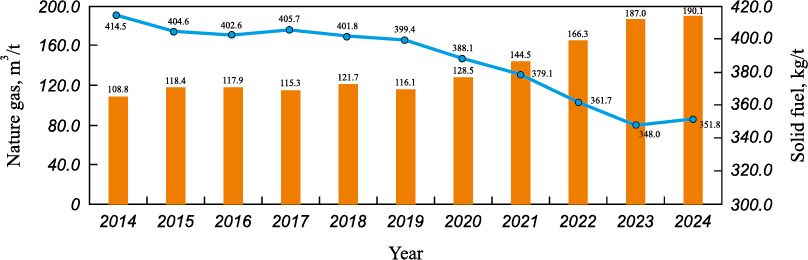
The theoretical minimum coke consumption in blast furnace smelting, determined from the standpoint of ensuring counter-current flow between reducing gases and liquid products of smelting, is estimated within a fairly broad range of 150 – 250 kg/t of pig iron, depending on the preparation of iron ore raw materials, slag yield, and the hot strength of coke [2; 3]. At the turn of the 21st century, an actual dry skip coke consumption of 415 – 450 kg/t of pig iron was considered acceptable for domestic metallurgists, while a level of 250 kg/t of pig iron appeared to practicing blast-furnace specialists as a purely theoretical and unattainable abstraction. Advances in science and technology in the areas of improving coke quality characteristics, applying its substitutes, preparing the iron ore charge, and improving monitoring and control systems for blast furnace smelting have made it possible over the past decade (2014 – 2024) to reduce this indicator at the blast furnaces of PJSC Severstal, on average across the shop, from 415 to 350 kg/t of pig iron, i.e., by approximately 15.7 abs. %. This substantial reduction was achieved without major changes to blast furnace design and was mainly the result of improved blast furnace operating practices. The changes in the specific consumption of solid fuel (the sum of skip coke and its solid substitutes) and gaseous fuel (natural gas) during pig iron smelting at PJSC Severstal over this period are shown in Fig. 1. The best average monthly results achieved were 301.1 kg of coke + 206.8 m3 of natural gas per ton of pig iron for BF No. 1 (useful volume 1007 m3) and 307.4 kg of coke + 214.2 m3 of natural gas per ton of pig iron for BF No. 3 (useful volume 3200 m3).
Fig. 1. Changes in specific consumption of solid and gaseous fuel during iron smelting |
At present, there remains unrealized potential to reduce coke consumption in blast furnace pig iron smelting by 100 – 200 kg/t of pig iron (i.e., 28.6 – 57.1 abs. %) relative to the theoretical minimum level. Achieving an economically justified reduction in the specific consumption of solid carbon fuel, including partial replacement of coke and its solid carbon substitutes with injected natural gas, requires improving the metallurgical properties of the blast furnace charge and solid fuel, as well as the application of an optimal, technologically and economically justified level of secondary resources use in the charge.
Studies carried out in the 1960s – 1970s on the influence of increased iron content in the blast furnace charge on the techno-economic indicators of the blast furnace process showed that each 1 % increase in total iron content (Fetot ) resulted in a 1.0 – 1.5 % decrease in coke consumption and a 1.7 – 2.2 % increase in productivity [4]. At that time, the specific consumption of raw materials in the blast furnace charge at domestic plants was approximately 1700 – 1920 kg/t of pig iron, while the SiO2 content in sinter at domestic and foreign plants ranged from 6.5 to 11.0 %, and in pellets it was 1.5 – 2.0 % lower [5; 6]. The development of beneficiation technologies and the use of iron-rich concentrates and sintering ores significantly influenced the processes occurring in the blast furnace and created the need for comprehensive studies of the metallurgical properties of blast furnace charges with reduced SiO2 content. The research by blast furnace specialists has shown that the processes of melt formation from sinter and pellets differ fundamentally [7; 8]. The effect of increasing iron content in the blast furnace charge under different agglomeration methods on reduction, melting, and dripping of melts from sinter and pellets through a coke layer of varying reactivity must be studied in order to identify stable patterns in the formation of slag and metal–carbon melts when optimizing the composition of the blast furnace charge. A comparative evaluation of the quality of ordinary pellets (4.9 – 7.2 % SiO2 ) and low-silica pellets (2.8 – 3.0 % SiO2 ), carried out in laboratory studies of liquid phase formation during charge melting, showed that in low-silica pellets the temperature level of the softening zone, the point of complete loss of gas permeability of the iron ore layer, and the dripping of primary slag melts increase by 45 – 50 °C compared with ordinary pellets. This leads to an expansion of the dry zone in the blast furnace and to improved reducibility of iron ore materials. In addition, industrial trials demonstrated that the total iron content in low-silica pellets, at equal basicity, increased by 2.6 %, while the content of alkali elements decreased by 0.05 %. With pellets accounting for 32 – 34 % of the blast furnace charge, this resulted in a reduction in alkali load by approximately 0.28 – 0.30 kg/t of pig iron and, accordingly, a decrease in coke consumption by 3.0 – 3.4 kg/t of pig iron.
It should be noted that an increase in the share of pellets has a positive effect due to a significant increase in the porosity of the blast furnace charge [9]. Calculations show that increasing the share of pellets from 35 to 100 % increases the porosity of the iron ore layer in the dry zone of the blast furnace by 17.2 rel. %. This indicates improved utilization of reducing gases during smelting and therefore enables a higher level of application of gaseous coke substitutes.
The screening of iron ore materials generated during the screening of sinter and pellets in blast furnace production is currently reused in pig iron smelting at modern metallurgical plants in two ways: as return fines in sinter production and as a component of the blast furnace charge. The influence of return fines on sinter productivity and quality is ambiguous [10; 11]. Wherever possible, their amount during the sintering process should therefore be reduced. A more effective approach is the direct use of iron ore screening in the blast furnace. A method has been developed for charging screened fractions of sinter and pellets into the blast furnace, regulating both the quantity and frequency of charging of this component [12]. The practical implementation of this method made it possible in 2017 to use more than 200,000 tons of 3 – 5 mm iron ore screening in blast furnace smelting, corresponding to 22.3 kg/t of pig iron.
The selection of coals, expansion of the raw-material base, improvement of coking technologies, and production of coke with specified properties combining optimal economic and technological performance represent the main directions for the development of coke-chemical production. In general, the behavior of coke in the blast furnace can be described as a sequence of transformations in its composition and properties as it descends through the furnace under the thermal, physicochemical, and mechanical conditions of smelting. Under real operating conditions, the most reliable assessment of coke quality is obtained by analyzing samples extracted directly from operating blast furnaces. To study the characteristics of tuyere-level coke at the blast furnaces of PJSC Severstal, coke samples were taken at the tuyere level during shutdowns associated with the replacement of tuyere equipment. In addition, to investigate the influence of alkalis on coke characteristics, samples were taken from the shaft of BF No. 4 at a depth of 10 – 12 m below the blast furnace charge level under conditions of a total alkali load (K2O + Na2O) of 2.8 – 3.0 kg/t of pig iron. The results showed that under conditions of pig iron smelting with a low alkali load (reduced from 3.2 to 2.8 kg/t of pig iron, i.e., by 0.4 kg/t of pig iron), there is potential for the use of solid fuel with increased reactivity. The further development of this direction involved the creation and industrial implementation at PJSC Severstal of a new method for producing an innovative carbon-containing product with specified characteristics from coals conditionally suitable for coking (60 – 100 % in the coal charge) through layer coking in coke oven batteries with gravity charging [13].
Developing technological measures for replacing part of the coke with natural gas requires determining the reducing components contained in the gas and evaluating the thermal effect of its transformation in the blast furnace tuyere zone. Numerous studies [14; 15] on blast furnace smelting with combined blast injection have established the technical parameters required to determine the rational consumption of natural gas. Among the most commonly used parameters are the theoretical tuyere gas temperature [16 – 18], which accounts for the combined combustion of carbon, coke, and natural gas, and the coke replacement coefficient for natural gas [19]. An increased consumption of natural gas leads to a higher proportion of hydrogen in blast furnace gases, which requires significant adjustments to blast furnace operating technology. Laboratory studies have demonstrated the influence of various compositions of reducing gases with variable hydrogen content on the reduction process of sinter and pellets. It was shown that the reduction factor increases by 2.5 – 3.0 % for each 5 % increase in hydrogen content in the gas mixture, confirming the feasibility of increasing natural gas consumption in pig iron smelting. In practice, these results were applied in the development of blast furnace smelting technology with increased natural gas consumption in the range of 140 – 250 m3/t, combined with an increase in the share of pellets in the iron ore part of the blast furnace charge from 32 to 60 %. A blast furnace operating method with an increased natural gas consumption of 140 – 250 m3/t of pig iron, compared with the initial level of 110 – 140 m3/t of pig iron, was developed and implemented in industrial practice [20]. During the period 2021 – 2023, the average natural gas consumption across the pig iron production shop of PJSC Severstal exceeded 190 m3/t of pig iron, while the solid fuel consumption remained below 350 kg/t of pig iron, with a coke replacement coefficient for natural gas of 0.704 kg/m3.
At present, PJSC Severstal has introduced into its technological process management practice the indicator “carbon consumption during pig iron smelting in blast furnaces”, which provides a realistic assessment of blast furnace smelting efficiency from the perspective of the climate agenda. This indicator is calculated as the sum of the masses of carbon introduced into the blast furnace process with the components of solid fuel, injected natural gas, and the iron ore part of the charge, referred to the mass of pig iron produced. Over the period 2014 – 2023, carbon consumption during pig iron smelting in blast furnaces decreased by 12.4 kg/t of pig iron (3.0 rel. %), which corresponds to a reduction of 45.5 kg CO2/t of pig iron (Fig. 2).
Fig. 2. Changes in specific consumption of solid and gaseous fuel and carbon consumption |
Currently, a solid fuel consumption of 250 kg/t of pig iron, previously regarded as a theoretical abstraction, is becoming a practical target and a result to be achieved. This optimism is supported by the successful introduction of technologies for producing high-quality coke from stamped coal charges, the application of ultra-high natural gas consumption (over 200 m3/t of pig iron), and the use of a high proportion of pellets in the blast furnace charge.
It should also be noted that PJSC Severstal pays considerable attention to extending the inter-repair operating period of metallurgical units [21; 22]. Based on an analysis of the overall condition of blast furnace refractories during shutdowns for major repairs of the first category, the most wear-prone areas of the lining were identified, and technological measures were developed and implemented to:
– protect the refractory surface with a skull layer, which absorbs the erosive action of the melt and isolates the refractory lining and cooling-system elements from contact with liquid metal and hot gases;
– control the properties of the liquid products of smelting, including both chemical properties (their aggressiveness toward the skull layer and lining) and physical properties (temperature and flow velocity relative to the furnace structure);
– form a blast furnace charge column that simultaneously facilitates skull formation in the shaft and the formation of a coke bed in the hearth with maximum permeability for liquids.
The condition of the refractory lining and cooling-system elements of BF No. 4 and BF No. 5 after blowout prior to major repairs of the first category is presented in Fig. 3.
Fig. 3. Photos of the blast furnace interior after blowout for major repairs: |
The implementation of these measures, under conditions of changes in blast furnace operating technology and blast furnace charge composition, as well as an almost 1.5-fold increase in coke replacement by natural gas, made it possible to extend the campaign of BF No. 5 (the largest blast furnace in Europe, with a useful volume of 5500 m3) to 17.5 years, producing 75.2 million tons of pig iron [11]. At BF No. 4 (useful volume 2700 m3), the campaign completed in 2025 lasted 19.5 years and enabled the production of more than 46 million tons of pig iron. The achieved results provide strong grounds for expecting a long blast furnace campaign life of 20 – 30 years, confirming the role of blast furnaces as highly efficient units for the production of primary molten metal for the steelmaking stage.
Determining directions for the further development
of the pig iron production chain: the case of PJSC Severstal
At present, approximately 72 % of global steel production is carried out through the blast furnace–basic oxygen furnace process route1. An immediate abandonment of steelmaking technologies that have evolved over more than a century is unlikely, given the enormous capital investment that would be required and the still limited development of carbon-free technologies for producing primary iron from mined ores.
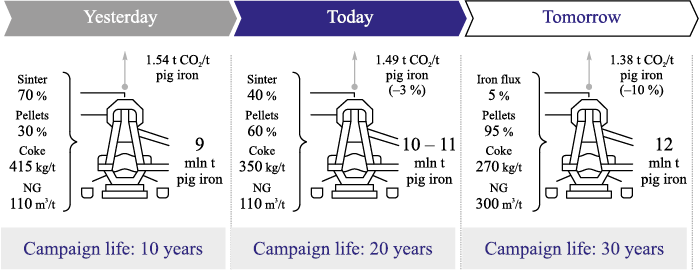
For a large metallurgical complex producing more than 11 million tons of steel annually, the most realistic approach is to maximize the efficiency of existing production units while gradually shifting the development focus toward low-carbon or carbon-free reduction of iron oxides and electric melting, as the cost of green hydrogen and renewable electricity declines. PJSC Severstal is following this approach, aiming to maximize the efficiency of the first processing stage during the transition period (Fig. 4).
Fig. 4. Potential for development of technological chain of cast iron production |
Conclusions
An analysis of theoretical estimates and current pig iron production results at PJSC Severstal has made it possible to determine the potential for reducing solid fuel consumption in blast furnace smelting.
The study proposes directions for adjusting the composition and quality characteristics of raw materials and fuels, as well as the technological parameters and operating practices of pig iron production, during the transition from conventional to low-carbon metallurgy.
Based on the results obtained and the identified patterns, a development strategy for the first processing stage at PJSC Severstal has been formulated and adopted for implementation. The strategy provides for the gradual phase-out of the sintering stage, an increase in the share of pellets in the blast furnace charge to 90 %, a reduction in coke consumption in blast furnace smelting to 270 kg/t of pig iron, and an increase in the consumption of the gaseous coke substitute (natural gas) to 300 m3/t of pig iron.
1. The Making, Shaping and Treating of Steel. 11th ed. The AISE Steel Foundation, Pittsburgh, PA; 1999; Chapter 1:1.
2. Andronov V.N. Extraction of Ferrous Metals from Natural and Technogenic Raw Materials. Blast Furnace Process. Donetsk: Nord-Press; 2009:377. (In Russ.).
3. Borisov A.F. Advice to the Head of Blast Furnace Shop. Moscow: Firma Progress; 1996:256. (In Russ.).
4. Babarykin N.N., Galatonov A.L., Sagaidak I.I., etc. Experimental smelting with reduced slag output. Stal’. 1964;(12):1069–1079. (In Russ.).
5. Kopyrin I.A., Borts Yu.M., Yarkho E.N., etc. Optimal Basicity of Sinter and Pellets. Moscow: Chermetinformatsiya; 1972; ser. 3(4):27. (In Russ.).
6. Volkov Yu.P., Shparber L.Ya., Gusarov F.K. Technologist-Blast Furnace Operator. Reference and Methodological Guide. Moscow: Metallurgiya; 1986:263. (In Russ.).
7. Nesterov A.S., Balmagambetov I.Kh., Gladkov N.A., etc. On the issue of optimizing the basicity of sinter and pellets. Stal'. 1989;(11):4–9. (In Russ.).
8. Gladkov N.A., Nesterov A.S. Processes in the layer of iron ore materials during heating. Russian Netallurgy (Metally). 1987;(3):9–11. (In Russ.).
9. Korshikov G.V. Encyclopedic Reference Book on Metallurgy. Lipetsk: Lipetskoe izdatel’stvo Goskompechati RF; 1997:781. (In Russ.).
10. Bazilevich S.V., Vegman E.F. Agglomeration Sintering. Moscow: Metallurgiya; 1967:368. (In Russ.).
11. Vegman E.F. Theory and Technology of Agglomeration Sintering. Moscow: Metallurgiya; 1974:288. (In Russ.).
12. Sukhanov M.Yu., Gurkin M.A., Vinogradov E.N., etc. Blast furnace charging process. Patent RF no. 2518880. MPK C21B 7/00. Bulleten’ izobretenii. 2014;(16). (In Russ.).
13. Vinogradov E.N., Karunova E.V., Kal’ko A.A., Gorokhovskii V.V. Carbon-containing innovative product end method of its production. Patent RF no. 2733610. MPK C10B 57/04 С10В 57/06. Bulleten’ izobretenii. 2020;(16). (In Russ.).
14. Ramm A.N. Application of combined blowing in blast furnace smelting. In: Modern Problems of Metallurgy. Moscow: AN SSSR; 1968:61–95. (In Russ.).
15. Ramm A.N. Determination of Technical Indicators of Blast Furnace Smelting. Methodological guide. Leningrad: LPI; 1971:111. (In Russ.).
16. Kas’yan V.V. Theoretical combustion temperature as a parameter of combined blast. Stal'. 1975;(8):684–687. (In Russ.).
17. Borisov Yu.S. Calculation of theoretical combustion temperature during combined blast in blast furnaces. Stal’. 1965;(10):884–890. (In Russ.).
18. Potebnya Yu.M., Rikhter R.G., Tuluevskaya T.A., Tsaplina T.S. Technological factors that determine the theoretical combustion temperature. Stal'. 1982;(10):14–17. (In Russ.).
19. Yusfin Yu.S., Koroleva V.L., Myshlyaev A.I. Effect of coke consumption on theoretical combustion temperature. Izvestiya. Ferrous Metallurgy. 1991;34(5):8–12. (In Russ.).
20. Vinogradov E.N., Kal’ko A.A., Volkov E.A., Karimov M.M., Terebov A.L., Baboedov E.A. Method for conducting blust furnace smelting. Patent RF no. 2798507. MPK C21B 5/00. Bulleten’ izobretenii. 2023;(18). (In Russ.).
21. Kal’ko A.A., Vinogradov E.N., Kal’ko O.A., Kal’ko A.A. Development and implementation of technological measures to extend the campaign of blast furnace No. 5 of PJSC Severstal. Izvestiya. Ferrous Metallurgy. 2024;67(3):260–269. https://doi.org/10.17073/0368-0797-2024-3-260-269
22. Kal’ko A.A., Leont’ev L.I., Volkov E.A. Assessment of the effectiveness of technological measures to extend the campaign of blast furnace No. 5 of PJSC Severstal (2006 – 2024) based on an examination of its working space during a first-category overhaul. Izvestiya. Ferrous Metallurgy. 2024;67(5):520–530. https://doi.org/10.17073/0368-0797-2024-5-520-530
Evgenii N. Vinogradov, Deputy General Director of Production – General Director Severstal Russian Steel Division and Mining Assets
30 Mira Str., Cherepovets, Vologda Region 162608, Russian Federation
Leopol’d I. Leont’ev, Academician, Adviser, Russian Academy of Sciences; Dr. Sci. (Eng.), Prof., National University of Science and Technology “MISIS”; Advisor to the General Director, I.P. Bardin Central Research Institute of Ferrous Metallurgy of the Russian Academy of Sciences
23/9 Radio Str., Moscow 105005, Russian Federation
4 Leninskii Ave., Moscow 119049, Russian Federation
32a Leninskii Ave., Moscow 119991, Russian Federation
Andrei A. Kal’ko, Head of Technological Development Center Upstream
30 Mira Str., Cherepovets, Vologda Region 162608, Russian Federation
Vinogradov E.N., Leont’ev L.I., Kal’ko A.A. Achievements and development prospects of sintering and blast furnace division of PJSC Severstal. Izvestiya. Ferrous Metallurgy. 2026;69(1):6-13. https://doi.org/10.17073/0368-0797-2026-1-6-13
 Email this article (Login required)
Email the author (Login required)
Email this article (Login required)
Email the author (Login required) Publishing House of National University of Science and Technology "MISIS"
4, Leninskii prospekt, Moscow, 119991, Russia
Phone: +7 (495) 638-44-11, +7 (495) 784-58-66
E-mail: fermet.misis@mail.ru
 – natural gas, m3/t;
  – solid fuel, kg/t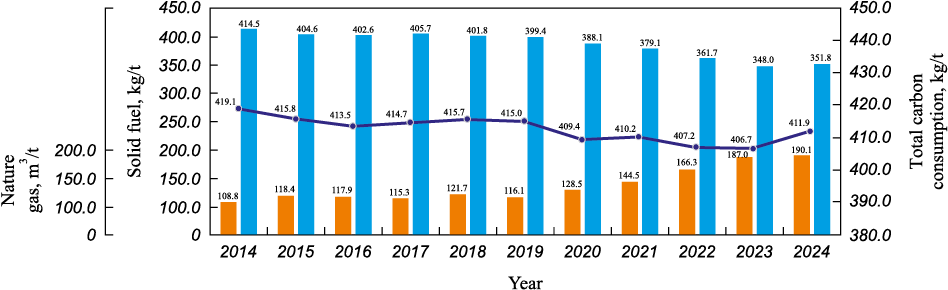
 – solid fuel, kg/t;
  – total carbon consumption during pig iron smelting, kg/t