Contents
Scroll to:
https://doi.org/10.17073/0368-0797-2025-6-621-625
Scroll to:
The article solves the problem of determining thermoelastic stresses in calibrated strikers in a unit of combined casting and deformation during production of hollow steel billets using the calculation methodology developed by the authors. The authors substantiate the relevance of determining thermoelastic stresses in insulated strikers when compressing the wall of a hollow billet and at idle run when cooling the strikers with water, and describe the striker geometry to produce a hollow billet in one pass. The paper considers the initial data and temperature boundary conditions for calculating the temperature field of the striker during production of hollow billets in a unit of combined casting and deformation. The boundary conditions are given to determine the striker temperature as well as the values of heat flow and effective heat transfer coefficient. The results of calculating the temperature fields are performed in four sections and are presented for characteristic lines and points located on the striker contact surface and in the contact layer at a depth of 5 mm from the working surface. Dimensions of the finite element grid are given to calculate thermoelastic stresses in calibrated strikers using the finite element method with ANSYS package. The authors determined the magnitudes and patterns of distribution of thermoelastic stresses in a calibrated striker when compressing the wall of a hollow billet and at idle run when such a billet is produced in one pass in a unit of combined casting and deformation. Based on the calculated temperature values and the magnitude of the maximum compressive thermoelastic stresses on the contact surface of the strikers, it is proposed to use a pipe billet as a material for making strikers.
Lekhov O.S., Bilalov D.Kh. Calculation of temperature and thermoelastic stresses in strikers during production of hollow steel billets in a unit of combined casting and deformation. Part 2. Izvestiya. Ferrous Metallurgy. 2025;68(6):621-625. https://doi.org/10.17073/0368-0797-2025-6-621-625
Introduction
The main and most heavily loaded elements of a unit of combined casting and deformation are the strikers [1; 2]. During the working stroke, they simultaneously compress the wall of a steel hollow shell and move it in the casting direction. In this process, combined stresses arise in the strikers during the working stroke due to the compression force and the thermal load [3 – 5]. Therefore, a relevant problem is to substantiate the selection of the striker material that ensures the ability to withstand cyclic loading under the combined action of mechanical and thermoelastic stresses [6 – 8].
To calculate the stress state of the striker in the unit, its temperature field was first determined based on solving the unsteady thermal conductivity equation with the corresponding initial and boundary conditions [9 – 11].
The outer and inner diameters of the hollow billet made of 09G2S steel are 100 and 60 mm, respectively. The angular speed of the eccentric shafts was taken as 40 min–1. At this speed, the contact time of the striker with the wall of the hollow billet during the working stroke is 0.375 s, and the pause time is 1.125 s. The temperature of the hollow billet in the striker entry zone is 1200 °С [12 – 14].
The geometry of the striker with dimensions is given in [9]. Iterative calculations showed that, to ensure a temperature of 350 °C on the striker contact surface at a heat transfer coefficient of 2000 W/(m2·K), the heat flux density is 4.6 MW/m2 [15].
It was established that, under the action of heat flow during compression of the hollow billet wall by the strikers, the temperature on the striker contact surface lies in the range of 370 – 451 °C. Subsequently, during idle operation with water cooling, the temperature of the striker contact surface decreases and falls within the range of 289 – 370 °С.
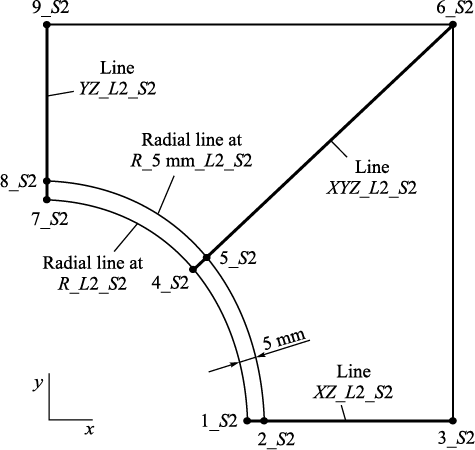
Based on the obtained temperature fields, thermoelastic stresses in the strikers of the unit were determined by the finite element method using the ANSYS package [16] (with elements of the calculation methodologies described in [16 – 18]). The finite element size in the deformation zone and in the calibrating sections of the strikers was taken as 1 mm. By symmetry, the calculation was performed for one half of the striker shown in Fig. 1 [9]. The calculation results for radial (SR), tangential (Sθ), axial (SZ), and equivalent (SEQV) thermoelastic stresses are presented only for the characteristic lines XZ_L2_S2, XYZ_L2_S2, and R_L2_S2 and for the points of section 2 associated with the striker contact surface (Fig. 1).
Fig. 1. Position of points and lines in section 2 |
The Table presents the values of thermoelastic stresses at the points of the characteristic lines of section 2 under the action of heat flow (HF) and during water cooling (WC).
Values of radial, tangential, axial and equivalent stresses at points
| ||||||||||||||||||||||||||||||||||||||||||||||||||||||||||||||||||||||||||||||||||||||||||||||||||||||||||
Fig. 2 shows the patterns of thermoelastic stress distribution in the strikers along the characteristic line R_L2_S2.
Fig. 2. Nature of thermoelastic stresses along the R_L2_S2 line: |
Let us consider the distribution of thermoelastic stresses in the strikers along the characteristic lines of section 2 (Fig. 1), where the maximum compressive stresses arise during compression of the wall of the steel hollow billet. Thus, at point 1_S2 of the XZ_L2_S2 line, which passes along the axis of symmetry of the striker caliber, at the contact surface, the maximum compressive axial stresses SZ reach −703 MPa (Fig. 2, Table).
During idle operation with water cooling, compressive thermoelastic stresses Sθ and SR at the striker contact surface at point 1_S2 are significantly lower and amount to −58 and −191 MPa, respectively (Fig. 2, Table).
It should be noted that along the XYZ_L2_S2 line, the compressive thermoelastic stresses Sθ and SZ at the striker contact surface during compression of the hollow billet wall are quite high; at point 4_S2, they are −381 and −652 MPa, respectively (Fig. 2, Table).
During idle operation, at the striker contact surface at point 4_S2, the tangential stresses Sθ are tensile, with a maximum value of 148 MPa, while the axial stresses SZ are compressive, with a value of –142 MPa. However, through the striker thickness, the axial stresses initially increase to –312 MPa, then decrease, change sign, and become tensile, reaching a maximum value of 141 MPa (see Table).
Let us consider the distribution of thermoelastic stresses along the radius of the striker contact surface (line R_L2_S2, Fig. 1).
During compression of the hollow billet wall, at point 1_S2 of the striker contact surface, the thermoelastic stresses Sθ and SZ are compressive, amounting to –589 and –703 MPa, respectively. Along the radius, they decrease and at point 4_S2 become –381 and –652 MPa, while at point 7_S2 they are –59 and –63 MPa, respectively (Fig. 2, Table).
During idle operation, at point 1_S2 of the striker contact surface, compressive thermoelastic stresses Sθ and SZ arise with values of –58 and –191 MPa, respectively. Further along the radius of the striker contact surface, at point 7_S2, they become tensile, reaching 25 and 341 MPa, respectively (Fig. 1, Table).
As a result of the study, it was established that the temperature of the striker contact surface during compression of the steel hollow billet wall can reach 451 °C. At this temperature, the compressive thermoelastic stresses at the striker contact surface reach 703 MPa.
The calculated values of thermoelastic stresses correlate well with the results obtained in similar studies using the QForm analysis software system [19].
Considering the above, the strikers of the unit of combined casting and deformation for producing steel hollow billets should be manufactured from 4Kh4VMFS steel. This is a die steel with increased resistance to heat checking and high wear resistance. The conditional yield strength of the steel at a temperature of 500 °C is 1309 MPa, which significantly exceeds the maximum thermoelastic stresses caused by the thermal load [20]. This steel is also used for manufacturing tooling for high-speed machine forging and upsetting on horizontal forging machines.
Conclusions
A procedure has been developed for calculating thermoelastic stresses in calibrated strikers of a unit of combined casting and deformation during the production of steel hollow pipe billets. The magnitudes and patterns of thermoelastic stress distribution in three sections of the calibrated striker during the production of steel hollow billets in a unit of combined casting and deformation have been determined. It has been established that the maximum compressive thermoelastic stresses at the striker contact surface reach 703 MPa. It is proposed that the strikers of the unit of combined casting and deformation for producing steel hollow billets be manufactured from 4Kh4VMFS steel, whose yield strength at a temperature of 500 °C is 1309 MPa.
1. Lykov A.V. Theory of Thermal Conductivity. Moscow: Vysshaya shkola; 1967:600. (In Russ.).
2. Matteo D. Wicon EVO – a preview of Danieli’s easy-to-use rolling process simulation software for wire rod and bar mills. In: Proceedings of the Rolling12, Trieste, Italy, 25–28 October 2022. Trieste, Italy; 2022.
3. Khloponin V.N., Kosyreva M.V., Kosyak A.S. Influence of cooling system on thermal operating conditions of roll surface layer. In: Proceedings of the MISIS. Issue 100. Moscow: MISiS; 1977:90–93. (In Russ.).
4. Kushner V.S., Vereshchaka A.S., Skhirtladze A.G., Negrov D.A. Technological Processes in Mechanical Engineering. Part II. Metal Forming and Welding Production. Omsk: OmSTU; 2005:200. (In Russ.).
5. Lekhov O.S., Bilalov D.Kh. Technological capabilities of installations for combined continuous casting and deformation processes for the production of metal products. Proizvodstvo prokata. 2016;(7):24–26. (In Russ.).
6. Lekhov O.S. Study of stress-strain state of rolls-band system at rolling of broad-flanged beam in stands of universal beam mill. Report 2. Izvestiya. Ferrous Metallurgy. 2014;57(12): 15–19. (In Russ.). https://doi.org/10.17073/0368-0797-2014-12-15-19
7. Boley B.A., Weiner J.H. Theory of Thermal Stresses. New York: John Wiley & Sons; 1960:586.
8. Kazakov A.L., Spevak L.F. Numeral and analytical studies of nonlinear parabolic equation with boundary conditions of a special form. Applied Mathematical Modelling. 2013; 37(10-13):6918–6928. https://doi.org/10.1016/j.apm.2013.02.026
9. Lekhov O.S., Bilalov D.Kh. Calculation of temperature and thermoelastic stresses in strikers during production of hollow steel billets in a unit of combined casting and deformation. Part 1. Izvestiya. Ferrous Metallurgy. 2025;68(4):366–371. https://doi.org/10.17073/0368-0797-2025-4-366-371
10. Matsumia Т., Nakamura Y. Mathematical model of slab bulging during continuous casting. In: Applied Mathematical, and Physical Models in Iron and Steel Industry Proceedings of the 3rd Process. Tech. Conf., Pittsburgh, Pa, 28-31 March 1982. New York; 1982:264–270.
11. Karrech A., Seibi A. Analytical model of the expansion in of tubes under tension. Journal of Materials Processing Technology. 2010;210:336–362.
12. Stebunov S., Biba N., Vlasov A., Maximov A. Thermally and Mechanically Coupled Simulation of Metal Forming Processes. In: Proceedings of the 10th Int. Conf. on Technology of Plasticity, Aachen, Germany, 25–30 September 2011. Aachen, Germany; 2011.
13. Marciniak Z., Duncan J.L., Hu S.J. Mechanics of Sheet Metal Forming. Butterworth-Heinemann Elsevier Ltd.: Oxford; 2002:228.
14. Park C.Y., Yang D.Y. A study of void crushing in large forgings: II. Estimation of bonding efficiency by finite-element analysis. Journal of Materials Processing Technology. 1997;72(1):32-41.
15. Lekhov O.S., Mikhalev A.V., Shevelev M.M. Stresses in the Striker–Strip System during Production of Steel Sheets at a Unit of Continuous Casting and Deformation. Yekaterinburg: UPI; 2018:125. (In Russ.).
16. ANSYS. Structural Analysis Guide. Rel. 15.0.
17. Takashima Y., Yanagimoto I. Finite element analysis of flange spread behavior in H-beam universal rolling. Steel Research International. 2011;82(10):1240–1247. https://doi.org/10.1002/srin.201100078
18. Jansson N. Optimized sparse matrix assembly in finite element solvers with one-sided communication. In: High Performance Computing for Computational Sience – VECPAR 2012. Berlin, Heidelberg: Springer; 2013:128–139.
19. Stebunov S.A., Mal’tsev P.A., Gladkov Yu.A., Belugin V.S., Alimov I.S. Modeling and design of long-range rolling in industrial production using QForm and Calibre. In: Proceedings of the XIV Congress of Rollermen. Cherepovets, April 16 – 18, 2024. Cherepovets: 2024:112–114. (In Russ.).
20. Bulanov L.V., Karlinskii S.E., Volegova V.E. Durability of casters for external and internal cooling. In: Reliability of Large Machines. Collection of Sci. Papers of NIItyazhmash. Sverdlovsk: NIItyazhmash; 1990:126–132. (In Russ.).
Oleg S. Lekhov, Dr. Sci. (Eng.), Prof. of the Chair of Engineering and Vocational Training in Machinery and Metallurgy
11 Mashinostroitelei Str., Yekaterinburg 620012, Russian Federation
Damir Kh. Bilalov, Assist. Prof. of the Chair of Engineering and Vocational Training in Machinery and Metallurgy
11 Mashinostroitelei Str., Yekaterinburg 620012, Russian Federation
Lekhov O.S., Bilalov D.Kh. Calculation of temperature and thermoelastic stresses in strikers during production of hollow steel billets in a unit of combined casting and deformation. Part 2. Izvestiya. Ferrous Metallurgy. 2025;68(6):621-625. https://doi.org/10.17073/0368-0797-2025-6-621-625
 Email this article (Login required)
Email the author (Login required)
Email this article (Login required)
Email the author (Login required) Publishing House of National University of Science and Technology "MISIS"
4, Leninskii prospekt, Moscow, 119991, Russia
Phone: +7 (495) 638-44-11, +7 (495) 784-58-66
E-mail: fermet.misis@mail.ru